Shahed 129 vs Wing Loong II
Shahed 129 vs Wing Loong II at a glance — top speed 175 vs 370 km/h, range 1,700 vs 1,000 km, built 42 vs 100 units.
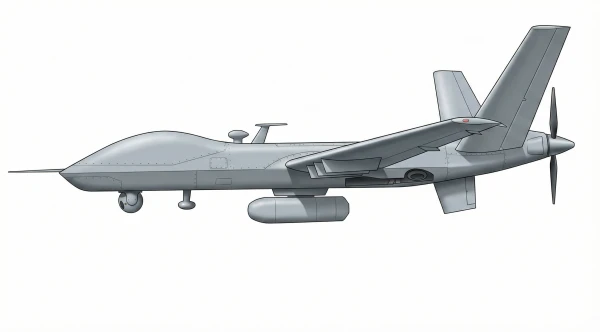
| Shahed 129 | Wing Loong II | |
|---|---|---|
| Origin country | 🇮🇷 Iran | 🇨🇳 China |
| Category | Military Drones | Military Drones |
| Manufacturer | HESA | Chengdu |
| First flight | 1 March 2012 | 1 February 2017 |
| Year introduced | 2013 | 2018 |
| Number produced | 42 units | 100 units |
| Average unit price | $2 million | $2 million |
| Wingspan | 16.0 m | 20.5 m |
| Height | 3.1 m | -- m |
| Length | 8.0 m | 11.0 m |
| Maximum speed | 175 km/h | 370 km/h |
| Operational range | 1,700 km | 1,000 km |
| Service ceiling | 7,300 m | 9,000 m |
| Max. takeoff weight | -- kg | 4,200 kg |
| Empty weight | -- kg | 1,500 kg |
| Total thrust | 1 x 75 kW | -- |
Detailed Comparison
Tehran’s Shahed 129 and Beijing’s Wing Loong II target the exact same capability gap: providing medium-altitude long-endurance (MALE) strike and reconnaissance for operators denied access to Western systems like the MQ-9 Reaper. While both platforms utilize a conventional pusher-propeller configuration, the Chinese airframe is a heavily industrialized export commodity, whereas the Iranian platform remains an embargo-constrained system optimized for regional proxy warfare.
Development and Design
HESA’s development of the Shahed 129 relies heavily on reverse-engineering, utilizing the airframe geometry of an Israeli Hermes 450 paired with commercial-off-the-shelf components. Its aluminum superstructure and composite paneling house a 75 kW Rotax 914 engine, a civilian powerplant adapted due to Western sanctions. Production remains slow, yielding roughly 42 units since 2013 at a rate of three airframes annually.
CAIG engineered the Wing Loong II to capture international market share. Scaling up the original Wing Loong I, the design mimics the MQ-9 Reaper's V-tail and mid-wing configuration. CASC industrialized the production line, yielding over 100 units since its 2017 first flight and driving the unit cost down to $2.0 million.
Specifications and Performances
The Wing Loong II surpasses the Shahed 129 across kinematic metrics. At 4,200 kg maximum takeoff weight, the Chinese platform uses this mass to carry heavier payloads at higher speeds. The Wing Loong II reaches 370 km/h and a 9,000-meter service ceiling, keeping it above short-range low-altitude air defense systems. The Shahed 129 is limited to 175 km/h with a 7,300-meter ceiling, increasing its vulnerability to ground fire.
The baseline Shahed 129 relies on a line-of-sight datalink restricted to a 200–400 km radius. Later variants introduced a bulging nose for SATCOM, a standard integration on the Wing Loong II that enables over-the-horizon operations throughout its 32-hour endurance window.
For armament, the Shahed 129 carries a maximum 400 kg payload on two twin hardpoints, typically utilizing:
- Sadid-345 precision-guided glide bombs
- Sadid-1 or Fat'h 362 anti-tank missiles
The Wing Loong II utilizes six hardpoints for up to 480 kg of external stores, integrating a wider array of laser-guided bombs and anti-armor missiles.
Deployment and usage
The IRGC deployed the Shahed 129 in Syria starting in 2014 for localized strikes and battle damage assessment. Its vulnerability materialized in 2017 when U.S. F-15E Strike Eagles destroyed two units near al-Tanf, and a Pakistani JF-17 downed a third over Balochistan.
The Wing Loong II operates as a primary strike asset for the United Arab Emirates and Saudi Arabia. In the Libyan civil war, UAE-operated Wing Loong IIs conducted hundreds of sorties targeting Government of National Accord (GNA) forces, destroying Turkish-supplied Bayraktar TB2s on the ground, though operators lost several airframes to air defenses.
Conclusion
The Wing Loong II is the definitive choice for conventional armed forces requiring a dedicated MALE strike platform. Its $2 million unit cost, standard SATCOM integration, and higher service ceiling provide an accessible alternative to Western hardware. The Shahed 129 fails to compete in export markets due to its production rate of three units per year, reliance on commercial engines, and datalink restrictions. The Iranian airframe functions strictly as a regional tool for border patrol and proxy overwatch in uncontested airspace, entirely outmatched by the Chinese industrial output and aerodynamic envelope.