BTR-60 vs BTR-80
BTR-60 vs BTR-80 at a glance — weight 10,300 vs 13,600 kg, top speed 80 vs 80 km/h, range 500 vs 600 km, crew 3 crew + 14 passengers vs 3 (+7 passengers).
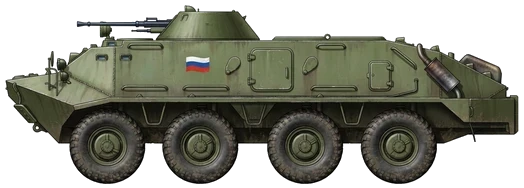
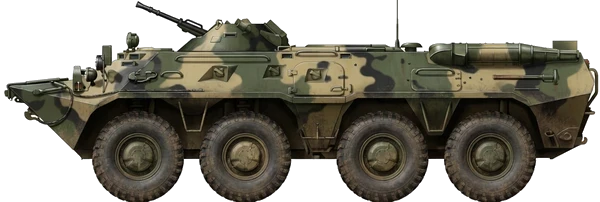
| BTR-60 | BTR-80 | |
|---|---|---|
| Origin country | 🇷🇺 Russia | 🇷🇺 Russia |
| Category | Armored Personnel Carrier | Armored Personnel Carrier |
| Type | Armoured personnel carrier | 8x8 Wheeled Armored Personnel Carrier |
| Manufacturer | GAZ | Arzamas Machine-Building Plant |
| Number produced | 25,000 units | 5,000 units |
| Estimated unit price | $-- million | $-- million |
| Combat weight | 10.3 tons | 13.6 tons |
| Maximum speed | 80 km/h | 80 km/h |
| Operational range | 500 km | 600 km |
| Length | 7.56 m | 7.70 m |
| Width | 2.83 m | 2.90 m |
| Height | 2.31 m | 2.41 m |
| Crew | 3 crew + 14 passengers | 3 (+7 passengers) |
Detailed Comparison
The GAZ-designed BTR-60 established the Soviet 8x8 motorized rifle paradigm in 1960, replacing older 4x4 and 6x6 platforms with a fast, amphibious, NBC-protected carrier. Twenty-six years later, the BTR-80 emerged from the Arzamas Machine-Building Plant as a direct mechanical correction to the BTR-60's operational failures in Afghanistan, discarding the twin-gasoline engine layout in favor of a single diesel powerplant and redesigning infantry dismount procedures.
Development and Design
The BTR-60 was engineered around industrial limitations. Unable to source a single engine powerful enough for a 10.3-ton APC, GAZ installed two 90 hp GAZ-49B gasoline engines side-by-side. This created a complex synchronization requirement and a high fire hazard. The troop compartment sat in the middle, forcing infantry to dismount through roof hatches or small upper side doors, exposing them to enemy fire. The BTR-80 corrected this architecture by integrating a single 260 hp KamAZ-7403 diesel engine. This allowed for a redesigned rear hull and the introduction of horizontally split side doors. Infantry dismount under the protection of the forward-opening upper door while using the lower half as a step, reducing exposure during egress.
Protection and Firepower
Both platforms prioritize mobility and amphibious capability over survivability. The 7–9 mm steel hulls limit protection to 7.62 mm ball ammunition and light shrapnel; neither chassis withstands 12.7 mm fire or modern anti-tank munitions. Baseline armament remains identical across early models: a 14.5 mm KPVT heavy machine gun and a 7.62 mm PKT coaxial machine gun. However, the BTR-80 turret increased maximum elevation from 30 degrees to 60 degrees. This modification, driven by the inability of BTR-60s to engage elevated Mujahideen ambush positions in Afghanistan, allows the BTR-80 to fire on steep slopes and low-flying aerial targets. Modernization programs widen the firepower gap; BTR-82A variants integrate 30 mm 2A72 autocannons, while BTR-60 upgrades like the Ukrainian Khorunzhyi focus simply on diesel conversions.
Mobility and Logistics
At 13.6 tons, the BTR-80 is heavier than the 10.3-ton BTR-60, yet achieves the same 80 km/h top speed while extending operational range from 500 km to 600 km. The BTR-60's twin-engine configuration places a massive logistical burden on maintenance units. Synchronizing the dual carburetors requires highly trained mechanics, and the gasoline engines suffer from power loss at high altitudes. The BTR-80’s single diesel engine simplifies the supply chain by standardizing fuel with main battle tanks and lowers the mechanical failure rate.
Deployment and Combat Record
The BTR-60 suffered high attrition rates during the 1969 Sino-Soviet border conflict and the Soviet-Afghan War. Its tendency to ignite upon penetration led Soviet troops to ride on the roof, a practice that persists today. Field data from Chechnya, Syria, and Ukraine reveals consistent vulnerabilities for both platforms:
- Total overmatch by 12.7 mm and heavier caliber weapons
- High lethality from basic IEDs and landmines due to the flat hull bottom
- Rapid attrition from FPV drones and loitering munitions in modern conventional warfare
Conclusion
The BTR-80 completely obsoletes the BTR-60. By replacing the hazardous, maintenance-heavy twin-gasoline engines with a single diesel block and introducing clamshell side doors, Arzamas engineers corrected the fatal ergonomic and logistical flaws of the GAZ design. While neither vehicle possesses the armor thickness or mine-blast shaping to survive frontline combat against peer adversaries, the BTR-80 remains a viable rear-echelon and patrol asset. The BTR-60, burdened by an obsolete powerplant and hazardous egress routes, is a liability in any modern combat scenario and functions today strictly as a desperate gap-filler for depleted mechanized units.