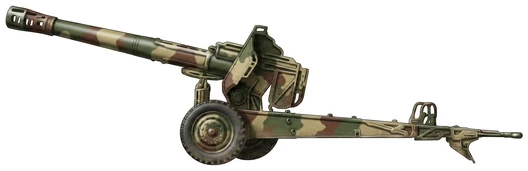
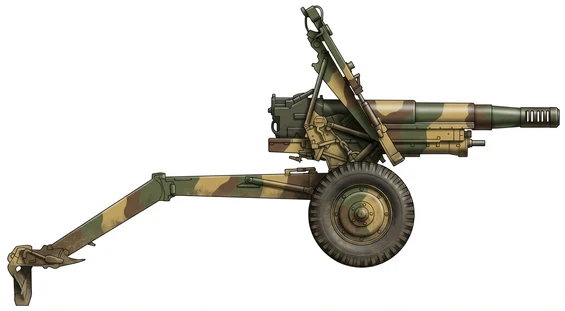
The Soviet D-20 152 mm gun-howitzer and the Italian OTO Melara Mod 56 105 mm pack howitzer address opposing artillery requirements. Designed for massed divisional fire, the 5.7-ton D-20 dictates heavy payload and range over tactical agility. Conversely, the 1.29-ton Mod 56 sacrifices lethality and structural endurance to achieve extreme portability for mountain and airborne formations.
Development and Design
Fyodor Petrov’s team at Sverdlovsk Artillery Plant No. 9 developed the D-20 in the late 1940s to replace World War II-era 152 mm howitzers like the ML-20. Entering service in 1955, it utilizes a split-trail carriage shared with the 122 mm D-74. OTO Melara engineered the Mod 56 in the 1950s specifically for the Italian Army's Alpini brigades. The design mandate required the weapon to break down into 12 components for transport by pack mules over steep terrain, resulting in a strictly lightweight architecture.
Protection and Firepower
The D-20 fires 152 mm separate-loading projectiles out to 17 km. Its ammunition suite spans standard high-explosive, smoke, and modern precision-guided munitions like the Krasnopol. A semi-automatic vertical sliding-block breech enables a steady rate of fire, while a center-sliding shield offers baseline crew protection from shrapnel. The Mod 56 utilizes standard US 105 mm M1 ammunition with a maximum range of 11 km. Its lightweight construction limits its capacity for sustained barrage fire. During the Vietnam War, Australian and New Zealand gunners noted the Mod 56 lacked the physical robustness required for continuous fire missions, leading to structural fatigue.
Mobility and Logistics
Mobility defines the operational footprint of both systems.
The D-20 weighs 5.7 tons and requires a heavy 6x6 prime mover or tracked tractor. Emplacement is labor-intensive, requiring an 8 to 10-man crew to engage a front pivot jack and lift the main wheels via auxiliary bogies.
The Mod 56 weighs 1.29 tons. A 7-man crew can manually handle the piece, tow it behind a light 4x4, or disassemble it in minutes. Stripped of its shield, it fits inside an M113 armored personnel carrier, and its weight permits single-lift external transport by utility helicopters.
Deployment and Combat Record
Soviet motor rifle divisions deployed the D-20 en masse during the Cold War. In the 2022 invasion of Ukraine, both Russian and Ukrainian forces have reactivated D-20s from reserve storage for static, attritional fire missions. The Mod 56 saw combat in Aden, Borneo, and Vietnam. It armed the Allied Command Europe Mobile Force until 1975 and was employed by both Argentine and British forces during the 1982 Falklands War. British forces replaced the Mod 56 with the L118 light gun due to the Mod 56's range limitations against Argentine artillery.
Conclusion
The D-20 holds the tactical advantage in conventional mechanized warfare. Its 152 mm payload and 17 km range dictate operations in static conflicts like Ukraine, where sheer volume of fire overrides mobility concerns. The Mod 56 is obsolete for peer-state conventional warfare due to its restricted 11 km range and poor structural endurance. It remains applicable strictly in extreme mountain or jungle environments where heavier, durable 155 mm systems cannot physically deploy.