D-74
The D-74 is a Soviet 122mm towed field gun introduced in 1955, used primarily for long-range indirect fire support, distinguished by its split-trail carriage and muzzle brake. Key figures: weight 5.62 t. In service with 3 armies — Sudan (100), Nigeria (90), Algeria (25).
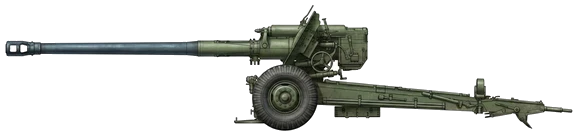
| Sub-type | Field gun |
| Crew | 8 or 9 personnels |
| Mass | 5.6 tons |
| Height | 2.7 m (8.9 ft) |
| Width | 2.35 m (7.7 ft) |
| Length | 9.875 m (32.4 ft) |
| Weapon 1 | 122 mm gun (52 calibre barrel) |
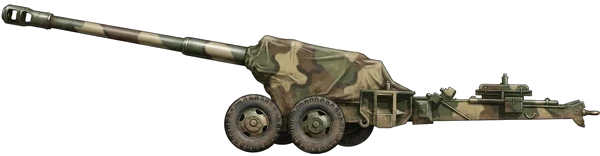
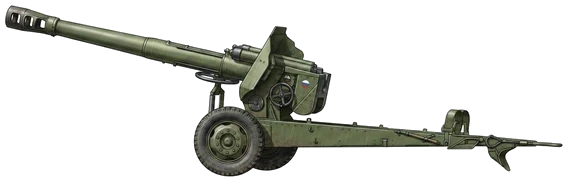
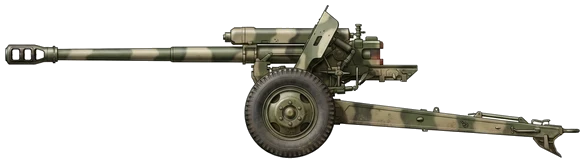
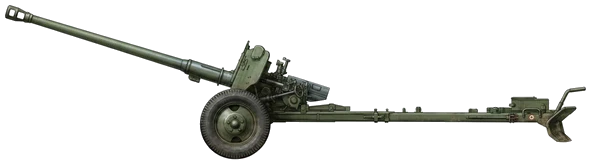
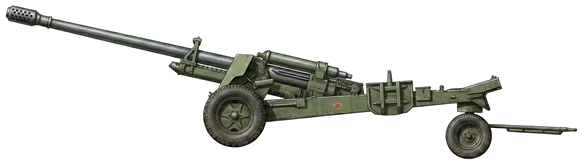
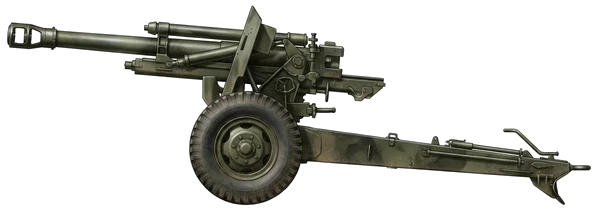
Description
The D-74 is a Soviet 122 mm towed field gun developed in the late 1940s. After the Second World War the Soviet Union sought long-range replacements for the 122 mm gun M1931 (A-19), the M1931/37, and the 152 mm M1910/30 and M1935 (Br-2) guns. Two designs resulted: the 122 mm D-74 and the 130 mm M-46. The D-74 was produced by the design bureau at Artillery Plant No. 9 in Sverdlovsk under Fëdor Fëdorovich Petrov, and was first seen publicly in 1955. The same team developed the 152 mm D-20 gun-howitzer concurrently, and the two weapons share a carriage. Both the D-74 and M-46 entered Soviet service, but the M-46's heavier projectile and longer range meant it remained in service after the D-74 had been withdrawn. A quantity was produced under licence in the People's Republic of China as the Type 60.
The gun has a long barrel fitted with a double-baffle muzzle brake and a semi-automatic vertical sliding-block breech with tied jaw, the block dropping to open. The barrel sits in a ring cradle with trunnions just forward of the breech, the recoil buffer and recuperator above the barrel, and compression balancing gear behind the saddle support that can be re-pressurised manually by a pump below the breech. A projectile retaining catch prevents the shell sliding back at high elevation before ramming. Top traverse is 60° with elevation from −5° to 50°. Box-girder split trails carry small fixed spades, with larger spades stowed on the trail sides for soft ground and attached by pintle in the same manner as the M-46; these spades are the principal difference from the D-20 carriage. A pivot jack at the front of the cradle support assists all-round traverse, the gun firing from its foam-filled rubber-tyred wheels rather than a firing platform. For large changes of arc, trail jacks lift the piece onto bogie wheels swung down from each trail. The pivot jack also locks the barrel vertically for towing, with the cradle tensioned onto the jack base and a bolt securing the barrel in centre traverse.
A shield is fitted, with a folding section below the cradle support and a sliding, folding upper centre section to clear the barrel at high elevation, offering protection primarily against small-arms fire. Sights are non-reciprocating and arranged for one-man laying: an OP4M direct-fire anti-tank telescope, a PG1M panoramic periscopic sight, an angle-of-sight scale and a range drum permitting the Soviet semi-direct fire technique. Ammunition is separate-loading with a metal cartridge case providing obturation, using a single charge without increments and not interchangeable with 122 mm howitzer ammunition; an APHE projectile is available. Rate of fire is generally given as six rounds per minute, with a detachment of eight or nine. Soviet prime movers included the URAL-375 truck and the AT-S and AT-L tractors.
The type was widely exported. Operators have included Algeria, Chad, China, Laos, Mauritania, Nigeria, North Korea, Russia, Sudan, Syria, Vietnam and Zimbabwe. Former operators include the Soviet Union, Afghanistan, Burkina Faso, Cambodia, Cuba, Egypt and Pakistan; examples were also used by Islamic State.
Frequently Asked Questions
What type of vehicle is the D-74?
What is the weight of the D-74?
How many crew members does the D-74 require?
What weapons does the D-74 carry?
- AUG 152026 Created D-74 page created (specifications, overview, 18 operators)