M1A1 Abrams vs T-72
M1A1 Abrams vs T-72 at a glance — weight 63,000 vs 44,500 kg, top speed 66 vs 60 km/h, range 465 vs 500 km, crew 4 vs 3 (commander, gunner, driver).
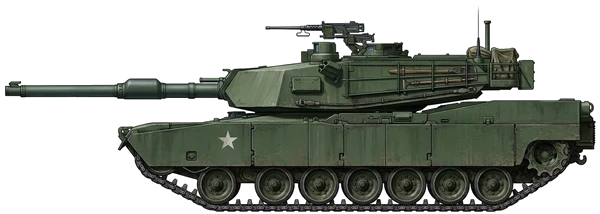
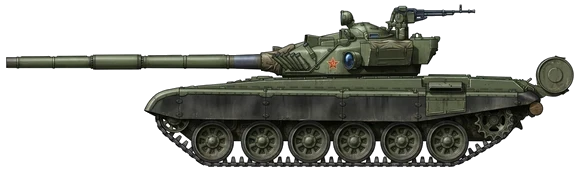
| M1A1 Abrams | T-72 | |
|---|---|---|
| Origin country | 🇺🇸 United States | 🇷🇺 Ex-USSR |
| Category | Main Battle Tank | Main Battle Tank |
| Type | Heavy Main Battle Tank | Medium Main Battle Tank |
| Manufacturer | General Dynamics Corp. | Malyshev HMB Plant |
| Number produced | 9,200 units | 25,000 units |
| Estimated unit price | $4.3 million | $2 million |
| Combat weight | 63.0 tons | 44.5 tons |
| Maximum speed | 66 km/h | 60 km/h |
| Operational range | 465 km | 500 km |
| Length | 9.83 m | 9.73 m |
| Width | 3.65 m | 3.59 m |
| Height | 2.43 m | 2.23 m |
| Crew | 4 | 3 (commander, gunner, driver) |
| M1A1 Abrams | T-72 | |
|---|---|---|
| Main armament | 1 M256 120mm smoothbore barrel (40 shells) gun | 125 mm 2A46M-5 smoothbore gun |
| Secondary weapon | 1 M-2HB 12.7mm machine gun (1000 rounds) | 7.62 mm PKT coax. machine gun |
| Engine | AGT-1500 Turbine with 1500 hp | V-92S2F (T-72B3 & T-72B3M) 1,130 hp (840 kW) |
Detailed Comparison
At 63.0 tons, the American M1A1 Abrams outweighs the Soviet-designed T-72 by 18.5 tons, reflecting divergent armored warfare doctrines. General Dynamics engineered the Abrams for crew survivability and sensor overmatch, while Uralvagonzavod designed the T-72 for mass mobilization, minimizing weight and profile to field 25,000 units.
Development and Design
The T-72 entered service in 1973 as a reliable mobilization alternative to the T-64. Using a three-man crew and a mechanical carousel autoloader, designers reduced the vehicle's height to 2.23 meters. The M1A1 entered service in 1986. Retaining a four-man crew, its 9.83-meter length and 2.43-meter height present a larger target, but the internal volume accommodates segregated ammunition storage.
Protection and Firepower
The M1A1 utilizes Chobham composite arrays, augmented with depleted uranium, to defeat kinetic energy threats. Its M256 120mm smoothbore gun fires single-piece ammunition stored in a turret bustle with blow-out panels, isolating crews from secondary explosions. The T-72 relies on a sloped steel turret and composite hull, heavily dependent on explosive reactive armor (ERA) to survive modern munitions. Its 125mm 2A46M gun uses two-piece ammunition stored in a floor carousel. Penetration often triggers immediate ammunition detonation, a flaw repeatedly documented in Chechnya, Syria, and Ukraine.
Mobility and Logistics
The Abrams utilizes a 1,500 hp AGT1500 gas turbine, reaching 66.0 km/h. This turbine provides high torque but demands an intense logistical footprint for fuel, restricting operational range to 465 km. The T-72 employs a traditional diesel engine—upgraded to the 1,130 hp V-92S2F in T-72B3 variants—offering a 500 km range and simpler field maintenance. At 44.5 tons, the T-72 crosses standard bridges and utilizes standard rail transport, whereas the 63-ton M1A1 requires heavy equipment transporters.
Deployment and Combat Record
Direct engagements heavily favor the Abrams. During the 1991 Gulf War, M1A1s engaged Iraqi T-72s, recording zero losses to enemy tank fire while destroying hundreds of Iraqi vehicles by utilizing thermal optics to fire outside the T-72's effective range. In the Russo-Ukrainian War, both platforms face intense threats from FPV drones and mines. T-72 variants suffer high attrition and immediate crew fatalities. Ukrainian forces operate refurbished M1A1SAs; while vulnerable to top-attack drones, they consistently yield higher crew survival rates post-penetration.
Conclusion
The M1A1 Abrams holds a clear edge in direct combat and crew survivability. The T-72 serves best in militaries requiring large volumes of inexpensive armor ($2.0 million vs $4.3 million) operating over weak infrastructure.
The M1A1 outclasses the T-72 in tank-on-tank engagements due to:
- Isolated ammunition storage ensuring crew survival after armor penetration
- Thermal optics allowing target acquisition beyond the T-72's return range
- Depleted uranium armor arrays that defeat standard 125mm kinetic penetrators
The T-72's carousel autoloader guarantees high crew fatalities upon penetration, making it a liability in conflicts where trained personnel are difficult to replace.