Vickers Challenger vs M1 Abrams
Vickers Challenger vs M1 Abrams at a glance — weight 62,000 vs 66,800 kg, top speed 56 vs 72 km/h, range 450 vs 426 km, crew — vs —.
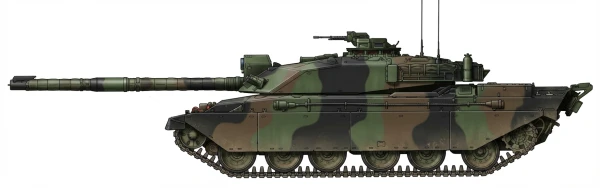
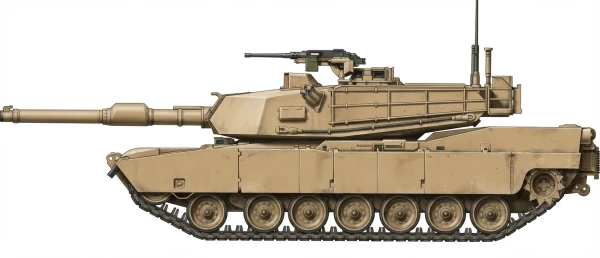
| Vickers Challenger | M1 Abrams | |
|---|---|---|
| Origin country | 🇬🇧 United Kingdom | 🇺🇸 United States |
| Category | Main Battle Tank | Main Battle Tank |
| Type | Heavy Main Battle Tank | Heavy Main Battle Tank |
| Manufacturer | Vickers Defense Systems | General Dynamics Corp. |
| Number produced | 420 units | 10,300 units |
| Estimated unit price | $1.5 million | $8.5 million |
| Combat weight | 62.0 tons | 66.8 tons |
| Maximum speed | 56 km/h | 72 km/h |
| Operational range | 450 km | 426 km |
| Length | 11.56 m | 9.77 m |
| Width | 3.51 m | 3.66 m |
| Height | 2.95 m | 2.44 m |
| Crew | 4 (commander, gunner, loader, driver) | 4 (commander, gunner, loader, driver) |
| Vickers Challenger | M1 Abrams | |
|---|---|---|
| Main armament | Royal Ordnance L11A5 120 mm rifled gun | 120 mm L/44 M256 smoothbore gun (40 rounds) |
| Secondary weapon | 7.62 mm L8A2 | 1 × 0.50 caliber (12.7 mm) M2HB heavy machine gun with 900 rounds |
| Engine | Perkins CV12 26 litre diesel 1,200 hp (895 kW) | Honeywell AGT1500 multi-fuel turbine engine 1,500 shp (1,120 kW) |
Detailed Comparison
The British Challenger 1 and American M1 Abrams emerged in the early 1980s as third-generation main battle tanks designed to counter Soviet armored formations in Central Europe. While both platforms integrated British-developed Chobham composite armor and advanced fire control systems, they diverged in powertrain selection and armament doctrine, with the Challenger retaining a rifled gun and diesel engine against the Abrams' eventual smoothbore cannon and gas turbine.
Development and Design
The Challenger 1 evolved from an Iranian order for an advanced Chieftain variant, reoriented for British Army requirements following the Iranian Revolution. It entered service in 1983 with Vickers Defense Systems producing 420 units. In contrast, the M1 Abrams resulted from the terminated MBT-70 program, designed by Chrysler Defense (later General Dynamics) to replace the M60. Entering service in 1980, the Abrams introduced a new hull and turret architecture, with over 10,300 units manufactured. The Abrams remains in service with continuous upgrades, whereas the Challenger 1 was retired by the UK in 2001.
Protection and Firepower
Both vehicles utilize Chobham composite armor, offering increased survivability against HEAT and kinetic rounds compared to rolled homogeneous steel. The Abrams later integrated depleted uranium mesh for added density. Armament differs significantly: the Challenger 1 mounts the Royal Ordnance L11A5 120 mm rifled gun, maintaining compatibility with High Explosive Squash Head (HESH) ammunition. The M1 Abrams (specifically the M1A1/M1A2 variants) utilizes the 120 mm L/44 M256 smoothbore gun, optimizing kinetic energy penetrator performance. The Abrams incorporates blowout panels for ammunition storage, a safety feature absent in the Challenger 1.
Mobility and Logistics
The M1 Abrams is powered by a Honeywell AGT1500 multi-fuel turbine producing 1,500 shp, achieving a top speed of 72.0 km/h despite a heavier combat weight of 66.8 tons. This engine provides high acceleration but consumes fuel at a higher rate, complicating logistics. The Challenger 1 utilizes a Perkins CV12 diesel engine (1,200 hp) with a lower top speed of 56.0 km/h. However, the Challenger's hydropneumatic suspension offers superior cross-country ride quality compared to the torsion bar system of the Abrams, aiding gunnery stability on rough terrain.
Deployment and Combat Record
Both tanks saw primary combat during the 1990-1991 Gulf War. British Challengers destroyed approximately 300 Iraqi tanks without loss, achieving a record long-range engagement. The Abrams spearheaded US armored thrusts, demonstrating reliability in desert conditions despite initial concerns regarding sand ingestion in the turbine. While the Challenger 1 was sold to Jordan (designated Al-Hussein) and retired by 2023, the Abrams remains active, seeing combat in Iraq, Afghanistan, Yemen, and the Russo-Ukrainian War.
Conclusion
The M1 Abrams constitutes a high-mobility platform with a substantial logistical footprint, suitable for expeditionary warfare requiring speed and kinetic dominance. The Challenger 1 functioned as a defensive specialist, prioritizing hull-down survivability and long-range accuracy over operational tempo. The Abrams' production volume and modular design allowed for decades of modernization, while the Challenger 1 served as a transitional capability between the Chieftain and the Challenger 2.