Leopard 2 vs M1 Abrams
Leopard 2 vs M1 Abrams at a glance — weight 62,500 vs 66,800 kg, top speed 70 vs 72 km/h, range 340 vs 426 km, crew 4 vs 4 (commander, gunner, loader, driver).
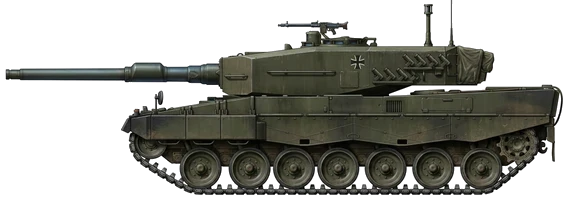
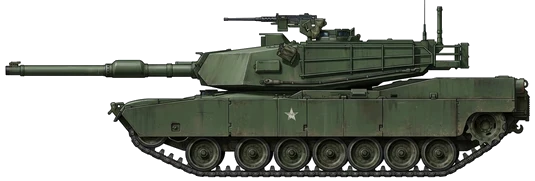
| Leopard 2 | M1 Abrams | |
|---|---|---|
| Origin country | 🇩🇪 Germany | 🇺🇸 United States |
| Category | Main Battle Tank | Main Battle Tank |
| Type | Heavy Main Battle Tank | Heavy Main Battle Tank |
| Manufacturer | Krauss-Maffei | General Dynamics Corp. |
| Number produced | 3,600 units | 10,300 units |
| Estimated unit price | $29 million | $8.5 million |
| Combat weight | 62.5 tons | 66.8 tons |
| Maximum speed | 70 km/h | 72 km/h |
| Operational range | 340 km | 426 km |
| Length | 9.97 m | 9.77 m |
| Width | 3.76 m | 3.66 m |
| Height | 3.00 m | 2.44 m |
| Crew | 4 | 4 (commander, gunner, loader, driver) |
| Leopard 2 | M1 Abrams | |
|---|---|---|
| Main armament | Rheinmetall 120 mm L/55 | 120 mm L/44 M256 smoothbore gun (40 rounds) |
| Secondary weapon | 7.62 mm MG3A1 or 7.62 mm FN MAG | 1 × 0.50 caliber (12.7 mm) M2HB heavy machine gun with 900 rounds |
| Engine | MTU MB 873 MTCA Diesel Engine with 1500 hp | Honeywell AGT1500 multi-fuel turbine engine 1,500 shp (1,120 kW) |
Detailed Comparison
The M1 Abrams and Leopard 2 are third-generation main battle tanks originating from the divergent requirements following the terminated MBT-70 joint program. Entering service in 1980 and 1979 respectively, both vehicles utilize 120 mm smoothbore cannons and advanced composite armor. The Abrams relies on a Honeywell turbine engine, while the Leopard 2 utilizes a diesel powerplant, reflecting distinct logistical doctrines between the United States and Germany.
Development and Design
The M1 Abrams, manufactured by General Dynamics Land Systems, replaced the M60 tank. Following the XM1 competitive phase, the design incorporated a Honeywell AGT1500 multi-fuel turbine, prioritizing acceleration and power density. Production reached 10,300 units. Conversely, the Krauss-Maffei-manufactured Leopard 2 evolved from experimental development phases in the 1970s intended to upgrade existing platforms. It retained a conventional MTU MB 873 diesel engine, aligning with European logistical infrastructure. Total production stands at 3,600 units. Both tanks require a four-person crew, lacking the autoloaders found in Soviet-era designs.
Protection and Firepower
Initial M1 models fielded a 105 mm gun, later upgraded to the 120 mm L/44 M256 smoothbore. The Leopard 2 mounts the Rheinmetall 120 mm, evolving from the L/44 to the longer L/55 variant, which generates higher muzzle velocity. The Abrams utilizes Chobham composite armor reinforced with depleted uranium mesh and isolates all ammunition behind blowout panels to mitigate catastrophic detonation. The Leopard 2 employs spaced multilayer armor; variants from A5 onward feature angled turret appliqué armor. While the Leopard 2 turret bustle has blowout panels, secondary ammunition stored in the hull lacks this compartmentalization.
Mobility and Logistics
The M1 Abrams is heavier at 66.8 tons compared to the Leopard 2's 62.5 tons. The turbine engine propels the M1 to 72.0 km/h, slightly exceeding the Leopard 2's 70.0 km/h. Per the provided data, the M1 lists an operational range of 426 km, while the Leopard 2 lists 340 km. Logistics differ fundamentally: the M1's turbine offers high performance but generates a distinct heat signature and consumes fuel rapidly at idle. The Leopard 2's diesel engine shares commonality with commercial heavy transport, simplifying maintenance, and the vehicle supports deep-water fording with preparation.
Deployment and Combat Record
The M1 saw combat in the Gulf War, Iraq War, and Afghanistan. Saudi forces deployed it in the Yemeni Civil War, and Ukraine operates the M1A1SA against Russian forces. The Leopard 2 debuted in Kosovo, followed by ISAF operations in Afghanistan by Canadian and Danish forces. Turkish A4 variants engaged ISIS in Syria, facing anti-tank guided missiles. Since 2023, both platforms have engaged in the Russo-Ukrainian War, encountering drone warfare and modern artillery threats.
Conclusion
The M1 Abrams prioritizes maximum crew survivability through complete ammunition isolation and heavy depleted uranium armor, positioning it as a specialized breakthrough asset supported by a robust logistical tail for its turbine engine. The Leopard 2 presents a configuration optimized for mobile warfare in European terrain, offering superior gun ballistics with the L/55 and lower acquisition costs ($10.0 million vs $29.0 million listed price difference notwithstanding). The M1 excels in high-threat frontal assaults, while the Leopard 2 functions effectively as a maneuver-centric platform within standard diesel-based supply chains.