M1 Abrams vs T-90
M1 Abrams vs T-90 at a glance — weight 66,800 vs 48,000 kg, top speed 72 vs 60 km/h, range 426 vs 550 km, crew — vs 3.
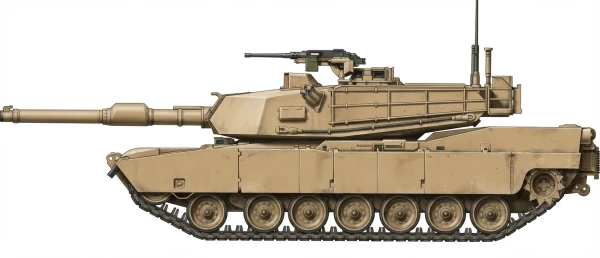
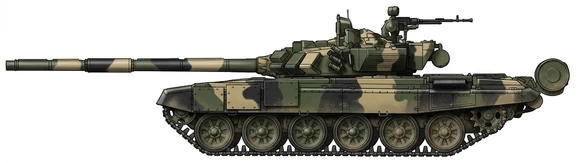
| M1 Abrams | T-90 | |
|---|---|---|
| Origin country | 🇺🇸 United States | 🇷🇺 Russia |
| Category | Main Battle Tank | Main Battle Tank |
| Type | Heavy Main Battle Tank | Medium Main Battle Tank |
| Manufacturer | General Dynamics Corp. | Malyshev HMB Plant |
| Number produced | 10,300 units | 4,000 units |
| Estimated unit price | $8.5 million | $4.5 million |
| Combat weight | 66.8 tons | 48.0 tons |
| Maximum speed | 72 km/h | 60 km/h |
| Operational range | 426 km | 550 km |
| Length | 9.77 m | 9.63 m |
| Width | 3.66 m | 3.78 m |
| Height | 2.44 m | 2.22 m |
| Crew | 4 (commander, gunner, loader, driver) | 3 |
| M1 Abrams | T-90 | |
|---|---|---|
| Main armament | 120 mm L/44 M256 smoothbore gun (40 rounds) | 2A46M-5 125 mm smoothbore gun |
| Secondary weapon | 1 × 0.50 caliber (12.7 mm) M2HB heavy machine gun with 900 rounds | 12.7mm Kord Heavy machine gun |
| Engine | Honeywell AGT1500 multi-fuel turbine engine 1,500 shp (1,120 kW) | V-92S2F |
Detailed Comparison
The M1 Abrams is a 66.8-ton heavy main battle tank developed by the United States, utilizing a gas turbine engine and manual loading, while the Russian T-90 represents a 48.0-ton medium main battle tank platform derived from the T-72, featuring a diesel engine and an autoloader system. The Abrams entered service in 1980 with over 10,000 units produced, whereas the T-90 followed in 1992 with a production run of approximately 4,000 units.
Development and Design
Developed to replace the M60 following the termination of the MBT-70 program, the M1 Abrams was designed by Chrysler Defense (now General Dynamics Land Systems). It prioritizes crew survivability through physical bulk and compartmentalization, requiring a four-person crew. The T-90, designed by the Kartsev-Venediktov Design Bureau, is an evolution of the T-72B (Object 188). It maintains the Soviet design requirement for a low profile—2.22 m compared to the Abrams' 2.44 m—and reduced weight. The integration of an autoloader in the T-90 reduces the crew requirement to three by eliminating the loader position.
Protection and Firepower
The M1 relies on composite armor, including Chobham and depleted uranium layers, with blast-proof doors separating ammunition from the crew to prevent catastrophic detonation. Its primary armament is the 120 mm L/44 M256 smoothbore gun carrying 40 rounds. The T-90 employs a layered defense of steel and composite materials, supplemented by Explosive Reactive Armour (ERA) such as Kontakt-5 or Relikt and the Shtora active protection system. It utilizes a 125 mm 2A46M-5 smoothbore gun, which can fire standard munitions and AT-11 Sniper anti-tank guided missiles.
Mobility and Logistics
Propulsion distinguishes the two platforms significantly. The Abrams uses a Honeywell AGT1500 multi-fuel turbine producing 1,500 shp, allowing for speeds of 72.0 km/h. However, this power plant limits operational range to 426 km and imposes a high fuel logistics burden. The T-90 utilizes a V-92S2F diesel engine. While slower with a maximum speed of 60.0 km/h, the lighter chassis and diesel efficiency allow for an extended operational range of 550 km. The T-90's lower combat weight facilitates transport across infrastructure with lower load classifications compared to the Abrams.
Deployment and Combat Record
The M1 Abrams has served in the Gulf War, Iraq War, and Afghanistan, and is currently operated by Ukraine. With a unit price of $10.0 million, it is a high-cost asset. The T-90, priced at $4.5 million, first saw action in Dagestan (1999) and has been deployed in Syria, the Second Nagorno-Karabakh War, and extensively during the Russian invasion of Ukraine. Both platforms have sustained confirmed losses in Ukraine, facing threats from artillery, anti-tank guided missiles, and drone warfare.
Conclusion
The M1 Abrams emphasizes maximum crew protection, sensor integration, and fire control superiority, favoring hull-down positions and open-terrain maneuver despite its logistical heaviness. The T-90 provides a lighter, lower-profile alternative with integrated guided missile capability and superior operational range, suited for forces prioritizing strategic mobility and lower unit costs over the extreme survivability measures found in heavier Western counterparts.