M1 Abrams vs Merkava 4
M1 Abrams vs Merkava 4 at a glance — weight 66,800 vs 65,000 kg, top speed 72 vs 64 km/h, range 426 vs 500 km, crew 4 (commander, gunner, loader, driver) vs 4.
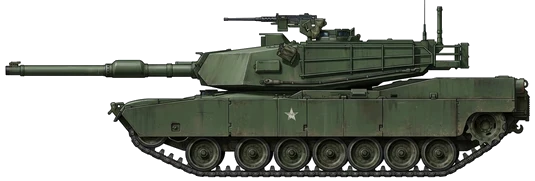
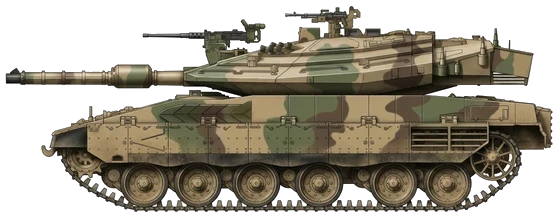
| M1 Abrams | Merkava 4 | |
|---|---|---|
| Origin country | 🇺🇸 United States | 🇮🇱 Israel |
| Category | Main Battle Tank | Main Battle Tank |
| Type | Heavy Main Battle Tank | Heavy Main Battle Tank |
| Manufacturer | General Dynamics Corp. | Israeli Military Industries |
| Number produced | 10,300 units | 360 units |
| Estimated unit price | $8.5 million | $4.5 million |
| Combat weight | 66.8 tons | 65.0 tons |
| Maximum speed | 72 km/h | 64 km/h |
| Operational range | 426 km | 500 km |
| Length | 9.77 m | 9.04 m |
| Width | 3.66 m | 3.72 m |
| Height | 2.44 m | 2.66 m |
| Crew | 4 (commander, gunner, loader, driver) | 4 |
| M1 Abrams | Merkava 4 | |
|---|---|---|
| Main armament | 120 mm L/44 M256 smoothbore gun (40 rounds) | 1 IMI 120mm rifled barrel (50 shells) gun |
| Secondary weapon | 1 × 0.50 caliber (12.7 mm) M2HB heavy machine gun with 900 rounds | 1 60mm mortar |
| Engine | Honeywell AGT1500 multi-fuel turbine engine 1,500 shp (1,120 kW) | Continental AVDS 1790 V-12 Diesel Engine with 1500 hp |
Detailed Comparison
The Merkava Mk. 4 and M1 Abrams are heavy main battle tanks weighing 72.0 tons and 66.8 tons respectively, both utilizing 120mm main armaments and advanced composite armor arrays. While the M1 Abrams entered service in 1980 featuring a conventional layout and turbine propulsion, the Merkava Mk. 4, introduced in 2004, utilizes a unique front-engine configuration and diesel power, reflecting divergent national design requirements.
Development and Design
The M1 Abrams, manufactured by General Dynamics, emerged from the XM1 program to replace the M60 series. It prioritizes mobility and low silhouette, incorporating a multi-fuel turbine engine. The design focuses on kinetic energy defeat and crew isolation. In contrast, the Merkava Mk. 4, designed by MANTAK, places the engine block forward of the crew compartment to serve as a spaced armor component. This configuration allows for a rear access hatch, facilitating ammunition resupply or emergency casualty evacuation.
Protection and Firepower
The M1 Abrams relies on Chobham composite armor, reinforced with depleted uranium in later variants. A critical survivability feature is the isolation of main gun ammunition in a turret bustle with blowout panels. The Merkava Mk. 4 employs modular composite armor and detachable modules, allowing for rapid field repairs. The 'Windbreaker' variant integrates the Trophy active protection system (APS) to intercept anti-tank projectiles.
Regarding armament, the Abrams mounts the 120mm M256 smoothbore gun with 40 rounds, supported by a .50 caliber M2HB and two 7.62mm M240 machine guns. The Merkava utilizes an IMI 120mm gun with a higher ammunition capacity of 50 shells and a semi-automated loading system. It features unique secondary armaments, including an internal 60mm mortar for indirect fire and the capability to launch LAHAT anti-tank missiles through the main barrel.
Mobility and Logistics
The M1 Abrams is powered by a Honeywell AGT1500 turbine engine generating 1,500 hp, allowing a maximum speed of 72.0 km/h. However, the turbine's fuel consumption limits the operational range to 426 km. The Merkava Mk. 4 uses a Continental AVDS 1790 V-12 diesel engine, also rated at 1,500 hp. While its top speed is lower at 64.0 km/h, the diesel powerplant offers a longer operational range of 500 km and simplifies logistics compared to the turbine's requirements.
Deployment and Combat Record
The M1 Abrams has been produced in large numbers (10,300 units) and exported to nations including Egypt, Saudi Arabia, Australia, and Poland. It saw combat in the Gulf War, the Iraq War, Afghanistan, and with Ukrainian forces against Russia. The Merkava Mk. 4 serves primarily with the Israel Defense Forces. It saw action in the 2006 Lebanon War and the 2023 ground offensive in the Gaza Strip.
Conclusion
The M1 Abrams emphasizes high-speed maneuver warfare and kinetic dominance, suited for engagement in open terrain. The Merkava Mk. 4 prioritizes maximum crew survivability and versatility, with design features such as the internal mortar, APS, and rear hatch specifically optimized for urban combat and asymmetric warfare scenarios.