M1A1 Abrams vs M1 Abrams
M1A1 Abrams vs M1 Abrams at a glance — weight 63,000 vs 66,800 kg, top speed 66 vs 72 km/h, range 465 vs 426 km, crew 4 vs —.
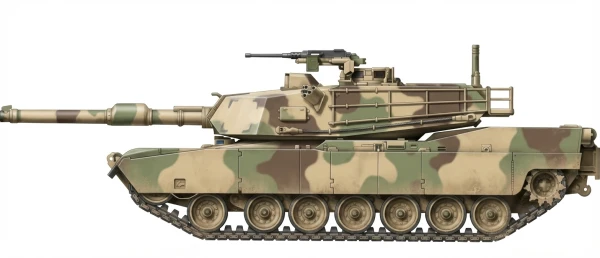
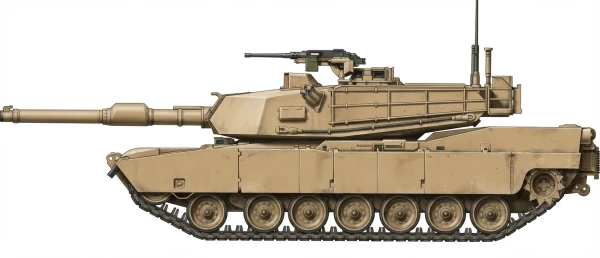
| M1A1 Abrams | M1 Abrams | |
|---|---|---|
| Origin country | 🇺🇸 United States | 🇺🇸 United States |
| Category | Main Battle Tank | Main Battle Tank |
| Type | Heavy Main Battle Tank | Heavy Main Battle Tank |
| Manufacturer | General Dynamics Corp. | General Dynamics Corp. |
| Number produced | 9,200 units | 10,300 units |
| Estimated unit price | $4.3 million | $8.5 million |
| Combat weight | 63.0 tons | 66.8 tons |
| Maximum speed | 66 km/h | 72 km/h |
| Operational range | 465 km | 426 km |
| Length | 9.83 m | 9.77 m |
| Width | 3.65 m | 3.66 m |
| Height | 2.43 m | 2.44 m |
| Crew | 4 | 4 (commander, gunner, loader, driver) |
| M1A1 Abrams | M1 Abrams | |
|---|---|---|
| Main armament | 1 M256 120mm smoothbore barrel (40 shells) gun | 120 mm L/44 M256 smoothbore gun (40 rounds) |
| Secondary weapon | 1 M-2HB 12.7mm machine gun (1000 rounds) | 1 × 0.50 caliber (12.7 mm) M2HB heavy machine gun with 900 rounds |
| Engine | AGT-1500 Turbine with 1500 hp | Honeywell AGT1500 multi-fuel turbine engine 1,500 shp (1,120 kW) |
Detailed Comparison
The M1 Abrams and M1A1 Abrams constitute the foundational variants of the United States' primary main battle tank lineage, manufactured by General Dynamics Land Systems. While the designated M1 represents the initial production model entering service in 1980, the M1A1, produced between 1986 and 1992, integrates the 120 mm smoothbore cannon and heavy armor upgrades that defined subsequent modernization efforts for the platform.
Development and Design
Originating from the XM815 and XM1 projects following the 1970 termination of the joint U.S.-West German MBT-70 program, both vehicles were designed to replace the M60 Patton. The chassis design incorporates a Honeywell AGT1500 gas turbine engine, a departure from traditional diesel powerplants, utilizing high-hardness-steel torsion bars and rotary shock absorbers. The M1A1 variant represented a specific shift toward increased survivability against Soviet kinetic energy penetrators, incorporating an overpressure system for Nuclear, Biological, and Chemical (NBC) defense, contrasting with the individual crew protection systems of the initial M1.
Protection and Firepower
The most distinct operational difference lies in armament. The initial M1 fielded a 105 mm rifled gun. The M1A1 standardized the M256 120 mm smoothbore cannon, a license-produced Rheinmetall L/44, capable of firing high-explosive anti-tank (HEAT) and armor-piercing fin-stabilized discarding sabot (APFSDS) rounds. The M1A1 also introduced depleted uranium (DU) mesh into the Chobham composite armor arrays on the turret, significantly increasing density. Both variants utilize separate ammunition storage with blowout panels to vent internal explosions. Secondary armament is identical: a pintle-mounted .50 caliber M2HB and two 7.62 mm M240 machine guns.
Mobility and Logistics
Propulsion for both vehicles is provided by the Honeywell AGT1500 multifuel gas turbine, generating 1,500 shp (1,120 kW) coupled to an Allison X-1100-3B transmission. The physical specifications reflect the armor upgrades; the M1A1 has a combat weight of 63.0 tons compared to the evolving weight of the general M1 lineage, which can reach 66.8 tons in modernized configurations. Consequently, the M1A1 has a governed top speed of 66.0 km/h, slightly lower than the 72.0 km/h potential of lighter M1 variants. Operational range varies between 426 km and 465 km, heavily dependent on terrain and fuel type.
Deployment and Combat Record
The M1A1 debuted in combat during the 1991 Gulf War, engaging T-72, T-62, and T-55 tanks without sustaining losses to enemy tank fire. Both platforms have seen service in the Iraq War and the War in Afghanistan. The M1A1 was the specific variant utilized by the U.S. Marine Corps until the divestment of their tank battalions in 2021. Export operators include Australia, Egypt, Poland, and Saudi Arabia. In 2023, M1A1SA variants were supplied to Ukraine to counter Russian armored forces.
Conclusion
The M1 established the technological baseline for third-generation American armor, introducing turbine propulsion and composite protection. The M1A1 functions as the up-gunned standardization of this platform, essential for engaging modern heavy armor. While the M1A1 lacks the fully digitized system architecture of later M1A2 SEP iterations, its combination of the 120 mm M256 cannon and depleted uranium armor package remains effective for high-intensity conventional warfare.