M48A5 Patton vs T-54 / T-55 / TM-800
M48A5 Patton vs T-54 / T-55 / TM-800 at a glance — weight 52,000 vs 36,500 kg, top speed 48 vs 50 km/h, range 465 vs 400 km, crew 4 vs 4.
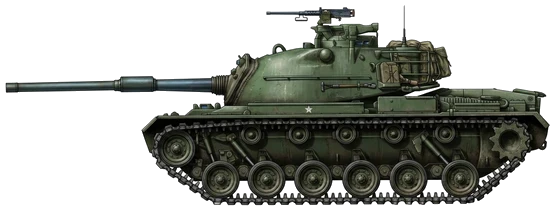
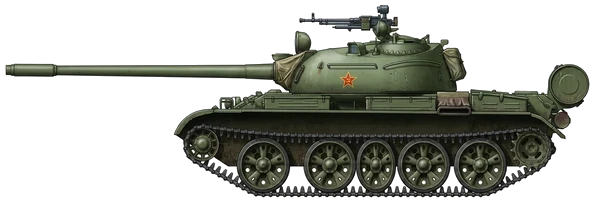
| M48A5 Patton | T-54 / T-55 / TM-800 | |
|---|---|---|
| Origin country | 🇺🇸 United States | 🇷🇺 Ex-USSR |
| Category | Main Battle Tank | Main Battle Tank |
| Type | Medium Main Battle Tank | Medium Main Battle Tank |
| Manufacturer | Detroit Tank Plant | Malyshev HMB Plant |
| Number produced | 6,764 units | 16,532 units |
| Estimated unit price | $0.3 million | $0.2 million |
| Combat weight | 52.0 tons | 36.5 tons |
| Maximum speed | 48 km/h | 50 km/h |
| Operational range | 465 km | 400 km |
| Length | 9.15 m | 9.00 m |
| Width | 3.63 m | 3.27 m |
| Height | 3.05 m | 2.40 m |
| Crew | 4 | 4 |
| M48A5 Patton | T-54 / T-55 / TM-800 | |
|---|---|---|
| Main armament | 1 M68 105mm rifled barrel (54 shells) gun | 1 D-10T2S 100mm rifled barrel (34 shells) gun |
| Secondary weapon | 1 M-2HB 12.7mm machine gun (3000 rounds) | 1 NSV 12.7mm machine gun (200 rounds) |
| Engine | Continental AVDS 1790 Diesel Engine with 690 hp | Diesel Engine with 690 hp |
Detailed Comparison
The 52-ton American M48A5 and the 36.5-ton Soviet T-54/55 series bring entirely different weight classes and upgrade limits to the battlefield, despite frequently clashing in Cold War and modern proxy conflicts. The T-54/55 was a clean-sheet post-WWII design manufactured for mass adoption, while the M48A5 was a 1975 retrofit program that brought aging reserve hulls up to the 105mm firepower standard of the M60 series.
Development and Design
Soviet engineers designed the T-54/55 around a low 2.4-meter profile and high producibility. Entering service in 1948, it combined a cast dome turret with a cramped internal layout, prioritizing silhouette reduction over crew ergonomics. The T-55 variant introduced the PAZ NBC protection system in 1958 to allow operations in nuclear battlefields. Conversely, the M48A5 is a modernization of older M48 hulls (A1, A2C, A3) utilizing the M60A1 RISE update kit. Standing 3.05 meters tall, the M48A5 accepts a larger internal volume, allowing better depression angles for its main gun and improved crew efficiency at the cost of a larger targeting signature.
Protection and Firepower
The M48A5 outguns the T-55. The integration of the 105mm M68 rifled gun (54 rounds) paired with the M16 all-metric fire control system provides a clear engagement advantage over the T-55’s 100mm D-10T2S (34 rounds).
- T-55: Relies on early two-plane stabilization (STP-2) but suffers from a slow rate of fire due to restrictive turret space.
- M48A5: Incorporates better optics and the Israeli-designed Urdan cupola in many export variants, enhancing commander visibility without exposing the crew.
Neither tank can defeat modern anti-tank guided missiles (ATGMs) with their base cast steel armor. However, combat data from the Middle East indicates the T-55’s unprotected ammunition stowage frequently results in catastrophic detonations when penetrated, whereas the M48’s interior layout marginally improves survivability.
Mobility and Logistics
Both vehicles utilize 690 hp diesel engines. The T-55’s lighter 36.5-ton combat weight yields superior power-to-weight ratios and reduces the strain on infrastructure, allowing it to cross lighter bridges in regions like Angola and Vietnam. It reaches 50 km/h with a 400 km range. The heavier 52-ton M48A5 tops out at 48 km/h and requires more robust recovery vehicles, though its Continental AVDS-1790-2C and Allison cross-drive transmission provide a 465 km range and reliable torque vectoring across varied terrain.
Deployment and Combat Record
These platforms engaged each other directly during the Yom Kippur War, the Iran-Iraq War, and the 1982 Lebanon conflict. Israeli Magach (M48) units systematically dismantled Syrian T-55 formations by exploiting the 105mm gun’s range and depression advantages from hull-down positions. Today, both vehicles serve secondary roles. M48A5s remain active in Taiwan and Turkey for coastal defense and border patrol. In Ukraine and Syria, T-55s are regularly deployed as mobile assault guns, leveraging their 100mm high-explosive fragmentation rounds for indirect infantry support rather than armored spearheads.
Conclusion
The M48A5 holds the tactical edge in static defense and hull-down armored engagements, where its 105mm gun, superior depression, and better optics dictate the terms of engagement. However, the T-54/55 wins as a low-cost, expeditionary fire-support vehicle. Its 15.5-ton weight advantage and mechanical simplicity make it far easier to sustain in austere environments. For a mechanized force expecting tank-on-tank combat, the M48A5 is the mandatory choice; for light infantry requiring mobile artillery in poor infrastructure regions, the T-54/55 remains the standard.