GTK Boxer vs Patria AMV
GTK Boxer vs Patria AMV at a glance — weight 36,500 vs 32,000 kg, top speed 103 vs 100 km/h, range 1,050 vs 1,000 km, crew 2 vs —.
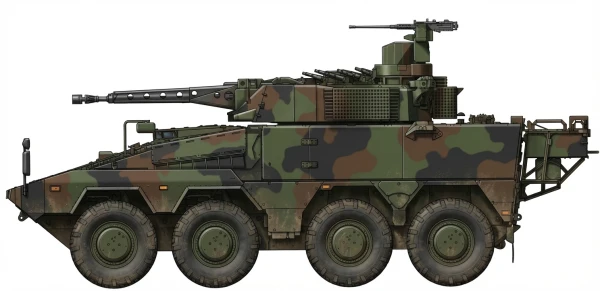
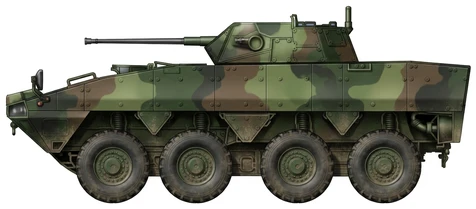
| GTK Boxer | Patria AMV | |
|---|---|---|
| Origin country | 🇩🇪 Germany | 🇫🇮 Finland |
| Category | Armored Personnel Carrier | Armored Personnel Carrier |
| Type | 8x8 Armored Personnel Carrier | Armoured personnel carrier |
| Manufacturer | ARTEC | Patria |
| Number produced | 472 units | 1,315 units |
| Estimated unit price | $5 million | $5 million |
| Combat weight | 36.5 tons | 32.0 tons |
| Maximum speed | 103 km/h | 100 km/h |
| Operational range | 1,050 km | 1,000 km |
| Length | 7.93 m | 7.70 m |
| Width | 3.00 m | 2.80 m |
| Height | 2.37 m | 2.30 m |
| Crew | 2 | 2–3 (commander, driver, optional gunner) |
| GTK Boxer | Patria AMV | |
|---|---|---|
| Main armament | 1 Mk-19 40mm grenade launcher | Up to 105 mm gun or twin 120 mm mortars in turret |
| Secondary weapon | 1 MAG 7.62mm machine gun | Protector RWS |
| Engine | Turbo-Diesel Engine with 710 hp | DI 12 Scania Diesel or DC 12 Scania Diesel or DC 13 Scania Diesel |
Detailed Comparison
The Patria AMV and GTK Boxer are European-designed 8x8 armored fighting vehicles weighing approximately 32 tons in combat configuration. Both platforms utilize modular architectures to fulfill roles ranging from personnel transport to heavy weapons platforms. The AMV, originating in Finland, focuses on chassis flexibility and export adaptability, while the German-Dutch Boxer employs a distinct drive-and-mission module separation system for logistical interchangeability.
Development and Design
The Patria AMV development began in 1996 to replace the Sisu Pasi 6x6, entering serial production in 2004. It utilizes a modular chassis available in three configurations: basic, high roof, and heavy weapon platform. This allows structural optimization for specific roles. The GTK Boxer, managed by OCCAR and ARTEC, features a unique design splitting the vehicle into a permanent Drive Module and interchangeable Mission Modules. These modules allow role reconfiguration (e.g., from APC to ambulance) in under one hour. Boxer production deliveries began in 2009, five years after the AMV, following delays caused by shifting consortium membership.
Protection and Firepower
The AMV frontal arc resists 30mm APFSDS rounds, and the hull withstands 10 kg TNT mine blasts. Polish variants deployed to Afghanistan utilized steel-composite armor sets to counter RPG-7 threats. The Boxer employs rolled all-welded steel with appliqué modules and a triple-layered v-shaped floor with decoupled seats to mitigate blast shock.
Armament on the Boxer is dictated by the mission module, commonly mounting remote weapon stations with 7.62mm/12.7mm machine guns or 40mm AGLs. Heavier variants, such as the Lithuanian Vilkas, mount 30mm turrets, and the platform can support the RCH 155 artillery module. The AMV frequently integrates heavier organic armaments, including 105mm guns or twin 120mm mortars, alongside standard machine gun configurations.
Mobility and Logistics
Performance metrics are comparable. The Boxer achieves 103.0 km/h and a 1050 km range, powered by a 710 hp MTU diesel engine. The AMV reaches 100.0 km/h with a 1000 km range using Scania diesel engines and utilizes independent hydropneumatic suspension for terrain negotiation. While combat weights are identical at 32 tons, the Boxer is physically larger, with a width of 3.0 m compared to the AMV's 2.8 m, which affects air transportability and maneuverability in restricted urban or wooded terrain.
Deployment and Combat Record
The AMV is widely exported, serving Finland, Poland, Croatia, Slovenia, Sweden, Slovakia, and the UAE. It is produced under license as the KTO Rosomak (Poland) and Badger (South Africa). The Rosomak saw combat in Afghanistan (2007) and Ukraine (2023), while UAE forces utilized the AMV in Yemen. The Boxer serves Germany, the Netherlands, Lithuania, and Australia, with recent UK procurement. It saw operational service with ISAF in Afghanistan and is currently deployed in the Russo-Ukrainian War.
Conclusion
The Patria AMV represents a flexible chassis approach, facilitating the integration of heavy direct and indirect fire systems and securing broad international licensing agreements. The GTK Boxer emphasizes logistical modularity through its swappable mission pods, optimizing fleet management for nations requiring rapid role changes. While the Boxer provides a high baseline of protection and standardization within NATO core members, the AMV has demonstrated wider operational variety as a heavy fire support platform.