M1 Abrams vs Type 99
M1 Abrams vs Type 99 at a glance — weight 66,800 vs 52,000 kg, top speed 72 vs 65 km/h, range 426 vs 450 km, crew — vs 3.
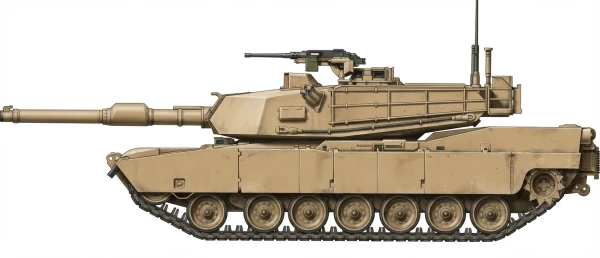
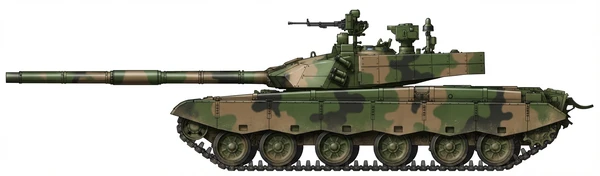
| M1 Abrams | Type 99 | |
|---|---|---|
| Origin country | 🇺🇸 United States | 🇨🇳 China |
| Category | Main Battle Tank | Main Battle Tank |
| Type | Heavy Main Battle Tank | Medium Main Battle Tank |
| Manufacturer | General Dynamics Corp. | Norinco |
| Number produced | 10,300 units | 1,300 units |
| Estimated unit price | $8.5 million | $2.5 million |
| Combat weight | 66.8 tons | 52.0 tons |
| Maximum speed | 72 km/h | 65 km/h |
| Operational range | 426 km | 450 km |
| Length | 9.77 m | 9.99 m |
| Width | 3.66 m | 3.45 m |
| Height | 2.44 m | 2.30 m |
| Crew | 4 (commander, gunner, loader, driver) | 3 |
| M1 Abrams | Type 99 | |
|---|---|---|
| Main armament | 120 mm L/44 M256 smoothbore gun (40 rounds) | 1 2A46M/ D-81TM 125mm smoothbore barrel gun |
| Secondary weapon | 1 × 0.50 caliber (12.7 mm) M2HB heavy machine gun with 900 rounds | 1 NSV 12.7mm machine gun |
| Engine | Honeywell AGT1500 multi-fuel turbine engine 1,500 shp (1,120 kW) | V-8 Diesel Engine with 1500 hp |
Detailed Comparison
The M1 Abrams serves as the primary main battle tank for the United States and several allied nations, while the Type 99 fulfills this role exclusively for the People's Liberation Army (PLA) of China. The M1 Abrams, weighing 66.8 tons, represents a heavy armor doctrine focused on crew survivability through bulk and composite materials. The Type 99, at 52.0 tons, follows a Soviet-influenced design lineage that prioritizes a lower profile and lighter weight to navigate the diverse geography of East Asia.
Development and Design
General Dynamics Land Systems (formerly Chrysler Defense) designed the M1 Abrams to replace the M60, delivering the first units in 1980. The vehicle incorporates a Honeywell AGT1500 turbine engine and introduced Chobham composite armor to U.S. forces. Over 10,300 units have been built. The Type 99, developed by the 201st Research Institute and manufactured by Norinco, entered service in 2001. Originating from the Type 98 and influenced by the T-72 chassis, it aimed to modernize the PLA's armored divisions. While the M1 utilizes a four-person crew with a manual loader, the Type 99 employs a three-person crew and a carousel-style autoloader.
Protection and Firepower
The M1 Abrams features composite armor reinforced with depleted uranium mesh in later variants. It utilizes a 120mm L/44 M256 smoothbore gun capable of firing APFSDS and canister rounds. Crew protection is central to the design, characterized by separate ammunition storage with blowout panels. The Type 99 utilizes modular composite armor and tandem-charge defeating explosive reactive armor (ERA), specifically Relikt-type on the Type 99A. Its primary armament is the 125mm ZPT-98 smoothbore gun, which supports gun-launched anti-tank guided missiles (ATGM) such as the GP125. A distinct feature of the Type 99 is the JD-3 active laser self-defense system, designed to blind enemy optical sensors.
Mobility and Logistics
Propulsion varies significantly between the platforms. The M1 Abrams is powered by a 1,500 shp multi-fuel turbine engine, achieving speeds of 72.0 km/h. This engine provides high acceleration but demands substantial logistical support due to fuel consumption and heat signature. The Type 99 uses a 1,500 hp liquid-cooled diesel engine (150HB), reaching 65.0 km/h with an operational range of 450 km. The Type 99's lower combat weight allows for easier transport across bridges and railways in China, whereas the M1 Abrams' weight restricts its strategic mobility in infrastructure-constrained environments.
Deployment and Combat Record
The M1 Abrams has been deployed in the Gulf War, Iraq War, War in Afghanistan, Yemeni Civil War, and the Russo-Ukrainian War. It has faced conventional armor, asymmetric threats, and modern drone warfare. Operators include the U.S., Australia, Egypt, Iraq, Kuwait, Poland, Saudi Arabia, Morocco, and Ukraine. The Type 99 has not seen active combat. It is deployed within the PLA's heavy combined arms brigades, with initial concentrations in the Beijing and Shenyang Military Regions. The Type 99B variant is specifically configured for high-altitude operations in the Himalayan border regions.
Conclusion
The M1 Abrams offers a combat-proven platform with superior frontal armor and crew survivability features, optimized for open-terrain warfare where heavy logistical tails can be maintained. The Type 99 presents a lighter, regionally optimized solution that integrates specific countermeasures like laser defense systems and gun-launched missiles, favoring mobility and firepower in terrain that limits heavier Western tanks.