BTR-70
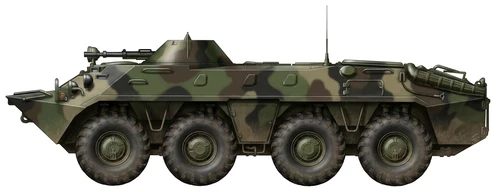
Introduced by the Soviet Union in 1972, the BTR-70 is an eight-wheeled armored personnel carrier powered by twin gasoline engines. Key figures: weight 11.5 t, top speed 80 km/h, range 600 km, built 8,000. In service with 9 armies — Turkmenistan (300), Ukraine (217), Russia (200) and 6 others.
| Sub-type | Armored personnel carrier |
| Crew | 3 (+7 passengers) personnels |
| Range | 600 km |
| Mass | 11.5 tons |
| Height | 2.32 m (7.6 ft) |
| Width | 2.8 m (9.2 ft) |
| Length | 7.535 m (24.7 ft) |
| Max. speed | 80 km/h (50 mph) |
| Engine | 2× gasoline ZMZ-4905, 120 hp (88.2 kW) each |
| Weapon 1 | 14.5 mm KPVT machine gun (or 12.7 mm DShK) |
| Weapon 2 | 7.62 mm PKT machine gun |
Description
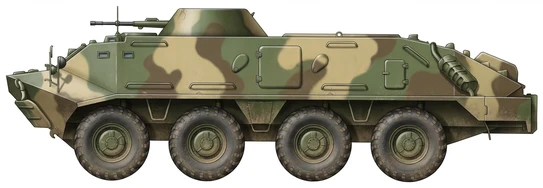
The BTR-70 is an eight-wheeled armored personnel carrier developed by the Soviet Union under the manufacturing designation GAZ-4905. Development began in the late 1960s to create a successor to the BTR-60 series, specifically the BTR-60PB. In 1971, Soviet designers built the GAZ-50 (Obiekt 50) prototype, incorporating elements of the BMP-1 infantry fighting vehicle. Due to high projected manufacturing costs and lower protection compared to the tracked BMP, a second prototype designated Obiekt 60—fitted with a turret mounting a 14.5 mm machine gun—was selected instead. The Soviet Armed Forces officially accepted the vehicle into service on August 21, 1972. Production continued until 1984, when it was superseded by the single-diesel BTR-80 following combat experience in the Soviet–Afghan War that highlighted vulnerabilities in the BTR-70's twin gasoline engine setup and entry/exit hatch arrangement. Romania also manufactured the design under license as the TAB-77.
The hull is constructed with thicker armor than the BTR-60PB and features escape hatches in the lower hull between the second and third wheel stations. Power is supplied by two petrol engines; early production models utilized GAZ-69B engines, while later units were fitted with ZMZ-49-05 V-8 engines. The drive train connects the right engine to the first and third wheel stations and the left engine to the second and fourth wheel stations, enabling continued mobility if one engine fails. The vehicle is fully amphibious, propelled in water by a single rear-mounted water jet activated alongside a trim vane and bilge pumps. Standard onboard equipment includes a central tire-pressure regulation system, an FVU NBC filtration system, a DK-3B detection device, an R-123M radio, an R-124 intercom, and various day/night vision periscopes and infrared searchlights. Primary armament consists of a turret-mounted 14.5 mm KPVT heavy machine gun with 500 rounds and a coaxial 7.62 mm PKT machine gun with 2,000 rounds. Internal storage accommodates two Strela-3 or Igla MANPADS, or optionally two AGS-17 automatic grenade launchers.
The Soviet Union exported the BTR-70 to Afghanistan, East Germany, Hungary, and Romania. Following the collapse of the Soviet Union, the vehicles were inherited or acquired by post-Soviet states and exported to multiple international operators. The vehicle saw its initial combat deployment during the Soviet–Afghan War. Small numbers were later operated by Angolan forces during the Angolan Civil War, and donated units were deployed by the United Nations Protection Force (UNPROFOR) during the Yugoslav Wars in Bosnia-Herzegovina. The vehicle subsequently saw action in the War in Donbas, the 2021 Kyrgyzstan–Tajikistan border clashes, and the 2022 Russian invasion of Ukraine.
Frequently Asked Questions
What type of vehicle is the BTR-70?
What is the weight of the BTR-70?
What is the maximum speed of the BTR-70?
What is the operational range of the BTR-70?
How many crew members does the BTR-70 require?
How many BTR-70 have been built?
What weapons does the BTR-70 carry?
- SEP 42026 Verified Weight verified against the published specifications
- AUG 42026 Updated Number built added
- AUG 22026 Created Page created: BTR-70