Congo Military Forces
Open-source order of battle for 2026: 10,000 active troops, 14 aircraft.
Armed Forces in 2026
| Domain | Strength | Composition |
|---|---|---|
| Air Force of the Republic of Congo | 14 aircraft | 2 combat 8 helicopters |
| Ground Forces | 30 tanks | |
| Personnel | 10,000 active | 2,000 paramilitary |
ARMS Index (Aggregate Rating of Military Strength)
Full ranking →| Pillar | Weight | Score | Basis |
|---|---|---|---|
| Manpower | 15% | 46.6 | Active, reserve & paramilitary personnel |
| Ground forces | 20% | 35.3 | Tanks, armor & artillery weighted by type |
| Naval power | 20% | 0.0 | Weighted by hull type: carrier tiers, nuclear vs conventional submarines |
| Air power | 25% | 16.7 | Weighted by aircraft type and fleet age |
| Nuclear deterrent | 10% | 0.0 | No declared nuclear capability |
| Defense budget | 10% | 21.4 | Annual spending, purchasing-power adjusted |
| Readiness | modifier | ×0.95 | Budget per soldier: proxy for training, maintenance & technology |
Country File
| Population | 6.3M (2024) |
| GDP | $15.7 billion (2024) |
| GDP per capita | $2,482 |
| Military budget | $189M (2024) |
| Share of GDP | 1.2% (2024) |
| Military spending per capita | $30 (2024) |
| Inflation rate | 3.09% (2024) |
| Capital | Brazzaville |
| Region | Africa |
| Land area | 341,500 km² |
| Coastline | 205 km |
| Land borders | 5,504 km |
| Bordering countries | 5 |
| Currency | XAF |
Strategic Overview in 2026
Strategic Position
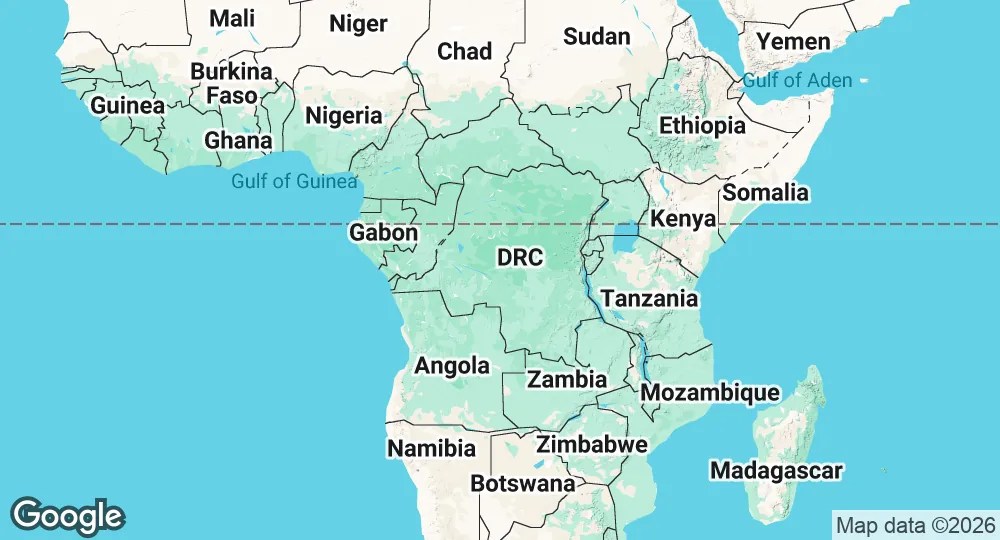
The Democratic Republic of the Congo (DRC) is centered in sub-Saharan Africa, sharing borders with nine nations. The country’s defense posture is primarily defined by internal security challenges and territorial integrity concerns in its eastern provinces, specifically North Kivu, South Kivu, and Ituri. Central to its strategic outlook is the persistent conflict with the March 23 Movement (M23), which is part of the broader Congo River Alliance (AFC). In January 2025, the M23 conducted an offensive resulting in the capture of Goma, the provincial capital of North Kivu.
The DRC maintains a adversarial relationship with Rwanda, which Kinshasa accuses of providing direct military support to M23 rebels—a claim supported by United Nations Group of Experts reports in 2025. Strategic priorities include the neutralization of foreign-backed insurgencies and the stabilization of mineral-rich territories.
Bilateral and regional alliances are central to the DRC's security architecture. The country is a member of the Southern African Development Community (SADC), which deployed the SADC Mission in the DRC (SAMIDRC) to assist government forces. While the United Nations Organization Stabilization Mission in the DRC (MONUSCO) has historically provided a security buffer, its phased withdrawal continued through 2025. Additionally, the DRC maintains a bilateral defense agreement with Burundi, which has deployed approximately 10,000 to 29,000 personnel to assist in counter-insurgency operations. In June 2025, a peace agreement was brokered in Washington D.C. between the DRC and Rwanda, followed by the Doha Declaration of Principles in July 2025, though active hostilities have persisted into 2026.
Military Forces
The Armed Forces of the Democratic Republic of the Congo (FARDC) is the primary state military organization, structured into Land Forces, an Air Force, and a Navy. Total active personnel are estimated between 130,000 and 150,000.
The Land Forces represent the largest branch and are organized into military regions. The FARDC operates a diverse inventory of armored vehicles, primarily of Soviet and Chinese origin. Main battle tank components include T-72, T-64, and Type 59 models. Mechanized infantry capabilities are supported by BMP-1 infantry fighting vehicles and BTR-60/80 armored personnel carriers. The FARDC also utilizes Chinese-made WZ-551 armored vehicles and various towed artillery systems. Specialized units include the Republican Guard, an elite formation responsible for the protection of the presidency and key state installations.
The Air Force operates a small fleet of combat and transport aircraft. Primary strike capabilities are provided by Su-25 ground-attack aircraft. The rotary-wing fleet includes Mi-24/35 attack helicopters and Mi-8/17 transport helicopters. In 2025, the force increased its reliance on unmanned aerial vehicles (UAVs), operating Chinese-built CH-4 combat drones for reconnaissance and precision strikes in the eastern conflict zones.
The Navy is primarily a brown-water force focused on Lake Tanganyika and the Congo River. It operates small patrol craft and fast interceptors intended for border surveillance and anti-smuggling operations.
Supplemental to the FARDC are paramilitary and irregular forces. The "Wazalendo" (Patriots) are a collection of pro-government militias integrated into the national defense strategy as territorial defenders. In 2025, the government continued efforts to operationalize the Reserve Armée de la Défense (RAD), a formal reserve structure designed to integrate these irregular combatants into the state security apparatus.
Defense Industry
The DRC’s domestic defense industry is limited, forcing a near-total reliance on foreign imports. The most notable domestic facility is an ammunition plant located in Likasi, which produces small arms ammunition. For heavy equipment, aircraft, and advanced electronics, the military depends on suppliers from China, Russia, and Eastern Europe. Recent procurement has focused on specialized equipment for counter-insurgency, including night-vision technology, tactical communications, and UAVs.
Strategic Trends
The DRC’s defense budget is currently characterized by a "war effort" financing model. In December 2025, the government established the Support and Development Fund for the Armed Forces (FSD-FARDC) to centralize resources for military programming. This initiative is part of an ambitious military spending plan estimated at $3.5 billion for the period ending in 2025. Defense spending as a percentage of GDP has trended between 1% and 2%, though emergency allocations for the eastern conflict frequently exceed baseline projections.
Force modernization is focused on improving rapid-response capabilities and intelligence, surveillance, and reconnaissance (ISR). However, the military faces persistent constraints, including fragmented command structures, logistical inefficiencies, and a heavy reliance on foreign mercenaries and irregular proxies. A key doctrinal shift observed in 2025 and 2026 is the formalization of the "people’s defense" concept, which seeks to institutionalize the role of civilian-militia partnerships through the RAD reserve system. This approach aims to compensate for FARDC manpower shortages but presents long-term challenges for military discipline and professionalization.
Military Expenditure: CIA World Factbook. Last updated on 4 August 2026. Suggest a change
Frequently Asked Questions
How large is Congo's military?
What is Congo's defense budget?
How does Congo rank militarily in the world?
Does Congo have nuclear weapons?
How many aircraft does Congo's air force have?
How many tanks does Congo have?
What percentage of GDP does Congo spend on defense?
What is Congo's military personnel per capita?
Does Congo have paramilitary forces?
- AUG 42026 Updated Global Military Index updated in a site-wide editorial pass
- JUL 162026 Updated Global Military Index updated in a site-wide editorial pass
- JUN 162026 Updated Yearly statistics, military spending and 2 more fields updated
- APR 82026 Updated Paramilitary personnel updated
- MAR 172026 Updated Paramilitary personnel updated
- JAN 172026 Updated Main battle tank count and Global Military Index updated
- JAN 132026 Updated Description added