Sudan Military Forces
Sudan ranks #73 of 170 militaries worldwide in 2026, with 104,300 active troops. The Sudanese Army fields 5,915 ground vehicles, including 224 main battle tanks; the Air Force flies 184 aircraft, including 91 combat aircraft. Sudan has no nuclear weapons.
Armed Forces in 2026
| Domain | Strength | Composition |
|---|---|---|
| Air Force | 184 aircraft | 91 combat 70 helicopters |
| Ground Forces | 5,915 vehicles | 224 main battle tanks |
| Personnel | 104,300 active | 60,000 paramilitary |
ATLAS Index (Aggregate Total of Land, Air and Sea strength)
Full ranking →| Pillar | Weight | Score | Basis |
|---|---|---|---|
| Manpower | 10% | 42.0 | Active, reserve & paramilitary personnel |
| Ground forces | 20% | 45.6 | ARMS inventory power: armour & artillery by type and era, attack helicopters, armament |
| Naval power | 20% | 0.0 | SEAS inventory power: hulls by type, size and era, air wing, sustainment, armament |
| Air power | 25% | 24.4 | AIRS inventory power: aircraft by type and generation, enablers, armament |
| Nuclear deterrent | 10% | 0.0 | No declared nuclear capability |
| Defense budget | 15% | 14.2 | Annual spending, purchasing-power adjusted |
| Availability | modifier | ground ×0.80 · naval ×1.00 · air ×0.80 | Budget per point of each force, from the branch indexes |
Country File
| Population | 50.4M (2024) |
| GDP | $49.7 billion (2024) |
| GDP per capita | $985 |
| Military budget | $375M (2021) |
| Share of GDP | 0.9% (2021) |
| Share of govt spending | 9.5% (2021) |
| Military spending per capita | $8 (2021) |
| Inflation rate | 138.81% (2022) |
| Capital | Khartoum |
| Region | Africa |
| Land area | 1,731,671 km² |
| Coastline | 853 km |
| Land borders | 6,764 km |
| Bordering countries | 7 |
| Currency | SDG |
Strategic Overview in 2026
Strategic Position
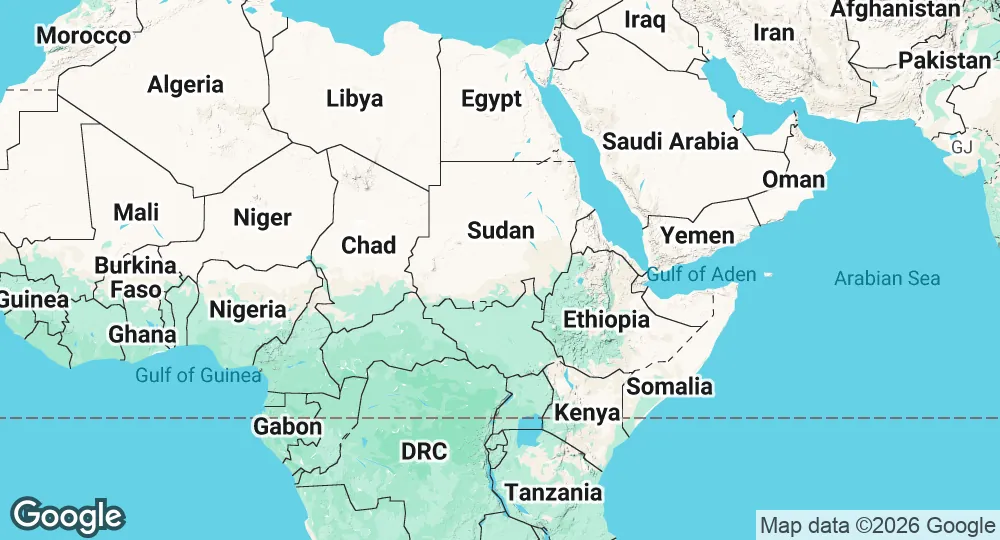
Sudan’s defense posture is defined by an internal conflict between the Sudanese Armed Forces (SAF) and the Rapid Support Forces (RSF). This conflict has restructured the country's security priorities toward internal territorial control and the protection of logistical corridors. Geopolitically, Sudan occupies a position on the Red Sea, making its coastline a focal point for international maritime security and foreign basing interests.
Sudan is a member of the United Nations, the African Union (currently suspended), and the Arab League. Defense relations are fragmented due to the internal war. The SAF maintains a bilateral security relationship with Egypt, which provides training and intelligence support. Engagement with Iran has increased in 2025, specifically regarding the procurement of unmanned aerial vehicles (UAVs). Discussions with Russia regarding a naval logistics center on the Red Sea coast persist, though active construction is tied to the stabilization of the central government.
Primary security concerns include the Fashaga border dispute with Ethiopia and the spillover of instability from Libya, Chad, and South Sudan. Control over the Nile River resources remains a long-term strategic priority, influencing relations with downstream and upstream neighbors.
Military Forces
The Sudanese military architecture is split between the regular Sudanese Armed Forces (SAF) and the Rapid Support Forces (RSF), a paramilitary organization that evolved from the Janjaweed militias.
Sudanese Armed Forces (SAF) The SAF is organized into the Army, Navy, and Air Force, under the command of the Transitional Sovereignty Council.
-
Army: The primary land force operates main battle tanks including T-72, T-54/55, and Chinese-made Type 59 and Type 96 models. Armored infantry units utilize BMP-1 and BMP-2 infantry fighting vehicles, along with BTR-series and Chinese-manufactured WZ-551 armored personnel carriers. Artillery capabilities consist of D-30 howitzers and BM-21 Grad multiple rocket launchers.
-
Air Force: Operates a mix of Soviet and Chinese airframes. The fighter and ground-attack fleet includes MiG-29, Su-24, Su-25, and Nanchang Q-5 aircraft. The transport fleet utilizes An-26 and Il-76 aircraft. Rotary-wing assets include Mi-24 attack helicopters and Mi-8/17 transport helicopters. Since 2024, the Air Force has integrated Iranian-designed Mohajer-6 and Zagil-3 UAVs for reconnaissance and strike missions.
-
Navy: A coastal defense force based primarily at Port Sudan and Flamingo Bay. It operates a fleet of patrol boats and fast attack craft intended for littoral monitoring and anti-smuggling operations.
Rapid Support Forces (RSF) The RSF functions as a highly mobile light infantry force. It does not operate a traditional naval or air branch but utilizes captured SAF equipment. Its primary inventory consists of thousands of "technicals"—pickup trucks mounted with heavy machine guns, anti-aircraft guns (ZU-23-2), and recoilless rifles. The RSF also operates MANPADS and has deployed commercial and tactical drones for urban surveillance and targeted strikes in 2025 operations.
Defense Industry
Sudan maintains a domestic arms production capability through the Military Industry Corporation (MIC). The MIC operates several complexes, such as the Al-Shajara Industrial Complex and the Al-Zarqā Engineering Complex.
Domestic production focuses on the refurbishment and assembly of foreign designs under license, primarily from China and Russia. The MIC produces the "Al-Bashir" (a variant of the Type 85 tank) and the "Khatim" (a variant of the BMP-1). The industry also manufactures small arms, including "Terab" assault rifles (based on the CQ-5.56), light machine guns, and various calibers of mortar and small arms ammunition. While Sudan achieved a degree of self-sufficiency in basic munitions and small arms before the current conflict, the industry is currently constrained by damage to manufacturing facilities in Khartoum and a heavy reliance on imported electronic components and high-grade steel.
Strategic Trends
The primary trend in 2025 and 2026 is the transition toward asymmetric warfare and the integration of low-cost technology. The SAF has shifted procurement toward loitering munitions and FPV (First Person View) drones to counter the RSF’s mobility. This shift reflects a move away from traditional large-scale armored maneuvers toward precision urban strikes.
Defense spending is difficult to quantify due to the fragmentation of the state and the use of off-budget gold mining revenue to fund military operations. The RSF maintains control over significant gold-producing regions, providing it with independent financial streams for arms procurement through regional black markets.
Future force structure depends on the outcome of the current conflict. If the SAF maintains control, the military likely faces a long-term reconstruction phase to replace airframes and heavy armor lost during the war. If the conflict remains a stalemate, the military posture will continue to evolve into localized, militia-integrated defense zones with a focus on securing the Red Sea trade routes and the administrative capital in Port Sudan. Constraints include a collapse in the formal economy, international sanctions on key commanders, and the mass displacement of technical personnel.
Military Expenditure: information from the Stockholm International Peace Research Institute (SIPRI) Military Expenditure Database. Last updated on 4 August 2026. Suggest a change
Frequently Asked Questions
How large is Sudan's military?
What is Sudan's defense budget?
How does Sudan rank militarily in the world?
Does Sudan have nuclear weapons?
How many aircraft does Sudan's air force have?
How many tanks does Sudan have?
What percentage of GDP does Sudan spend on defense?
What is Sudan's military personnel per capita?
Does Sudan have paramilitary forces?
- AUG 292026 Verified Military spending re-checked against SIPRI, which publishes no Sudan figure after 2021
- AUG 42026 Updated Global Military Index updated in a site-wide editorial pass
- AUG 32026 Updated Global Military Index updated
- JUL 162026 Updated Global Military Index updated in a site-wide editorial pass
- JUN 162026 Updated Yearly statistics and Global Military Index updated
- MAR 172026 Updated Paramilitary personnel updated
- JAN 172026 Updated Main battle tank count and Global Military Index updated