Q-5 / A-5 Fantan
Chinese ground-attack aircraft, notable for service in the Cold War period, often utilized in Pakistani and North Korean operations. Key figures: top speed 1,210 km/h, range 2,000 km, service ceiling 16,500 m, max takeoff weight 11,300 kg, unit price $3M, built 1,300. In service with 2 air forces as of 2026 — Myanmar (20), Sudan (20).
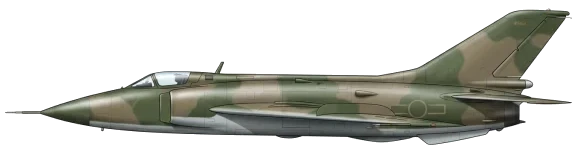
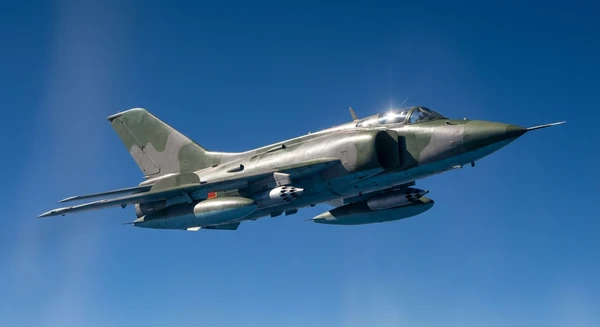
| Crew | 1 |
| Length | 15.7 m (51.3 ft) |
| Wingspan | 9.7 m (31.8 ft) |
| Height | 4.3 m (14.2 ft) |
| Wing area | 27.9 m² (300.3 sqft) |
| Empty weight | 6,400 kg (14,110 lbs) |
| Max. takeoff weight | 11,300 kg (24,912 lbs) |
| Powerplant | 2 × turbojets Shenyang WP-6A 3,750 kgf each |
| Ejection seat | HTY-1 |
| Maximum speed | 1210 km/h (752 mph) |
| Operational range | 2,000 km (1,243 mi) |
| Service ceiling | 16,500 m (54,134 ft) |
| Climb rate | 18.6 m/s (61.0 ft/s) |


Description
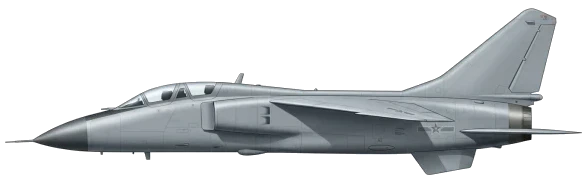
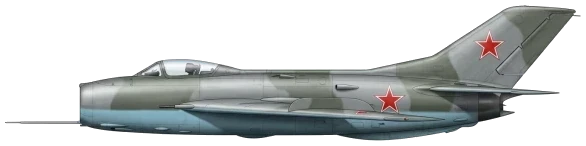
In August 1958, the People's Liberation Army requested the development of a jet attack aircraft for air support, leading to the Nanchang Q-5. Lu Xiaopeng was appointed chief designer, creating a design based on the MiG-19 but with a longer, area-ruled fuselage to reduce transonic drag and accommodate a 4 m (13-ft) internal weapons bay. The air intakes were moved to the fuselage sides, initially intended to free up space in the nose for a target radar which was never actually implemented. New wings with greater area and reduced sweep were incorporated. The Q-5 utilized the same Liming Wopen WP-6 A (Tumansky RD-9) turbojet engines as the J-6. Although production drawings were completed in 1960, the project was canceled in 1961 due to the political climate in China, but it was later revived. The first flight finally occurred on 4 July 1965, and series production began in 1969, with squadron deliveries starting in 1970.
Design
The Nanchang Q-5 incorporates significant design changes tailored for its ground-attack role compared to the Shenyang J-6 on which it was based. Its fuselage is longer and area-ruled to reduce transonic drag, accommodating a 4-meter internal weapons bay. The air intakes were moved to the fuselage sides, and new wings with greater area and reduced sweep were also incorporated. Fixed armament includes two Type 23-1 23 mm cannon, mounted in the wing roots, each with 100 rounds. Later models introduced advancements such as laser rangefinders, HUDs, and new navigation systems, enhancing precision strike capabilities.
Armament
For external stores, the aircraft is equipped with two pylons under each wing and two pairs of tandem pylons located under the engines, in addition to an internal weapons bay. It has a total of 10 hardpoints. The internal weapons bay has been used for an auxiliary fuel tank in later models, increasing fuel capacity by over 70%, or for delivering nuclear munitions in some variants like the Q-5A, retaining the bay for this purpose. The aircraft can carry up to 1,000 kg (2,205 lb) of ordnance internally and an additional 1,000 kg externally, for a total payload capacity of 2,000 kg (4,400 lb). The hardpoints allow for a variety of air-to-air missiles such as the PL-2, PL-5, and PL-7, as well as unguided rocket pods in 57 mm, 90 mm, and 130 mm sizes. It can also carry a range of bombs including 50 kg, 150 kg, 250 kg, and 500 kg unguided bombs, BL755 cluster bombs, and Matra Durandal anti-runway bombs. Fuel tanks, with capacities of 400 L, 760 L, and 1,100 L, can also be carried on the hardpoints.
Operational History
The Nanchang Q-5 has seen operational use in various regions and conflicts. The Sudanese Air Force deployed its A-5 attack jets during the War in Darfur. In March 2015, a Myanmar Air Force A-5C accidentally dropped bombs on a Chinese village within the Yunnan province, resulting in casualties. In April 2017, Q-5s were observed practicing air strikes in Bohai Bay. The aircraft was also exported to nations such as Pakistan, Bangladesh, and Myanmar, where it was often designated as the A-5. While considered a capable light attack platform, its navigation and weapons-delivery systems were superseded by more modern aircraft during the 2010s, leading to its eventual replacement by the Xi'an JH-7 in Chinese service.
Variants
Main Variants:
-
Q-5: The original production version featured a total of six pylons, two under each wing and two under the fuselage, and was later superseded by the Q-5A.
-
Q-5Jia: A modified Q-5 variant engineered to carry nuclear bombs, with only a limited number produced.
-
Q-5I (Q-5A): This variant replaced the internal weapon bay with an internal fuel tank, increasing fuel capacity by over 70%.
-
Q-5II (Q-5C): An improved Q-5I, this variant was equipped with omnidirectional radar warning receivers and, later, a Type 205 pulse doppler navigation radar was installed on several planes to enhance navigation capabilities.
-
Q-5D: Introduced during the 1996 Taiwan Strait Crisis, this interim attack aircraft featured the DG-1 integrated doppler navigation/GPS system, replacing the separate systems of the Q-5C.
Frequently Asked Questions
What type of aircraft is the Q-5 / A-5 Fantan?
What is the maximum speed of the Q-5 / A-5 Fantan?
What is the range of the Q-5 / A-5 Fantan?
When did the Q-5 / A-5 Fantan first fly?
How many Q-5 / A-5 Fantan have been built?
Which countries operate the Q-5 / A-5 Fantan?
How much does a Q-5 / A-5 Fantan cost?
What is the service ceiling of the Q-5 / A-5 Fantan?
- AUG 272026 Updated Unit price re-based (flyaway cost of the most-produced variant, then-year USD convention)
- AUG 52026 Updated Thrust updated
- JUL 292026 Updated Sources and cross-references refreshed
- JUL 232026 Updated Sources and cross-references refreshed
- APR 72026 Updated Sources and cross-references refreshed
- APR 52026 Updated Ejection seat added
- FEB 72026 Updated Range added