Columbia-class
Future US ballistic missile submarine replacing the Ohio class, the US Navy's top procurement priority. Key figures: length 171 m, crew 155, unit cost $9.2B, built 12. Not yet in service; on order for 1 navy — United States.
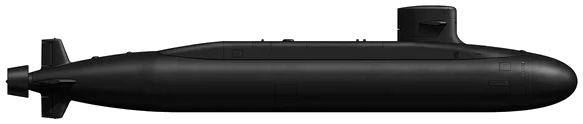
| Subtype | Nuclear-powered ballistic missile submarine |
| Displacement submerged | 21140 tons |
| Crew | 155 members |
| Width | 13.1 m (43.0 ft) |
| Length | 171.0 m (561.0 ft) |
| Propulsion | S1B nuclear reactor, turbo-electric drive, pump-jet propulsor |
- 16 × Trident II D5 submarine-launched ballistic missiles
- 533 mm torpedo tubes with Mk 48 torpedoes
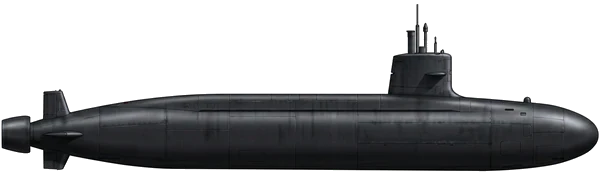
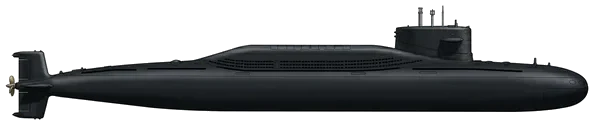
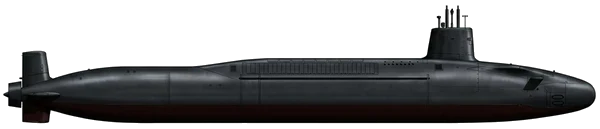
Description
The Columbia class is the future backbone of the American sea-based nuclear deterrent, designed to replace the Ohio-class ballistic missile submarines from the early 2030s. Twelve boats are planned to sustain continuous at-sea deterrent patrols, down from fourteen Ohios thanks to a life-of-ship reactor core that eliminates the mid-life refueling overhaul. At a projected $109.8 billion for the class, it is the US Navy's top procurement priority.
At about 171 meters and 21,000 tons submerged, the Columbias will be the largest submarines ever built by the United States. Each boat carries sixteen Trident II D5 missile tubes — shared with the British Dreadnought class through the Common Missile Compartment program — plus torpedo tubes for self-defence. The design introduces a turbo-electric drive powered by the S1B reactor, driving a pump-jet propulsor inherited from the Virginia class, with X-form stern surfaces for improved quieting: the class is intended to be the stealthiest submarine the US has ever fielded.
Construction of the lead boat, District of Columbia, began officially in October 2022 at Electric Boat, with Newport News Shipbuilding building major modules; the second boat, Wisconsin, followed in 2024. The program has struggled with supplier-base and workforce bottlenecks, putting the lead ship roughly one to two years behind the original 2027 delivery target, but the first deterrent patrol is still required by the start of the 2030s as the Ohio fleet ages out. In July 2026 the Navy awarded Electric Boat and Newport News Shipbuilding 29.5 billion dollars for five Build II boats, part of a combined 76.6 billion dollar submarine package with the Virginia class that also funded 5 billion dollars of shipyard and workforce improvements at both builders.
Frequently Asked Questions
What type of ship is the Columbia-class?
How many crew members serve on the Columbia-class?
How many Columbia-class ships have been built?
Which countries operate the Columbia-class?
How much does a Columbia-class cost?
- AUG 32026 Updated Description updated
- JUL 242026 Created Page created: Columbia