Riachuelo-class (S-BR)
The Riachuelo-class is a Brazilian Navy diesel-electric attack submarine, commissioned starting in 2022, derived from France's Scorpène design. Key figures: displacement 1,900 tons, length 71 m, crew 32, unit cost $1B, built 3. In service with 1 navy — Brazil (3).
| Subtype | Diesel-electric attack submarine |
| Displacement | 1900 tons |
| Crew | 32 members |
| Width | 6.2 m (20.3 ft) |
| Length | 70.62 m (231.7 ft) |
| Max. depth | 400 m (1312.3 ft) |
| Propulsion | 4x MTU 12V 396 SE84 diesel generators, 1x Jeumont-Schneider electric motor (3,909 hp), 1 shaft |
| Shaft power | 3,909 hp |
| Max. speed submerged | 21 knots |
- 6 x 533 mm torpedo tubes
- 8 x SM39 Exocet anti-ship missiles
- 18 x F21 heavy-weight torpedoes
- 30 x naval mines
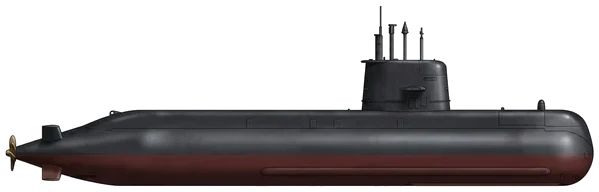
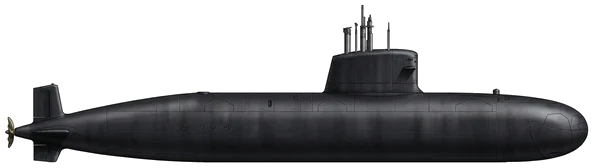
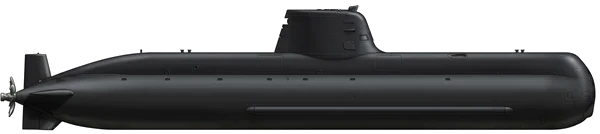
Description
The Riachuelo class is a group of Brazilian attack submarines built by the state-owned shipyard Itaguaí Construções Navais (ICN) and derived from the French Scorpène class. The class originated in a 2008 strategic partnership signed by the presidents of Brazil and France, covering four conventionally powered boats and French support for Brazil's first nuclear-powered submarine, under the programme known as PROSUB. Work began in 2010 at the Madeira Island base in Rio de Janeiro state, which serves as the development and manufacturing site. Between 2010 and 2012, 31 engineers, 25 officers and 6 civilian employees received theoretical training from DCNS at Cherbourg, France. The first steel plates for Riachuelo were cut in France, at which point technology transfer to Brazilian personnel began. By 2018 more than 400 Brazilian engineers were working on the nuclear submarine project alone.
The diesel-electric boats are longer and heavier than the French Scorpènes from which they derive, at 70.62 m and 1,900 tons against 61.7 m and 1,565 tons, with greater cargo capacity. Propulsion consists of four MTU 12V 396 SE84 diesels of 1,500 hp each and a Jeumont-Schneider EPM Magtronic electric motor of 3,909 hp driving a single shaft, with Exide Hagen batteries. Test depth is 400 m. Sensors comprise the Naval Group SUBTICS combat management system, Thales TSM 2233 Eledone hull and flank passive sonar arrays, a Thales Safare/S-Cube hull active sonar, and a Safran Series 20 target identification and classification system. Electronic warfare equipment includes Thales DR 3000/ITT AR 900 electronic support measures, Naval Group Contralto-S decoy launchers and CANTO anti-torpedo countermeasures. Armament is carried through six 533 mm torpedo tubes, with a load of eight SM39 Exocet anti-ship missiles, 18 F21 heavyweight torpedoes and 30 naval mines. Unit cost is approximately US$1 billion for the diesel-electric boats.
A fifth submarine, Álvaro Alberto (SN10), is to be nuclear-powered and shares much of its design with the diesel-electric boats. It is to displace 6,000 tons on a length of 100 m and a beam of 9.8 m, the wider hull accommodating a pressurized water reactor using 20 per cent low-enriched uranium. A 48 MW fully electric propulsion arrangement drives a single shaft. The reactor core contains all fuel required for the vessel's life cycle, removing the need for fuel imports. Unit cost is estimated at US$3.8 billion, with launch planned for 2037.
Names for the conventional boats commemorate Imperial Brazilian Navy operations of the Paraguayan War and the Platine War, together with Admiral Alfredo Karam; the nuclear boat honours Vice Admiral and scientist Álvaro Alberto da Motta e Silva. Riachuelo (S40) was launched on 14 December 2018 and commissioned on 1 September 2022. Humaitá (S41) followed on 11 December 2020 and 12 January 2024, and Tonelero (S42) on 27 March 2024 and 26 November 2025. Almirante Karam (S43) was launched on 26 November 2025 and is undergoing sea trials, with commissioning expected in 2026. In May 2026, Humaitá exercised with the US Navy carrier USS Nimitz (CVN-68) and the destroyer USS Gridley (DDG-101) off Rio de Janeiro during the Southern Seas 2026 exercises.
Frequently Asked Questions
What type of ship is the Riachuelo-class?
What is the displacement of the Riachuelo-class?
How many crew members serve on the Riachuelo-class?
How many Riachuelo-class ships have been built?
Which countries operate the Riachuelo-class?
How much does a Riachuelo-class cost?
- SEP 52026 Created Riachuelo-class submarine page created (specs, description, Brazilian Navy inventory linked)