BMP-1
Summary
| Origin country | 🇷🇺 Russia |
| Category | Infantry Fighting Vehicle |
| Sub-type | Infantry fighting vehicle |
| Manufacturer | Kurgan Machine Building Works |
| Number built | 20000 units |
Technical specifications
| Crew | 3 + 8 passengers personnels |
| Range | 600 km |
| Mass | 13.2 tons |
| Height | 2.068 m (6.8 ft) |
| Width | 2.94 m (9.6 ft) |
| Length | 6.735 m (22.1 ft) |
| Max. speed | 65 km/h (40 mph) |
| Engine | UTD-20 6-cylinder diesel, 300 hp |
| Weapon 1 | 73 mm 2A28 Grom smoothbore gun |
| Weapon 2 | 9M14 Malyutka ATGM launcher |
| Weapon 3 | 7.62 mm PKT coaxial machine gun |
Historical operators
Profile of BMP-1
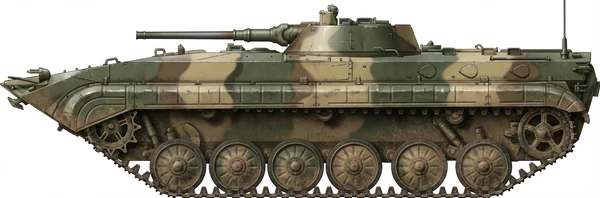
Description
The BMP-1 (Boyevaya Mashina Pyekhoty 1) is a Soviet amphibious tracked infantry fighting vehicle that entered service in 1966. Developed in the late 1950s, the design combined the characteristics of an armored personnel carrier and a light tank. Soviet military doctrine required a vehicle that allowed infantry to operate within an armored, radiation-shielded interior during nuclear, chemical, or biological warfare. This replaced the "battle taxi" concept with a system where infantry could engage targets from within the vehicle. The tracked Object 764 prototype was built in 1964, followed by the Object 765, which was accepted for service in 1966.
The vehicle utilizes a welded steel hull with a front-mounted engine and a rear troop compartment. The driver and commander are positioned in a tandem layout on the left side of the hull. Main armament consists of a 73mm 2A28 Grom low-pressure smoothbore gun and a coaxial 7.62mm PKT machine gun. Original models featured a rail launcher for 9M14 Malyutka anti-tank guided missiles. The BMP-1P modernization replaced this with a 9P135M launcher for Konkurs or Fagot missiles. The rear compartment carries eight soldiers seated on central benches, with firing ports and fume extractors provided for individual weapons.
Armor protection consists of welded rolled steel designed to withstand 23mm armor-piercing rounds across the frontal arc and 7.62mm rounds on the sides and rear. The vehicle is fully amphibious, using its tracks for propulsion in water after erecting a frontal trim vane. Combat experience in the Soviet–Afghan War identified vulnerabilities to anti-tank mines and RPGs, leading to the BMP-1D variant, which featured appliqué armor and reinforced floor plating but lacked amphibious capability. Recent Russian modernizations include the BMP-1AM Basurmanin, which replaces the original turret with a BTR-82A turret armed with a 30mm 2A72 autocannon.
The BMP-1 has been widely exported and produced under license in several countries, including Czechoslovakia, Romania, and India. China produced an unlicensed version designated as the Type 86. Major operators include Russia, India, Poland, and China. The vehicle first saw combat during the 1973 Yom Kippur War with Egyptian and Syrian forces. It was used extensively during the Soviet–Afghan War, the Syrian Civil War, and the Russian-Ukrainian War. In local conflicts, the vehicle's thin side armor and the proximity of fuel storage to the troop compartment have been noted as design limitations, often resulting in personnel riding on the exterior of the hull in combat zones.