BMP-1 vs BMP-2
BMP-1 vs BMP-2 at a glance — weight 13,200 vs 14,300 kg, top speed 65 vs 65 km/h, range 600 vs 600 km, crew 3 + 8 passengers vs 3 (commander, gunner, driver) + 7 troops.
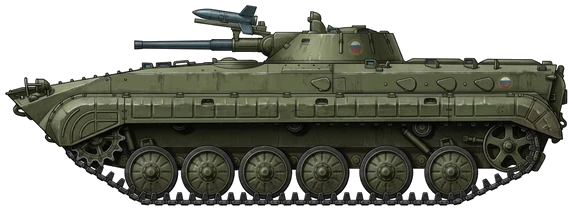
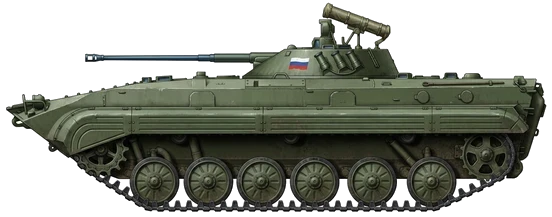
| BMP-1 | BMP-2 | |
|---|---|---|
| Origin country | 🇷🇺 Russia | 🇷🇺 Russia |
| Category | Infantry Fighting Vehicle | Infantry Fighting Vehicle |
| Type | Infantry fighting vehicle | Infantry Fighting Vehicle |
| Manufacturer | Kurgan Machine Building Works | Kurganmashzavod |
| Number produced | 20,000 units | 20,000 units |
| Estimated unit price | $-- million | $-- million |
| Combat weight | 13.2 tons | 14.3 tons |
| Maximum speed | 65 km/h | 65 km/h |
| Operational range | 600 km | 600 km |
| Length | 6.74 m | 6.72 m |
| Width | 2.94 m | 3.15 m |
| Height | 2.07 m | 2.45 m |
| Crew | 3 + 8 passengers | 3 (commander, gunner, driver) + 7 troops |
Detailed Comparison
The Kurganmashzavod BMP-1 and BMP-2 illustrate the evolution of Soviet mechanized infantry doctrine from nuclear battlefield survivability to high-volume conventional fire support. Introduced in 1966, the BMP-1 prioritized NBC protection and heavy anti-armor capability via a low-pressure gun. Fourteen years later, the BMP-2 shifted focus to autocannon rate of fire, weapon elevation, and crew situational awareness, directly addressing the tactical shortcomings of its predecessor identified in the Middle East. Both vehicles share the same foundational chassis but provide divergent solutions to infantry integration.
Development and Design
The BMP-1 originated in the late 1950s to satisfy a doctrine requiring infantry to fight from within an NBC-shielded envelope. It seated the commander behind the driver in the hull, creating a blind spot on the right side and isolating the commander from the gunner. The BMP-2, accepted into service in 1980, corrected this by introducing a two-man turret, relocating the commander alongside the gunner. This reduced the dismount capacity from eight to seven but improved command and control, target acquisition, and 360-degree observation.
Protection and Firepower
Both vehicles rely on welded rolled steel hulls, vulnerable to .50 caliber armor-piercing rounds and RPGs, especially along the flanks where rear doors double as fuel cells. The divergence lies in armament:
- The BMP-1 mounts the 73mm 2A28 Grom smoothbore gun and the 9M14 Malyutka ATGM. The Grom is inaccurate beyond 500 meters and lacks the elevation to engage targets in multi-story buildings or ridges.
- The BMP-2 utilizes the dual-feed 30mm 2A42 autocannon. It provides a 74-degree elevation angle, capable of suppressing infantry in elevated positions and engaging slow-flying aircraft.
- The BMP-2 relies on the roof-mounted 9P135M launcher for 9M113 Konkurs missiles, replacing the Malyutka's manual guidance with semi-automatic command to line of sight (SACLOS).
Mobility and Logistics
Both IFVs possess a 600 km operational range and a 65 km/h top speed, propelled by variations of the same diesel engine: the 300-hp UTD-20 in the 13.2-ton BMP-1 and the UTD-23 in the 14.3-ton BMP-2. Maintenance logistics are highly standardized across former Warsaw Pact states. Both utilize hydrodynamic fairings and track motion for water propulsion. However, field-expedient armor upgrades in Afghanistan and Ukraine—designated BMP-1D and BMP-2D—pushed both vehicles past their buoyancy limits, nullifying amphibious operations in favor of basic survivability against mines.
Deployment and Combat Record
The BMP-1 first saw combat with Syrian and Egyptian forces in 1973, where its 73mm gun struggled and its side armor failed against heavy machine guns. In Afghanistan, both vehicles suffered losses to mines and anti-tank weapons, forcing troops to ride on the exterior roof. In the Russo-Ukrainian War, both IFVs are deployed in mass. Russian forces increasingly rely on the BMP-1AM Basurmanin modernization, which grafts a BTR-82A 30mm turret onto the BMP-1 hull, mimicking the BMP-2's autocannon capabilities.
Conclusion
The BMP-2 provides better tactical utility and lethality. The BMP-1's one-man turret, poor ergonomics, and low-velocity 73mm gun render it obsolete for modern peer-to-peer conflict. The BMP-2's two-man turret, high-elevation 30mm autocannon, and improved command layout provide the necessary volume of fire and situational awareness for urban and trench assaults. While neither vehicle survives modern top-attack munitions or heavy ATGMs, the BMP-2 remains a viable fire support platform, whereas the base BMP-1 functions primarily as a delivery chassis requiring an immediate turret replacement to remain combat-relevant.