GTK Boxer
Summary
| Origin country | 🇩🇪 Germany |
| Category | Armored Personnel Carrier |
| Sub-type | 8x8 Armored Personnel Carrier |
| Manufacturer | ARTEC |
| Number built | 472 units |
| Est. avg unit price | $5 million |
Technical specifications
| Crew | 2 personnels |
| Range | 1050 km |
| Mass | 36.5 tons |
| Height | 2.37 m (7.8 ft) |
| Width | 3.0 m (9.8 ft) |
| Length | 7.93 m (26.0 ft) |
| Max. speed | 103 km/h (64 mph) |
| Engine | Turbo-Diesel Engine with 710 hp |
| Weapon 1 | 1 Mk-19 40mm grenade launcher |
| Weapon 2 | 1 MAG 7.62mm machine gun |
Historical operators
Profile of GTK Boxer
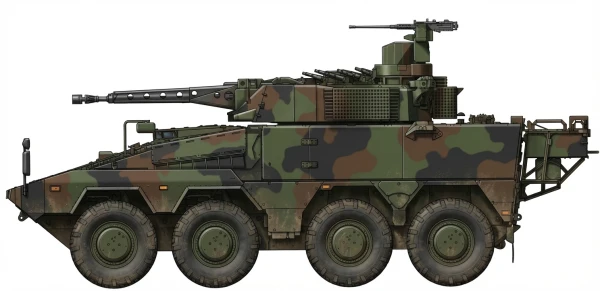
Description
The Boxer program originated in 1993 as a joint venture between Germany and France, with the United Kingdom joining in 1996. Following the withdrawal of France in 1999 to pursue a domestic design, the Netherlands joined the consortium in 2001. The program is managed by the Organisation for Joint Armament Cooperation (OCCAR) and executed by the ARTEC GmbH industrial group, a consortium comprising Rheinmetall and KNDS Deutschland. The vehicle was officially named in 2002, and the first production models were delivered to the German Army in 2009. The United Kingdom, which had withdrawn in 2003, rejoined the program in 2018.
The vehicle utilizes a modular design consisting of a permanent drive module and interchangeable mission modules. The drive module contains the eight-wheel drive system, steering, and a powerpack consisting of an MTU diesel engine coupled to an Allison automatic transmission. Mission modules are pod-like units attached to the drive module by four points, allowing reconfiguration for different roles in under one hour. Drive modules have evolved through several iterations, including the A1, A2, and A3, as well as the B0 Future Common Drive Module and the C0 module for specialized variants.
Armor protection consists of rolled all-welded steel fitted with appliqué modules. The hull features a triple-layered floor in a v-shaped configuration to provide protection against mines and improvised explosive devices. Internal survivability is supported by spall liners and crew seats decoupled from the floor to mitigate shock. Firepower is determined by the specific mission module. Common configurations utilize remote weapon stations armed with 7.62mm or 12.7mm machine guns or 40mm automatic grenade launchers. More heavily armed variants utilize turrets equipped with 30mm automatic cannons, such as the Lance or RCT30, or specialized systems including the Skyranger 30 for air defense and the RCH 155 for mobile artillery.
The Boxer is operated by several countries, including Germany, the Netherlands, Lithuania, and Australia. The United Kingdom and Ukraine have also ordered or received the platform, and it is in use by Qatar. In Lithuanian service, the vehicle is designated as the Vilkas. The vehicle saw operational service during the Afghanistan war with the International Security Assistance Force (ISAF) and has been deployed in the Russo-Ukrainian War. It is utilized in various roles, including infantry transport, command and control, medical evacuation, and engineering. The platform is also assigned to the NATO Response Force. In the German Army, the Boxer replaces portions of the M113 and TPz 1 Fuchs fleets, while the Australian Army utilizes it to replace the ASLAV.