Qatar Military Forces
Open-source order of battle for 2026: 16,500 active troops, 275 aircraft, 126 warships, 1,151 ground vehicles.
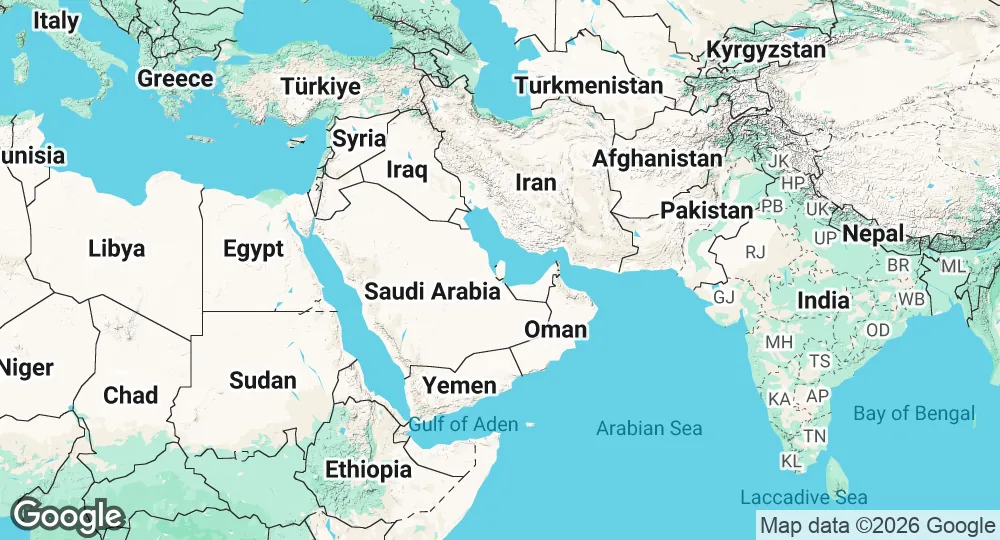

Armed Forces in 2026
| Domain | Strength | Composition |
|---|---|---|
| Qatar Emiri Air Force | 275 aircraft | 124 combat 86 helicopters +38 on order |
| Qatari Emiri Navy | 126 warships | |
| Ground Forces | 1,151 vehicles | 99 main battle tanks |
| Personnel | 16,500 active | 5,000 paramilitary |
Global Military Index
Full ranking →| Pillar | Weight | Score | Basis |
|---|---|---|---|
| Manpower | 15% | 50.9 | Active, reserve & paramilitary personnel |
| Ground forces | 20% | 47.0 | Tanks, armor & artillery weighted by type |
| Naval power | 20% | 40.5 | Weighted by hull type: carrier tiers, nuclear vs conventional submarines |
| Air power | 25% | 56.0 | Weighted by aircraft type and fleet age |
| Nuclear deterrent | 10% | 0.0 | No declared nuclear capability |
| Defense budget | 10% | 56.8 | Annual spending, purchasing-power adjusted |
| Readiness | modifier | ×1.20 | Budget per soldier: proxy for training, maintenance & technology |
Country File
| Population | 2.9M (2024) |
| GDP | $219.2 billion (2024) |
| GDP per capita | $76,689 |
| Military budget | $15.4 billion (2022) |
| Share of GDP | 6.5% (2022) |
| Share of govt spending | 26.9% (2022) |
| Military spending per capita | $5,429 (2022) |
| Inflation rate | 1.27% (2024) |
| Capital | Doha |
| Region | Asia |
| Land area | 11,586 km² |
| Coastline | 563 km |
| Land borders | 60 km |
| Bordering countries | 1 |
| Currency | QAR |
Strategic Overview in 2026
Strategic Position
Qatar occupies a peninsula on the western coast of the Persian Gulf, bordering Saudi Arabia to the south and maintaining maritime boundaries with Bahrain, Iran, and the United Arab Emirates. Its defense posture is centered on the protection of its hydrocarbon infrastructure, specifically its liquified natural gas (LNG) production and export facilities, and the maintenance of its sovereign territory within a complex regional security environment.
The state operates under a series of bilateral and multilateral defense frameworks. In January 2022, the United States designated Qatar as a Major Non-NATO Ally (MNNA). This partnership is centered on Al-Udeid Air Base, which hosts the forward headquarters of U.S. Central Command (CENTCOM) and the Combined Air Operations Center (CAOC). In May 2025, a new bilateral declaration of intent was signed, outlining potential investments exceeding $38 billion to upgrade military infrastructure and develop future defense capabilities.
Qatar also maintains a strategic defense relationship with Turkey. The Khalid bin al-Walid Camp hosts the Tariq bin Ziyad Battalion, a permanent Turkish military presence. In late 2025, Qatar and Turkey expanded this cooperation through new memoranda of understanding focused on defense industry integration and experience sharing in strategic development planning. Qatar is also a member of the Gulf Cooperation Council (GCC) and participates in regional security initiatives, including the "Gulf Shield" military exercises.
Military Forces
The Qatar Armed Forces (QAF) consist of the Qatari Emiri Land Force, the Qatar Emiri Air Force, the Qatari Emiri Navy, the Qatar Amiri Guard, and specialized units for special operations and cyber defense. Active-duty personnel numbers are approximately 16,000–25,000, supplemented by a mandatory national service program for male citizens.
Qatari Emiri Land Force (QELF) The Land Force is structured around armored, mechanized, and artillery units. Primary equipment includes Leopard 2A7+ main battle tanks, VBCI infantry fighting vehicles, and PzH 2000 self-propelled howitzers. Reconnaissance and light transport capabilities are provided by Fennek and various Turkish-made armored vehicles, such as the Ejder Yalçın and Kirpi.
Qatar Emiri Air Force (QEAF) The QEAF has undergone a multi-platform expansion. Its fighter fleet operates three distinct types: the Dassault Rafale, the F-15QA (Ababil), and the Eurofighter Typhoon. In 2025, Qatar initiated a program to upgrade the Rafale fleet to the F4 standard. Strategic airlift is maintained through a fleet of C-17 Globemaster III and C-130J Super Hercules aircraft. Rotary-wing assets include AH-64E Apache Guardian attack helicopters, alongside NH90 and AW139 multi-role helicopters. Pilot training is conducted using PC-21 and M-346 aircraft, with a dedicated training facility for F-15 pilots established at Mountain Home Air Force Base in the United States.
Qatari Emiri Naval Forces (QENF) The navy focuses on maritime domain awareness and coastal defense. Modernization is driven by a contract with Fincantieri, which has delivered Al Zubarah-class corvettes and Musherib-class offshore patrol vessels (OPVs). The fleet includes the Al Fulk, an 8,800-ton amphibious transport dock equipped for integrated air defense. Additional capabilities are provided by Turkish-built fast attack craft (FAC 50) and training ships.
Specialized Capabilities Integrated air and missile defense is a priority, utilizing Patriot PAC-3 and NASAMS batteries. In January 2026, the Middle Eastern Air Defense – Combined Defense Operations Cell (MEAD-CDOC) was opened at Al-Udeid Air Base to coordinate regional air and missile defense efforts.
Defense Industry
Qatar’s domestic defense sector is led by Barzan Holdings, a state-owned entity established to manage procurement, research, and development. Barzan Holdings operates through joint ventures with international partners to localize production and technology transfer.
Domestic capabilities include the assembly of light armored vehicles and the production of small arms and ammunition through Barzan Industrial Group and its subsidiaries. In 2025, Barzan Holdings expanded its export footprint by signing agreements to supply rifles and ammunition to the Indonesian military. The company is also developing a local ammunition factory in Indonesia through a joint venture. Current research priorities focus on autonomous systems, including unmanned surface vehicles (USVs) and unmanned ground vehicles (UGVs), as well as military artificial intelligence and electronic warfare systems.
Strategic Trends
The QAF is transitioning toward the "Defence Strategy 2025–2030," launched in December 2025. This strategy emphasizes digital sovereignty, technological resilience, and the integration of autonomous platforms. Procurement priorities have shifted toward unmanned aerial systems (UAS), including the MQ-9B SkyGuardian, and counter-UAS technologies, evidenced by a $1 billion agreement with Raytheon signed in late 2025.
A primary constraint remains the limited pool of domestic personnel, necessitating a continued reliance on foreign technical expertise for maintenance and specialized training. To address this, current programs focus on "national talent development" to increase the number of Qatari citizens in high-technology roles. Defense spending remains a high priority, sustained by consistent hydrocarbon revenues, with a focus on burden-sharing for the operation of international bases on Qatari soil.
Qatari Defense Manufacturing
Designed in QatarFrequently Asked Questions
How large is Qatar's military?
What is Qatar's defense budget?
How does Qatar rank militarily in the world?
Does Qatar have nuclear weapons?
How many aircraft does Qatar's air force have?
How large is Qatar's navy?
How many tanks does Qatar have?
What percentage of GDP does Qatar spend on defense?
What is Qatar's military personnel per capita?
Does Qatar have paramilitary forces?
Military Expenditure: information from the Stockholm International Peace Research Institute (SIPRI) Military Expenditure Database. Suggest a change