Jackal
The Jackal is a British light patrol vehicle introduced in 2008 for reconnaissance and fire support, distinguished by its open cabin and height-adjustable air suspension. Key figures: weight 7.6 t, top speed 130 km/h, range 800 km. In service with 2 armies — United Kingdom (723), Denmark (15).
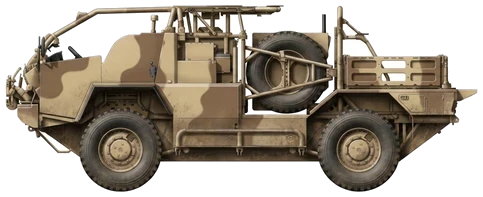
| Sub-type | Light patrol and fire support vehicle |
| Crew | 4 (3 on the Jackal 1) personnels |
| Range | 800 km |
| Mass | 7.6 tons |
| Height | 1.97 m (6.5 ft) |
| Width | 2.0 m (6.6 ft) |
| Length | 5.39 m (17.7 ft) |
| Max. speed | 130 km/h (81 mph) |
| Engine | Cummins 6.7-litre six-cylinder diesel (5.9 L ISBe on the Jackal 1) |
| Weapon 1 | 12.7 mm M2 heavy machine gun |
| Weapon 2 | 7.62 mm general purpose machine gun |
| Weapon 3 | 40 mm automatic grenade launcher |
Description
The Jackal, also designated MWMIK (Mobility Weapon-Mounted Installation Kit), is a family of light patrol vehicles designed by Supacat Ltd at Honiton, Devon, for the British Army and RAF Regiment. It was procured as an Urgent Operational Requirement to give British forces in Afghanistan an off-road patrol and fire-support vehicle, supplementing the Land Rover Wolf WMIK and replacing the Snatch Land Rover, which resisted small-arms fire but was vulnerable to improvised explosive devices and was described in the British press as a "mobile coffin". Its assigned roles are deep battlespace reconnaissance, rapid assault, fire support and convoy protection.
The design is based on the HMT (High Mobility Transporter) 400 4×4 platform developed by a former Supacat subsidiary and built under licence from Lockheed Martin. The chassis is produced by Universal Engineering, the engine by Cummins, the transmission by Allison, the suspension dampers by Fox Racing Shox, and the electronics by Fujitsu and Smartgauge Electronics. Blast and ballistic protection packages and the blast-mitigating seats were developed by Jankel Armouring, comprising armour plating beneath the crew compartment and along the vehicle sides. Height-adjustable air suspension can be lowered onto the bump-stops to form a stable firing platform or raised to clear obstacles. The cabin roof is open for observation, the design trading enclosed protection for mobility, visibility and weapon stand-off. Armament options include a 12.7 mm heavy machine gun, 7.62 mm general purpose machine gun and 40 mm automatic grenade launcher. Unrefuelled endurance exceeds 800 km.
Small batches are built at Honiton, with larger production runs by DML (Babcock Marine Services) at Plymouth. An initial order for up to 100 vehicles was followed by 72 more in June 2008 and 140 in June 2010.
The Jackal 2, ordered in April 2009 alongside 70 Coyotes and in service from July that year, increased the crew to four, moved the gun ring forward for all-round arcs of fire, adopted an uprated chassis for greater payload and armour, and fitted a larger 6.7-litre engine. The Jackal 2A adds a blast protection upgrade. The Coyote tactical support vehicle uses the six-wheeled HMT 600 chassis as a complementary load carrier and artillery tractor. The Jackal 3, introduced in summer 2024, is based on the HMT Extenda Mk3, convertible between 4×4 and 6×6 by inserting a third axle; 70 were ordered in February 2024 and 53 six-wheeled examples in September 2024, most built at Babcock's Devonport facility and the remainder at Supacat's Dunkeswell site.
The type entered operational service on 8 April 2008 during Operation Herrick with 16 Air Assault Brigade and 3 Commando Brigade. Off-road performance drew favourable comment, but by August 2009 thirteen British soldiers had been killed while aboard Jackals, prompting press criticism of the vehicle as a "deathtrap". During the September 2012 raid on Camp Bastion an RPG struck an RAF Regiment Jackal, wounding its crew.
Following Army 2020 the Jackal equips three light cavalry regiments. It has served with the Light Dragoons in Poland under NATO's Enhanced Forward Presence since 2016, and with the Light Dragoons and 1st The Queen's Dragoon Guards in Mali on Operation Newcombe in 2021. Four Jackal 2s were loaned to Estonian special forces for operations in Mali between 2020 and 2021.
Frequently Asked Questions
What type of vehicle is the Jackal?
What is the weight of the Jackal?
What is the maximum speed of the Jackal?
What is the operational range of the Jackal?
How many crew members does the Jackal require?
What weapons does the Jackal carry?
- AUG 292026 Created Jackal page created, covering the Supacat HMT 400/600 family from the Jackal 1 to the Jackal 3 and the Coyote