VBL
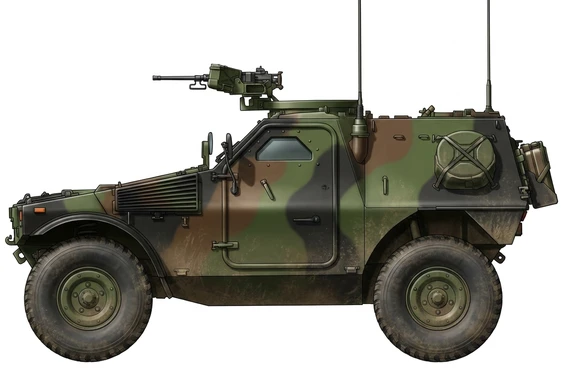
Introduced in France in 1990, the VBL is a light 4x4 reconnaissance vehicle featuring waterjet-powered amphibious capability. Key figures: weight 4 t, top speed 95 km/h, range 600 km, built 2,600. In service with 5 armies — France (1,343), Oman (124), Mexico (40) and 2 others.
| Sub-type | Light armoured vehicle |
| Range | 600 km |
| Mass | 4.0 tons |
| Max. speed | 95 km/h (59 mph) |
| Engine | 130 hp (97 kW) diesel engine |
Description
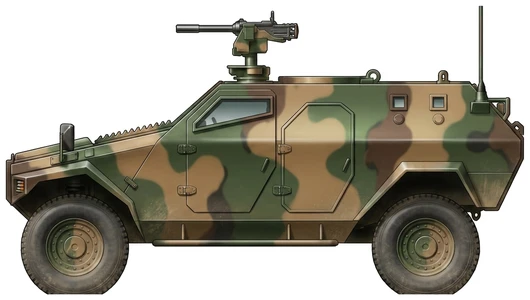
The Panhard Véhicule Blindé Léger (VBL) is a French wheeled 4×4 all-terrain light armored vehicle developed to fulfill French Army requirements for a light reconnaissance and anti-tank vehicle to operate alongside the AMX-10 RC and replace the Hotchkiss M201 jeep. Development began in 1978, with competitive trials between Panhard and Renault prototypes starting in 1982. Mexico ordered the Panhard model in 1984, becoming its first operator. France selected the vehicle in 1985, launching preproduction before its active operational entry in 1990. Serial production took place at Marolles-en-Hurepoix between 1985 and 2010.
Designed to combine off-road agility with protection against small arms fire, artillery fragments, mines, and NBC hazards, the VBL features a forward motor bay that provides additional protection to the rear crew compartment. The vehicle incorporates civilian mechanical components, including a Peugeot turbo-diesel engine, while later variants such as the VBL Mark 2 and VBL Ultima utilize updated engines. Standard production models are amphibious and can be transported by cargo aircraft, dropped by parachute, or carried underslung by heavy helicopters.
The VBL is produced in standard and lengthened chassis configurations. Reconnaissance variants carry a two-man crew and are armed with 7.62 mm or 12.7 mm machine guns, or 40 mm automatic grenade launchers. Anti-tank variants carry a three-man crew and deploy MILAN, TOW, or Eryx missiles. Other specialized configurations include command post vehicles fitted with radios and auxiliary batteries, ALBI-MISTRAL air defense platforms, and urban warfare variants.
The VBL was exported to multiple nations across Europe, Africa, the Middle East, Asia, and Central America. The French Army deployed the vehicle in peacekeeping and combat operations, including missions in Lebanon, Bosnia, Rwanda, Kosovo, Ivory Coast, Afghanistan, the Central African Republic, and Mali. During the Siege of Sarajevo, its use as transport for United Nations commanders earned it the nickname "Sarajevo Taxi."
Other military forces have operated the VBL in various regional conflicts. Mexican forces deployed the vehicle during the Chiapas conflict. Portuguese and Greek forces used VBLs for escort, reconnaissance, and checkpoint duties during NATO operations in Kosovo and North Macedonia. In Africa, Djiboutian forces used armored VBLs to resist ambushes during the Djiboutian Civil War, while the Nigerian Army deployed them during the Sierra Leone Civil War and operations against Boko Haram. Captured vehicles were also used by opposing forces during conflicts in Bosnia, Rwanda, and the Democratic Republic of the Congo.
Frequently Asked Questions
What type of vehicle is the VBL?
What is the weight of the VBL?
What is the maximum speed of the VBL?
What is the operational range of the VBL?
How many VBL have been built?
- AUG 22026 Created Page created: VBL