K9 Thunder
Summary
| Origin country | 🇰🇷 South Korea |
| Category | Self-Propelled Artillery |
| Sub-type | 155 mm self-propelled howitzer |
| Manufacturer | Hanwha Aerospace |
| Number built | 1136 units |
| Est. avg unit price | $3.1 million |
Technical specifications
| Crew | 3 (2 in emergency) personnels |
| Mass | 48.5 tons |
| Max. speed | 67 km/h (42 mph) |
| Engine | 1,000 hp STX Engine SMV1000 diesel engine |
| Weapon 1 | CN98 155 mm, 52-calibre artillery gun |
| Weapon 2 | Remote controlled weapon station (RCWS) |
Historical operators
Profile of K9 Thunder
Description
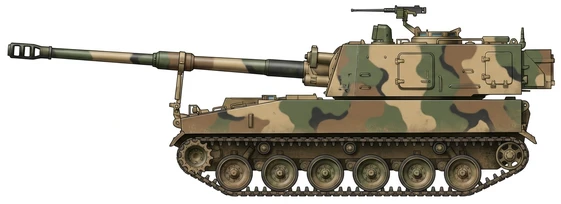
The Republic of Korea Armed Forces initiated the development of the K9 Thunder in the late 1980s to counter North Korean long-range artillery assets. Led by the Agency for Defense Development and Samsung Aerospace Industries, the project aimed to replace M107 and K55 systems with a platform offering longer firing ranges and higher rates of fire. Conceptual modeling was finalized in 1991, with domestic development prioritized after the evaluation of international systems. Technical milestones included the testing of mobility rigs in 1992 and the completion of the first prototypes in 1996. The system officially finished development in October 1998, with the first units delivered to the Republic of Korea Marine Corps in 1999 following border tensions.
The K9 is of welded construction using MIL-12560H armor steel, which provides protection against 152 mm shell fragments, 14.5 mm armor-piercing rounds, and anti-personnel mines. An air-purification system is integrated for crew protection against CBRN threats. The primary armament consists of a CN98 155 mm 52-caliber gun compatible with NATO standard ammunition. The vehicle features an automatic fire control system (AFCS) and a semi-automatic feeding system, enabling a burst fire rate of three rounds in 15 seconds and the ability to perform multiple rounds simultaneous impact (MRSI) missions. For mobility, the K9 utilizes a 1,000-horsepower diesel engine and a hydropneumatic suspension system designed for operation in diverse terrains, including mountainous, desert, and subarctic environments. Its "shoot-and-scoot" capability allows it to fire within 30 seconds of stopping and relocate within 30 seconds of mission completion to avoid counter-battery fire.
The system is produced in large numbers and operates in several countries, including Finland, Estonia, Norway, India, and Egypt. Turkey produces a variant designated the T-155 Firtina, while Poland uses the chassis for the AHS Krab and operates the K9PL. Australia, Romania, and Vietnam have also entered contracts for the platform. The K9 saw combat during the 2010 bombardment of Yeonpyeong, where South Korean Marine units employed the howitzers for counter-battery fire against North Korean positions. It was also deployed by the Indian Army in the Ladakh region during 2021. The fleet is undergoing upgrades to the K9A1 standard, which introduces an auxiliary power unit and GPS integration. A further variant, the K9A2, is in development featuring a fully automated loading system that reduces the crew requirement.