K9 Thunder vs M109 Paladin
K9 Thunder vs M109 Paladin at a glance — weight 48,500 vs 38,000 kg, top speed 67 vs 61 km/h, crew 3 (2 in emergency) vs 4 (section chief/commander, driver, gunner, ammunition handler/loader).
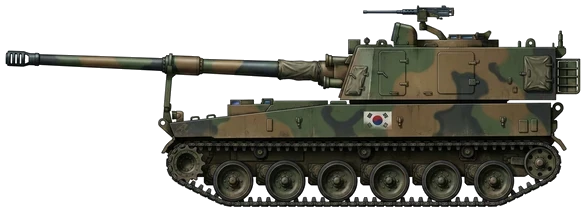
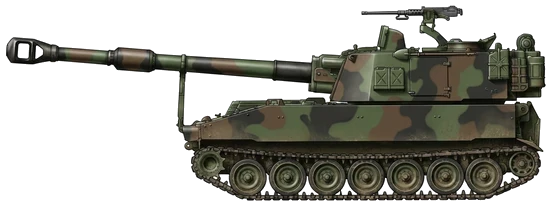
| K9 Thunder | M109 Paladin | |
|---|---|---|
| Origin country | 🇰🇷 South Korea | 🇺🇸 United States |
| Category | Self-Propelled Artillery | Self-Propelled Artillery |
| Type | 155 mm self-propelled howitzer | Self-propelled howitzer |
| Manufacturer | Hanwha Aerospace | BAE Systems |
| Number produced | 1,136 units | 7,000 units |
| Estimated unit price | $3.1 million | $14.4 million |
| Combat weight | 48.5 tons | 38.0 tons |
| Maximum speed | 67 km/h | 61 km/h |
| Operational range | -- km | 300 km |
| Length | -- m | 9.75 m |
| Width | -- m | 3.15 m |
| Height | -- m | 3.25 m |
| Crew | 3 (2 in emergency) | 4 (section chief/commander, driver, gunner, ammunition handler/loader) |
| K9 Thunder | M109 Paladin | |
|---|---|---|
| Main armament | CN98 155 mm, 52-calibre artillery gun | 155 mm M284 Cannon |
| Secondary weapon | Remote controlled weapon station (RCWS) | .50 caliber (12.7 mm) M2 machine gun |
| Engine | 1,000 hp STX Engine SMV1000 diesel engine | Detroit Diesel 8V71T diesel, 440 hp |
Detailed Comparison
South Korea’s K9 Thunder and the American M109 Paladin dictate current self-propelled artillery modernization. The M109 relies on continuous iteration of a 1960s architecture, while the K9 leverages a late-1990s clean-sheet design that commands over 50% of the contemporary self-propelled howitzer export market.
Development and Design
The M109 originated in the early 1960s to standardize U.S. mechanized artillery. Its current iteration, the M109A7, addresses obsolescence by replacing the legacy hull with Bradley Fighting Vehicle components, introducing a 600-volt power architecture and electric turret drives. The K9 emerged in 1999 from a South Korean requirement to outrange North Korean artillery. Built by Hanwha Aerospace, it was natively engineered for a 52-caliber gun and rapid displacement.
Protection and Firepower
Firepower reveals a strict mechanical divergence:
- The K9 mounts a CN98 155 mm 52-caliber gun, achieving unassisted ranges of 40 km and supporting multiple rounds simultaneous impact (MRSI) with a burst rate of three rounds in 15 seconds.
- The M109 Paladin retains a 39-caliber M284 cannon, limiting its unassisted range to 24 km (30 km with rocket-assisted projectiles).
The M109A7 integrates an automatic rammer, but lacks the K9's semi-automatic feed and the upcoming K9A2's fully automated loader. The K9’s 48.5-ton mass provides higher baseline fragmentation and MIL-12560H steel mine protection than the 38.0-ton M109.
Mobility and Logistics
The K9 uses a 1,000-horsepower STX diesel engine coupled with a hydropneumatic suspension, yielding a power-to-weight ratio of 20.6 hp/ton. This enables it to halt, fire, and relocate within 60 seconds. The legacy M109 relied on a 440-horsepower Detroit Diesel, producing 11.5 hp/ton, making it slower (61 km/h vs 67 km/h). The M109A7 upgrades to a 600-horsepower engine and simplifies U.S. Army logistics by sharing its powertrain and tracks with the Bradley fleet. At $3.1 million per unit, the K9 heavily undercuts the $14.4 million M109A7.
Deployment and Combat Record
The M109 operated extensively in Vietnam, the Yom Kippur War, and Iraq. In Ukraine, donated M109s suffer high attrition against Russian counter-battery fire and Lancet loitering munitions because their shorter range forces them closer to the frontline. The K9 engaged North Korean artillery during the 2010 Yeonpyeong bombardment and deployed to the Himalayas in 2021. Polish AHS Krabs, which utilize the K9 chassis, demonstrate higher survivability in Ukraine under intense operational tempos due to superior mobility.
Conclusion
The K9 Thunder is the objectively superior system for high-intensity, peer-level conflict. Its 52-caliber gun outranges the M109 by at least 10 kilometers—an absolute baseline requirement for surviving modern drone-directed counter-battery kill chains. The M109 remains viable for the U.S. Army strictly due to American air supremacy and Bradley fleet commonality, but its 39-caliber limitation makes it structurally obsolete for independent artillery duels.