PHL-03
The PHL-03 is a Chinese multiple rocket launcher system introduced in the early 2000s, designed for long-range indirect fire support, distinguished by its 300mm caliber rockets mounted on a 12-tube launcher. Key figures: weight 43 t, top speed 60 km/h, range 650 km. In service with 4 armies — China (175), Morocco (36), Cambodia (6) and 1 other.
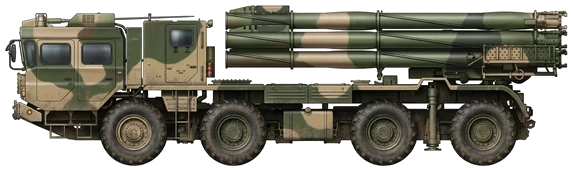
| Sub-type | Self-propelled multiple rocket launcher |
| Crew | 4 personnels |
| Range | 650 km |
| Mass | 43.0 tons |
| Height | 3.0 m (9.8 ft) |
| Width | 3.0 m (9.8 ft) |
| Length | 12.0 m (39.4 ft) |
| Max. speed | 60 km/h (37 mph) |
| Engine | Diesel engine, 500 hp |
| Weapon 1 | 12x 300 mm rocket tubes (BRC4, BRE2, Fire Dragon 140A guided rockets) |
Description
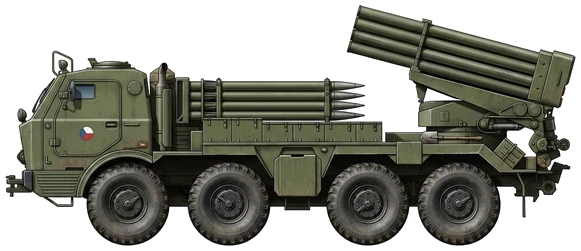
The PHL-03 is a truck-mounted 12-tube 300 mm long-range multiple rocket launcher developed for the People's Liberation Army Ground Force.
During the 1980s the PLA Ground Force sought a long-range multiple rocket launcher and opened a competition among Chinese defence corporations. Four designs were submitted: the AR-1 from the Changchun subsidiary of China North Industries Group Corporation (Norinco), the A-100 from the China Academy of Launch Vehicle Technology under China Aerospace Science and Technology Corporation (CASC), the WS-1 (Weishi) from the Sichuan 7th Academy, also under CASC, and the WM-80 from Norinco's Qiqihar subsidiary. China Aerospace Science and Industry Corporation did not enter the competition owing to time constraints, and only unveiled its own SY-400 design at the 2008 Zhuhai Airshow. The AR-1 was selected and received the military designation PHL-03.
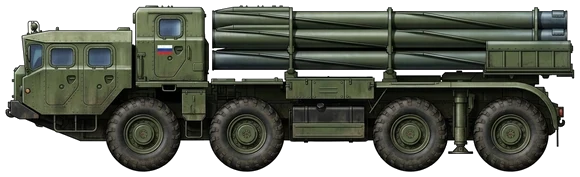
The AR-1 was the most conservative entrant, being a derivative of the Soviet BM-30 Smerch produced using reverse-engineered technology. It was not a direct copy: the two systems share neither ammunition nor fire-control compatibility. Its maturity allowed accelerated delivery to the PLA. Norinco Changchun subsequently developed the Fire Dragon guided rocket series to extend the system's capability.
The launcher retains the configuration of its Soviet predecessor, with twelve tubes for 300 mm rockets mounted on a wheeled chassis. A computerised fire-control system uses GPS, GLONASS and BeiDou satellite navigation. Intended targets include troop concentrations, airfields, command centres, air defence batteries and rear-area support facilities, along with counter-battery missions.
Ammunition comprises the 300 mm BRE family, including the BRC4, BRE2 and the guided Fire Dragon 140A, the latter credited with a range of 130 km. Rockets weigh around 800 kg with a 280 kg warhead, with maximum range varying between roughly 70 and 130 km depending on warhead type. Available warheads include high-explosive fragmentation, fuel-air explosive, and cluster types carrying anti-armour and anti-personnel submunitions, the latter including self-targeting anti-tank munitions. A full salvo can cover an area of up to 67 hectares. In October 2020 a new rocket was reported in service on the PHL-03 with a range some 30 km greater than existing types, indicating approximately 160 km.
Several variants exist. The AR-1 is the initial version. The AR-1A is a ten-round development using two five-tube launching modules. The AR-2 is an export development, while the AR-3 is an export variant able to fire either 300 mm or 370 mm rockets.
The PHL-03 serves with the People's Liberation Army Ground Force and has been exported. Operators include the Royal Moroccan Army, the Royal Cambodian Armed Forces and the Ethiopian Ground Forces; systems have also been employed by the Tigray Defense Forces. Armenia has been reported as an operator of the AR-1A.
Within the PLA the type is being succeeded by the more modular PHL-16.
Frequently Asked Questions
What type of vehicle is the PHL-03?
What is the weight of the PHL-03?
What is the maximum speed of the PHL-03?
What is the operational range of the PHL-03?
How many crew members does the PHL-03 require?
What weapons does the PHL-03 carry?
- AUG 152026 Created PHL-03 page created (specifications, overview, 5 operators)