M270 MLRS
American multiple rocket launcher system, over 1450 units built, manufactured by Lockheed Martin Vought Systems. Key figures: weight 25.191 t, top speed 72 km/h, range 483 km, unit cost $2.3M, built 1,450. In service with 15 armies — United States (991), Saudi Arabia (180), Japan (99) and 12 others.
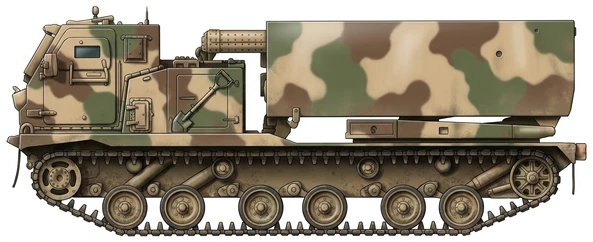
| Sub-type | Multiple Rocket Launcher System |
| Crew | 3 personnels |
| Range | 483 km |
| Mass | 25.2 tons |
| Height | n/a m ( ft) |
| Width | 3.6 m (11.8 ft) |
| Length | 6.55 m (21.5 ft) |
| Max. speed | 72 km/h (45 mph) |
| Engine | Cummins VTA-903T V8 Turbo-Diesel Engine with 500 hp |
| Weapon 1 | 12 roquettes M26 227mm. avec 644 charges M77 par roquette |
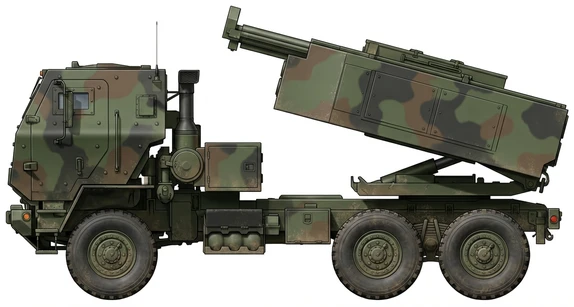
Description
The M270 Multiple Launch Rocket System is an American armored, tracked self-propelled multiple rocket launcher. Its development followed the 1973 Yom Kippur War, in which Israeli rocket artillery proved effective against rear-area targets such as surface-to-air missile sites. Until then US rocket artillery had been limited to remaining World War II-era stocks, while Soviet doctrine relied on massed truck-mounted launchers such as the BM-21. The US Army sought a system able to suppress enemy air defenses and conduct counter-battery fire, freeing cannon artillery for call-for-fire support.
Conceived as the General Support Rocket System (GSRS), the program began with a US Army Missile Command request for proposal in December 1975. Concept definition contracts went to Boeing, Emerson Electric, Martin Marietta, Northrop and Vought in March 1976, with Boeing Aerospace and Vought selected for prototype development in September 1977. In July 1979 the United States, West Germany, France and the United Kingdom signed a memorandum of understanding on joint development and production, and the program was redesignated MLRS in November 1979. Prototypes were evaluated between December 1979 and February 1980, and the Vought design was selected in May 1980. First production models were delivered in August 1982, and the first units reached the 1st Infantry Division in early 1983. European production began deliveries in 1989. Around 1,300 launchers were built in the United States and Western Europe; production ended in 2003 with a final batch for Egypt.
The vehicle consists of the M269 Launcher-Loader Module mounted on the M993 carrier, a lengthened derivative of the Bradley Fighting Vehicle chassis. Two interchangeable pods are carried, each holding six 227 mm rockets or one ATACMS missile; types cannot be mixed. All twelve rockets or two missiles can be fired in under a minute, with reloading by an integrated winch. Cold War doctrine called for dispersed shoot-and-scoot tactics to evade Soviet counter-battery fire. A single launcher firing twelve M26 cluster rockets could saturate one square kilometre, giving rise to the British nickname "grid square removal system". The M270A1 introduced the Improved Fire Control System and improved launcher mechanical system; the M270B1 added an enhanced armor package for the British Army; MARS II, LRU and MLRS-I are European variants using the European Fire Control System, which blocks submunition rockets to comply with the Convention on Cluster Munitions. The M270A2 adds the Common Fire Control System for the Precision Strike Missile, a new engine and rebuilt transmission.
First combat use came in the 1991 Gulf War, where over 230 US and 16 British launchers were deployed. Battery A, 6th Battalion, 27th Field Artillery fired eight ATACMS at Iraqi SAM sites on 18 January 1991; 4-27 FA fired 312 rockets in a single night mission in February. Roughly 6,000 MLRS rockets and 32 ATACMS were fired during the war. The system was used in the 2003 invasion of Iraq, by British forces in Helmand from 2007, by France in Mali during Operation Barkhane in 2016, and by Israel in the Gaza Strip. Ukraine received launchers from the United Kingdom, Germany, France, Norway and Italy from July 2022, employing GMLRS and ATACMS against Russian artillery, air defenses and aircraft.
Frequently Asked Questions
What type of vehicle is the M270 MLRS?
What is the weight of the M270 MLRS?
What is the maximum speed of the M270 MLRS?
What is the operational range of the M270 MLRS?
How many crew members does the M270 MLRS require?
How many M270 MLRS have been built?
What weapons does the M270 MLRS carry?
- AUG 302026 Updated Description updated
- JUL 272026 Updated M270 MLRS: service entry year added; M270 MLRS: service status added
- APR 72026 Updated Description added
- MAR 242026 Updated Category updated
- JAN 242026 Updated Cost added
- JAN 172026 Updated Description added