K239 Chunmoo
Introduced in 2015, the South Korean K239 Chunmoo is a multiple launch rocket system capable of firing various calibers of munitions from dual interchangeable launcher pods. Key figures: weight 31 t, top speed 80 km/h, range 450 km, unit cost $2.94M, built 356. In service with 3 armies — South Korea (367), Poland (174), United Arab Emirates (12).
| Sub-type | Self-propelled multiple launch rocket system |
| Crew | 3 (K239L launcher vehicle); 2 (K239T ammunition support vehicle) personnels |
| Range | 450 km |
| Mass | 31.0 tons |
| Height | 3.3 m (10.8 ft) |
| Width | 2.9 m (9.5 ft) |
| Length | 9.0 m (29.5 ft) |
| Max. speed | 80 km/h (50 mph) |
| Engine | HD Hyundai Infracore DV11K 6-cylinder diesel, 450 hp |
| Weapon 1 | K33 131 mm unguided rockets |
| Weapon 2 | KM26A2 230 mm rockets |
| Weapon 3 | 239 mm chunmoo guided rockets (CGR-080) |
| Weapon 4 | CTM-290 tactical ballistic missile |
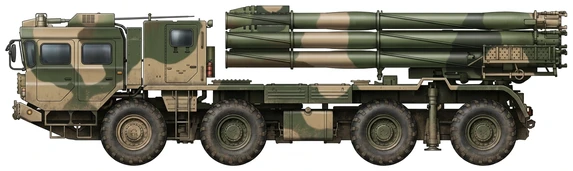
Description
The K239 Chunmoo is a South Korean self-propelled multiple launch rocket system developed to replace the K136 Kooryong. Development began in 2009 as a defense program led by private industry and funded by the Defense Acquisition Program Administration. Development was completed in 2013, with initial production commencing in 2014. Deployment with the Republic of Korea Army began in 2015, followed by deployments to Yeonpyeong Island and Baengnyeong Island with the Republic of Korea Marine Corps in 2016.
The system is mounted on an 8×8 truck chassis fitted with an armored cab that protects a three-person crew against small arms fire and artillery shell fragments, in addition to providing NBC protection. Vehicle mobility features include an anti-lock braking system, run-flat tires, and a central tire inflation system. Strategic transport inside C-130 aircraft is possible after removing the vehicle's tires and wheels. Each launcher operates alongside a K239T Ammunition Support Vehicle built on the same 8×8 chassis, which carries four reload pods. Operational batteries also utilize K200A1 armored vehicles for command support.
The artillery platform uses demountable launch pods rather than fixed launch rails, allowing two rocket pods to transport and fire different types of ammunition simultaneously. The launcher is compatible with 131 mm unguided rockets reaching a range of 36 kilometers, 230 mm unguided rockets reaching 45 kilometers, and 239 mm GPS-guided rockets with a range of 80 kilometers. The 239 mm guided rockets employ either penetrating high-explosive warheads designed for bunker destruction or cluster warheads filled with bomblets for area suppression. The platform can also be integrated with tactical ballistic missiles, such as the CTM-290, which extends engagement ranges to 290 kilometers. Rockets are fired from inside the armored cab or via a remote fire control device. An integrated load-lifting device allows full reload of two pods in seven to ten minutes.
The K239 operates with the armed forces of South Korea, the United Arab Emirates, Saudi Arabia, and Poland. The Polish variant, designated Homar-K, integrates the South Korean launcher module onto a Jelcz 8×8 chassis configured with the TOPAZ combat management system. Additional procurement contracts have been signed by Estonia and Norway, while variant concepts include a lighter single-pod launcher developed for amphibious and air-transportable operations.
Frequently Asked Questions
What type of vehicle is the K239 Chunmoo?
What is the weight of the K239 Chunmoo?
What is the maximum speed of the K239 Chunmoo?
What is the operational range of the K239 Chunmoo?
How many crew members does the K239 Chunmoo require?
How many K239 Chunmoo have been built?
What weapons does the K239 Chunmoo carry?
- AUG 42026 Updated Number built added
- AUG 22026 Created Page created: K239 Chunmoo