Wiesel
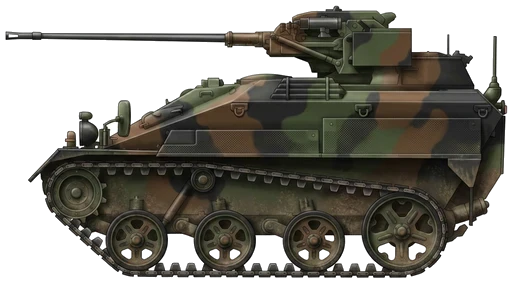
The Wiesel is a German air-transportable tracked armoured weapons carrier introduced in 1990, used primarily for airborne reconnaissance and fire support, notably light enough for helicopter transport. Key figures: weight 2.75 t, top speed 70 km/h, range 200 km, built 491. In service with 1 army — Germany (211).
| Sub-type | Armoured weapons carrier |
| Crew | 2-3 (driver, gunner, commander depending on variant) personnels |
| Range | 200 km |
| Mass | 2.8 tons |
| Height | 1.82 m (6.0 ft) |
| Width | 1.82 m (6.0 ft) |
| Length | 3.55 m (11.6 ft) |
| Max. speed | 70 km/h (43 mph) |
| Engine | Audi 2.1 L diesel, 64 kW (86 hp) |
| Weapon 1 | 20 mm Rheinmetall Mk 20 Rh 202 autocannon (KUKA E6-II-A1 turret) |
| Weapon 2 | BGM-71 TOW anti-tank guided missiles (Wiesel 1 TOW) |
| Weapon 3 | Spike anti-tank guided missiles (Wiesel 1 MELLS) |
| Weapon 4 | FIM-92 Stinger launchers or 120 mm mortar (Wiesel 2) |
Description
The Wiesel is a light, air-transportable armoured weapons carrier (Waffenträger) manufactured by Rheinmetall for the German Bundeswehr. It originated in a 1970s West German requirement for a vehicle capable of giving airborne infantry the means to engage main battle tanks, a role for which the Bundeswehr's parachute units were then considered ill-equipped. The specification called for a vehicle small enough to fit inside standard NATO transport aircraft, potentially air-droppable, and able to engage infantry, armour and aircraft. Porsche built prototypes in 1975, but the Bundeswehr suspended the programme in 1978 for budgetary reasons; Porsche continued development on the strength of foreign interest. The Bundeswehr placed an order for 343 vehicles in 1985, with deliveries beginning in the late 1980s. The name Wiesel ("weasel") reflects the vehicle's small size and agility, which make it difficult to detect.
Wiesel 1 production ended in 1993. Of the vehicles built, 210 were fitted with the Raytheon TOW wire-guided anti-tank missile system and 133 with the KUKA E6-II-A1 one-man turret mounting the dual-feed Rheinmetall Mk 20 Rh 202 20 mm autocannon. The hull is of welded steel armour proof against 5.56 mm and 7.62 mm small arms fire and shell splinters. Propulsion is by an Audi 2.1-litre diesel. Parachute delivery was tested but proved unworkable, four test vehicles being destroyed in the trials; the Wiesel is instead moved by helicopter or fixed-wing airlift, a single CH-53 carrying two vehicles and common transport aircraft four or more. Wiesel 1 variants in service include the Aufklärung reconnaissance vehicle, the ATM TOW and its battle management system update, the MELLS with Spike missiles replacing TOW, the MK20 fire support vehicle in two updated configurations, and a remotely controlled version carrying ground-scanning radar for the Route Clearance System. Trial configurations included the SAMM BTM-208 turret with M2HB and MG3 machine guns, HOT missile fits, the RATAC-S radar carrier and a 25 mm gun version.
The Wiesel 2 is a stretched derivative with a fifth road wheel, a Volkswagen 1.9-litre turbocharged direct-injection diesel with intercooler and ZF automatic transmission, nearly twice the internal volume of the Wiesel 1, thicker armour, air conditioning and NBC protection. The Bundeswehr ordered 178 in several configurations and the type entered service in 2001. Variants comprise the LeFlaSys light air defence family — command post, reconnaissance and fire control vehicle with air defence radar, and the Ozelot weapon carrier with two four-round FIM-92 Stinger box launchers or vertical launch cells for LFK NG missiles — together with ambulance, engineering scout, battalion command post, joint fire support team and company command and control vehicles, and mortar carriers including a 120 mm automatic laying system. Prototypes covered an APC configuration, the Argus and Primus reconnaissance vehicles, an ammunition carrier, a HOT missile carrier, the SYRANO robotic system for the French Army and a fit for the Rheinmetall RMK 30 recoilless autocannon.
Germany is the sole operator. The Wiesel has accompanied Bundeswehr deployments to UNOSOM II, IFOR, SFOR, KFOR, TFH and ISAF; both TOW and MK20 versions were sent to Somalia in 1993. In April 2023, MELLS and MK variants of Luftlandebrigade 1 secured an airfield near Khartoum during the evacuation of German citizens from Sudan.
Frequently Asked Questions
What type of vehicle is the Wiesel?
What is the weight of the Wiesel?
What is the maximum speed of the Wiesel?
What is the operational range of the Wiesel?
How many crew members does the Wiesel require?
How many Wiesel have been built?
What weapons does the Wiesel carry?
- AUG 292026 Created Wiesel page created (Wiesel 1 and Wiesel 2: specs, description, operator, related vehicles)