AW.660 Argosy
British four-turboprop twin-boom military transport, the RAF's Argosy C.1, in service from 1962 to 1978 for freight, troop, paratroop and casualty transport, with rear clamshell loading ramp. Key figures: range 5,552 km, service ceiling 7,010 m, max takeoff weight 47,627 kg, built 56.
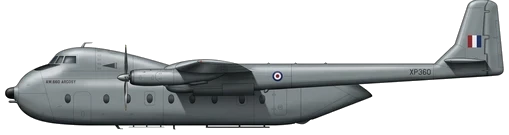
| Crew | 4 |
| Length | 26.4 m (86.7 ft) |
| Wingspan | 35.1 m (115.0 ft) |
| Height | 8.9 m (29.3 ft) |
| Wing area | 135.5 m² (1458.0 sqft) |
| Empty weight | 25,401 kg (56,000 lbs) |
| Max. takeoff weight | 47,627 kg (104,999 lbs) |
| Powerplant | 4 × turboprops Rolls-Royce Dart RDa.8 Mk 101 1,842 kW each |
| Operational range | 5,552 km (3,450 mi) |
| Service ceiling | 7,010 m (22,999 ft) |
Description
The Armstrong Whitworth AW.660 Argosy, designated Argosy C.1 in Royal Air Force service, is a British four-engined turboprop military transport derived from the AW.650 civil freighter. It was the last aircraft designed and produced by Armstrong Whitworth Aircraft. The type entered RAF service in March 1962 and was used for medium-range transport, paratroop and supply missions. It is known for its twin-boom "pod and boom" layout and the nickname "The Whistling Wheelbarrow."
Development
The Argosy originated with Operational Requirement 323. A 1955 specification based on it called for a freighter able to lift 25,000 lb (11,340 kg) and fly 2,000 mi (3,200 km) with 10,000 lb (4,500 kg). Armstrong Whitworth abandoned its twin-engined military AW.66 for lack of finance. It continued the civil AW.65 as a private venture, and after redesign with four Rolls-Royce Dart turboprops this became the AW.650, which first flew on 8 January 1959.
In 1959 the Air Ministry issued a specification for a military derivative to replace the Vickers Valetta and Handley Page Hastings. From July 1960 the second Series 100 airframe flight-tested the new clamshell rear door. The first AW.660 flew on 4 March 1961, and 56 were built for the RAF.
Design
The tailplane is carried on twin booms running aft from the inner engine nacelles, and the flight deck sits above the hold. On the AW.660 the civil nose door was sealed. An EKCO weather radar occupies the nose, with a toilet and galley in the space the door had used. A clamshell rear door with an integral loading ramp replaced the civil rear doors, and the cargo floor was strengthened. Port and starboard side doors allow paratroops to exit.
Further changes included a Rover APU in the left tailboom, additional centre-wing fuel tanks, strengthened landing gear and up to 72 rearward-facing seats. The wing was based on that of the Avro Shackleton to reduce design costs. Power comes from four Rolls-Royce Dart RDa.8 Mk 101 turboprops of 2,470 ehp each, driving four-bladed Rotol propellers.
The C.1 has a crew of four, a 115 ft (35.05 m) wingspan and a 105,000 lb (47,627 kg) maximum takeoff weight. It cruises at 253 mph (407 km/h), has a range of 3,450 mi (5,550 km), which is twice that of the civil Series 100, and has a service ceiling of 23,000 ft.
Operational History
In 1962 the Argosy equipped 105 Squadron in the Middle East and 114 and 267 Squadrons at RAF Benson. 215 Squadron at RAF Changi, Singapore, followed in 1963. It disbanded on 31 December 1967, and its aircraft passed to 70 Squadron at RAF Akrotiri, Cyprus.
The Argosy could carry 69 troops, 54 paratroops, 48 stretcher cases or 29,000 lb (13,000 kg) of freight. Loads included Ferret armoured cars, 105 mm howitzers and the Wombat. It also carried Saracen armoured cars until later changes to the Saracen and to the Argosy's mainspar, which runs across the top of the cargo bay, ruled this out. Lockheed Hercules deliveries from December 1970 progressively replaced the type. 70 Squadron retired the last transport Argosy in February 1975, a withdrawal made as an economy measure.
Other RAF users included No. 242 OCU, No. 6 FTS and the Empire Test Pilots School. Some surplus airframes went to civil operators. Ex-RAF XP447 flew as N1430Z with Duncan Aviation on Alaskan firefighting contracts until 1991.
Variants
- AW.650 Series 100: Initial civil freighter; 10 were built for Riddle Airlines and British European Airways.
- AW.650 Series 200/220: Civil version with a lighter fail-safe wing, enlarged doors and Dart 532/1 engines; seven were built.
- Argosy C.1 (AW.660): RAF tactical transport with a weather radar nose and a clamshell rear ramp; 56 were built.
- Argosy E.1: Nine C.1s converted in 1971 for flight inspection and flown by 115 Squadron until replaced by the Andover in 1978.
- Argosy T.2: Navigation trainer conversion; only XP447 and XR136 were modified before defence cuts ended the programme.
Frequently Asked Questions
What type of aircraft is the AW.660 Argosy?
What is the range of the AW.660 Argosy?
When did the AW.660 Argosy first fly?
How many AW.660 Argosy have been built?
Which countries operate the AW.660 Argosy?
What is the service ceiling of the AW.660 Argosy?
- OCT 12026 Created Page created: AW.660 Argosy