Blackburn Beverley
British four-engined heavy tactical transport that entered RAF service in 1956, designed to carry bulky loads and paratroops into rough forward airstrips and to air-drop supplies. Key figures: top speed 383 km/h, range 6,373 km, service ceiling 4,877 m, max takeoff weight 61,235 kg, built 49.
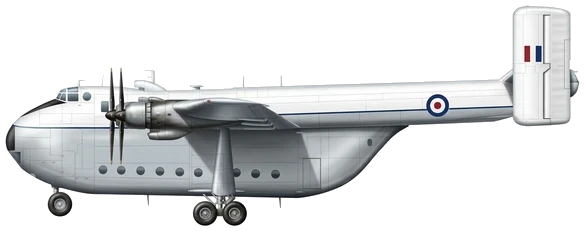
| Crew | 4 (2 pilots, radio operator, navigator) |
| Length | 30.3 m (99.4 ft) |
| Wingspan | 49.4 m (162.0 ft) |
| Height | 11.8 m (38.7 ft) |
| Wing area | 270.9 m² (2915.9 sqft) |
| Empty weight | 35,938 kg (79,230 lbs) |
| Max. takeoff weight | 61,235 kg (135,000 lbs) |
| Powerplant | 4 × piston engines Bristol Centaurus 173 2,125 kW each |
| Maximum speed | 383 km/h (238 mph) |
| Operational range | 6,373 km (3,960 mi) |
| Service ceiling | 4,877 m (16,001 ft) |
| Climb rate | 3.86 m/s (12.7 ft/s) |
Description
The Blackburn B-101 Beverley is a British heavy transport aircraft built by Blackburn Aircraft for the Royal Air Force (RAF). It was developed from the General Aircraft GAL.60 Universal Freighter and was the only land-based transport aeroplane built by Blackburn, a company that otherwise specialised in naval aircraft. The Beverley C.1 entered service with No. 47 Squadron at RAF Abingdon on 12 March 1956. Six squadrons of RAF Transport Command flew it until 1967. It was designed to carry bulky loads into rough airstrips and to drop supplies.
Development
General Aircraft's chief designer began work on the concept in 1939, drawing on the company's experience with the Hamilcar glider. A design study completed in 1945 examined layouts powered by Rolls-Royce Merlin, Bristol Hercules and Bristol Centaurus engines. The Air Ministry's Specification C.3/46 called for a medium-range tactical transport with a 25,000 lb payload, and General Aircraft received an order for one prototype. After General Aircraft merged into Blackburn, the prototype was completed at Feltham and moved by road to Brough. It first flew on 20 June 1950. At that time it was Britain's second-largest landplane, after the Bristol Brabazon.
The Ministry of Supply then raised the required all-up weight to 127,000 lb and the short-range payload to 50,000 lb. These changes led to a second prototype, the GAL.65, which first flew on 14 June 1953. The RAF ordered 20 aircraft on 1 October 1952, and follow-on orders raised the total to 47. Production reached 49 aircraft, and the last was completed in 1958. Blackburn offered the type to Silver City Airways as a cross-Channel car ferry and to Middle Eastern freight operators, but received no civil orders.
Design
The Beverley is a high-wing cantilever monoplane with fixed undercarriage. Its large low-pressure tyres gave a wheel loading similar to that of the Douglas DC-3. It is powered by four Bristol Centaurus 173 sleeve-valve radial engines rated at 2,850 hp each, mounted in interchangeable bays. The engines drive de Havilland reversible-pitch propellers, which shorten the landing run and allow the aircraft to reverse under its own power. Blackburn left out pneumatics and cabin pressurisation to simplify maintenance.
The twin-fin tail is carried on a high boom above removable clamshell doors. An "Elephant's Foot" support prevented the aircraft from tipping back during heavy loading. The crew of four comprised two pilots, a navigator and a radio operator. The flight controls were hydraulically augmented, with manual reversion. The 6,000 ft³ hold carried 94 troops, and the tailboom seated another 36. Alternative loads included up to nine Jeep-type vehicles or one bulldozer. Paratroops jumped from the boom through a floor hatch or left the hold through side doors.
Operational History
The first production aircraft flew on 29 January 1955. On entering service, the Beverley was the largest aircraft in RAF use, and No. 47 Squadron used it to run freight services to RAF Wildenrath. Nos. 53 and 30 Squadrons received the type in 1957, and it replaced the Handley Page Hastings. No. 30 Squadron flew airlifts to Iraq in 1958 and later operated from Kenya and Bahrain, where it supported Operation Vantage. No. 84 Squadron at RAF Khormaksar flew supply missions during the Aden Emergency and the 1962 Brunei revolt. By July 1963 it had carried over 20,000 tons of freight and 60,000 passengers.
In the Far East, No. 34 Squadron flew from RAF Seletar from 1960. From February 1966, Beverleys delivered aid to Da Nang, South Vietnam. Nine aircraft were lost in RAF service, and the type was withdrawn in 1967. XB259 is the only surviving complete Beverley.
Variants
- GAL.60 Universal Freighter Mk.1: First prototype, powered by Bristol Hercules engines.
- GAL.65 Universal Freighter Mk.2 (B-100): Second prototype with clamshell doors and Centaurus engines.
- Beverley C.1 (B-101): Production tactical transport for the RAF, 47 built.
- B-107: Unbuilt 1956 project with a new fuselage and four Rolls-Royce Tyne turboprops.
- B-107A: Unbuilt 1959 project with nose loading doors and a repositioned flight deck.
Frequently Asked Questions
What type of aircraft is the Blackburn Beverley?
What is the maximum speed of the Blackburn Beverley?
What is the range of the Blackburn Beverley?
When did the Blackburn Beverley first fly?
How many Blackburn Beverley have been built?
Which countries operate the Blackburn Beverley?
What is the service ceiling of the Blackburn Beverley?
- OCT 12026 Created Page created: Blackburn Beverley