ATR ATR-72
Summary
| Category | Military Transport Aircraft |
| Origin country | 🇫🇷 France • 🇮🇹 Italy |
| Manufacturer | ATR |
| First flight | 27 October 1988 |
| Year introduced | 1989 |
| Number produced | 1000 units |
| Average unit price | $26 million |
Technical specifications
| Version: 72-500 | |
|---|---|
| Operational range | 1,404 km (872 mi) |
| Maximum speed | 565 km/h (351 mph) |
| Wing area | 61 m² (656.6 sqft) |
| Wingspan | 27.1 m (88.7 ft) |
| Height | 7.7 m (25.1 ft) |
| Length | 27.2 m (89.1 ft) |
| Service ceiling | 7,620 m (25,000 ft) |
| Empty weight | 12,950 kg (28,550 lbs) |
| Max. takeoff weight | 22,500 kg (49,604 lbs) |
| Takeoff distance | 1,223 m (4,012 ft) |
| Powerplant | 2 x turboprops Pratt & Whitney Canada PW127F delivering 2051 kW each |
Current operating countries
| Country | Units | ||
|---|---|---|---|

|
Pakistan | 5 | |

|
Turkey | 5 | |

|
Italy | 4 | |

|
Philippines | 2 | |

|
Malaysia | 0 (+2) | |
Description
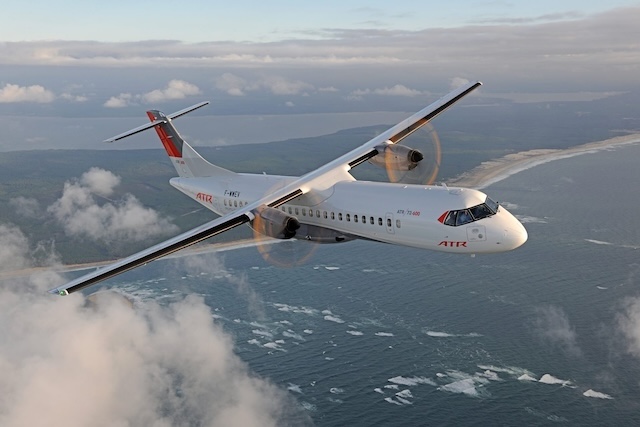
During the mid-1980s, French aerospace company Aérospatiale and Italian aviation conglomerate Aeritalia merged their work on a new generation of regional aircraft, leading to the establishment of ATR as a joint venture. ATR was created to develop, manufacture, and market their first airliner, later designated the ATR 42. Subsequently, the ATR 72 was developed as a stretched variant of the ATR 42, increasing the maximum seating capacity. The launch of the stretched ATR 72 program was announced on 15 January 1986, and the prototype performed its maiden flight on 27 October 1988. The ATR 72 received airworthiness certification from the French Directorate General for Civil Aviation on 25 September 1989, and Finnair became the first airline to introduce the aircraft into service on 27 October 1989.
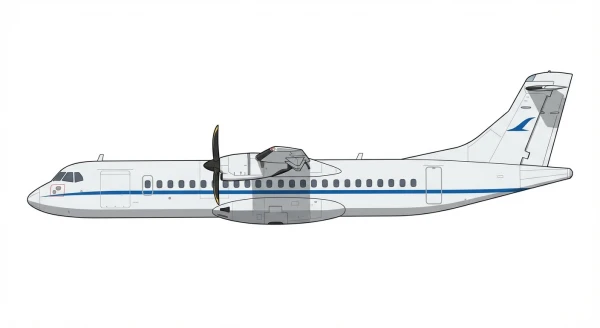
The ATR 72 is a turboprop-powered regional airliner with a maximum capacity of 78 passengers. It is powered by two Pratt & Whitney Canada PW100 turboprop engines, which drive four or six-bladed propellers supplied by Hamilton Standard. Earlier models used the PW124B engine rated at 1,800 kilowatts, while later models use the PW127 engine rated at a maximum of 2,050 kW for improved takeoff performance in high and hot conditions. Carbon fiber comprises 30% of the wing weight, achieving a 20% weight reduction. The standard configuration lacks an auxiliary power unit, though one can be installed in the C4 cargo section; to provide airflow and electrical power while on the ground, most operators equip their ATR 72s with a propeller brake that stops the propeller on the No. 2 (right) engine while the turbine continues to run, an arrangement referred to as "Hotel Mode". The majority of configurations feature a rear passenger door and a front cargo door, although some early models were intentionally configured with a front passenger door to accommodate jet bridges.
While primarily designed for civilian use, the ATR 72 has seen deployment in military roles, adapted as both utility and maritime patrol aircraft (MPA) by several nations. The ATR 72MP, a specialized variant developed by Leonardo, serves in search and rescue, maritime patrol, command and control, communication, computers, intelligence, surveillance and reconnaissance (C4ISR) roles. Leonardo Electronics designed its Airborne Tactical Observation and Surveillance (ATOS) backbone to manage sensors, combining their output in a tactical situation presented on up to four workstations. Main sensors include a multimode radar, possibly with active electronically scanned array (AESA) like the Leonardo Electronics Seaspray 7300, an electro-optical turret (EO/IR), an automatic identification system (AIS), and an airborne search and rescue direction finder (ASARS DF). A tactical display is added to the glass cockpit and can be integrated with INS/GPS positioning systems and IFF transponder. It can use three U/VHF radios, one HF radio and a wideband SATCOM for communications, and other sensors, systems and communications equipment can be integrated, like an electronic support measure (ESM) system. A defensive aids sub-system (DASS) is optionally available for operation in hostile areas. The ATR 72 ASW variant features similar onboard equipment as the MP, enhanced with anti-submarine warfare (ASW) capabilities and armed with lightweight aerial torpedoes, equipped with the Thales AMASCOS (Airborne Maritime Situation and Control System) surveillance system as well as electronic warfare and reconnaissance systems.
The Turkish Navy employs the ATR 72-600 in two configurations: the TMUA (Turkish Maritime Utility Aircraft) for transport and the TMPA (Turkish Maritime Patrol Aircraft) for maritime patrol, anti-submarine warfare (ASW), and anti-surface warfare (ASuW) duties, with the latter being developed in collaboration with Turkish Aerospace Industries (TAI) to incorporate specialized sensors and mission systems. Similarly, the Italian Air Force has adopted the ATR 72-600 MP, designated as the P-72A, as a multirole platform for maritime patrol, electronic surveillance, and C4 operations, while Italy's Guardia di Finanza operates the P-72B variant in border surveillance, maritime patrol, and search and rescue roles. Despite its operational capabilities, the ATR 72 bid to replace the German Navy's P-3 aircraft was ultimately unsuccessful.
Main Variants:
-
ATR 72-100: The initial production variant, offered in two sub-types, with the primary difference being the door configuration.
-
ATR 72-212A: Certified in January 1997, this updated version of the -210 features six-bladed propellers and either PW127F or PW127M engines.
-
ATR 72-600: Announced in October 2007, this series features improvements such as PW127M engines, a new glass cockpit, and enhanced avionics for improved performance.
-
ATR 72MP: This is an ATR 72-600 derivative developed by Leonardo for search and rescue, maritime patrol, command and control, communication, computers, intelligence, surveillance, and reconnaissance (C4ISR) missions.
-
-600F: A purpose-built freighter variant of the -600, launched in November 2017, features a large front cargo door for loading containers and a reinforced floor.