Bristol Belvedere
British twin-engine tandem rotor military transport helicopter, developed in the late 1950s and used in the 1960s, employed for troop transport, supply dropping and casualty evacuation. Key figures: top speed 222 km/h, range 740 km, service ceiling 3,658 m, max takeoff weight 8,618 kg, built 26.
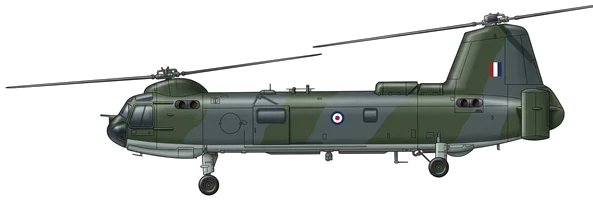
| Crew | 3 |
| Length | 16.6 m (54.3 ft) |
| Wingspan | 14.9 m (48.9 ft) |
| Height | 5.2 m (17.0 ft) |
| Wing area | 304 m² (3272.2 sqft) |
| Empty weight | 5,148 kg (11,349 lbs) |
| Max. takeoff weight | 8,618 kg (18,999 lbs) |
| Powerplant | 2 × turboshafts Napier Gazelle 1,092 kW each |
| Maximum speed | 222 km/h (138 mph) |
| Operational range | 740 km (460 mi) |
| Service ceiling | 3,658 m (12,001 ft) |
| Climb rate | 4.3 m/s (14.1 ft/s) |
Description
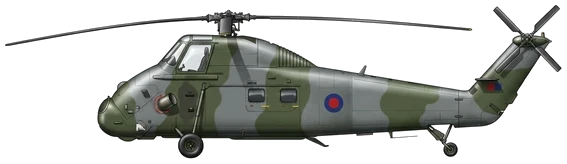
The Bristol Type 192 Belvedere is a British twin-engine, tandem-rotor military transport helicopter built by the Bristol Aeroplane Company. It entered Royal Air Force service in 1961 as the Belvedere HC Mark 1 and was used for troop transport, supply dropping and casualty evacuation. It was the only British tandem-rotor helicopter to enter production, and one of the few tandem-rotor types not built by Piasecki/Vertol or its successors. The RAF withdrew it in 1969.
Development
The Belvedere was derived from the Bristol Type 173, a 10-seat (later 16-seat) civilian helicopter that first flew on 3 January 1952. After the Type 173 was cancelled in 1956, Bristol concentrated on the Type 191 and Type 193, which were built to Royal Navy and Royal Canadian Navy specifications. Both naval projects were also cancelled, but RAF interest led to the Type 192. Three nearly complete Type 191 airframes were reused: two as ground test rigs for the Napier Gazelle turboshaft and one for fatigue testing.
The first prototype, XG447, flew on 5 July 1958. The Air Ministry supported the order as a means of sustaining domestic helicopter development, while HM Treasury pressed for production to be cut in favour of the licence-built Westland Wessex. Bristol built 26 aircraft. The type's lead designer named it after a Baroque palace in Vienna, his home city. Bristol also offered the Type 192C, a 24-seat civil variant for intercity services. To promote it, Bristol's chief test pilot set London–Paris and Paris–London speed records in a Belvedere in May 1961. No orders were placed.
Design
The Type 192 kept features of the naval designs. The tall forward undercarriage, intended to give clearance for loading torpedoes in the anti-submarine role, placed the main passenger and cargo doors 4 ft (1.2 m) above the ground. The engines sat at each end of the cabin, which ruled out a rear loading ramp. Access between the cockpit and cabin was through a narrow passage past the forward engine, producing a bulge on the left side of the fuselage.
The two Napier Gazelle turboshafts were rated at 1,465 shp each. The two rotors were synchronised by a shaft to prevent blade collision. If one engine failed, the other automatically ran up to double power so the aircraft could continue flying. The first prototype had wooden blades, fully manual controls and a castored, fixed quadricycle undercarriage. From the fifth prototype onward, all-metal four-bladed rotors were fitted. The prototypes' upward-hinged door tended to be slammed shut by rotor downwash and was replaced by a sliding door on later aircraft. Production controls and instruments were suitable for night operations.
The HC.1 carried a crew of three and could lift 18–19 equipped troops, 12 stretchers, or 6,000 lb (2,700 kg) of cargo internally or underslung. Maximum takeoff weight was 19,000 lb (8,618 kg), maximum cruise speed 138 mph (222 km/h), and range 460 mi (740 km).
Operational History
Pre-production aircraft went to the Belvedere Trials Unit at RAF Odiham, which became No. 66 Squadron in 1961. No. 72 Squadron received the type in 1961 and No. 26 Squadron in 1962. In June 1960, XG452 set a 130 mph (210 km/h) record between Gatwick and Tripoli. In 1962, a No. 72 Squadron aircraft lowered the 80 ft spire onto Coventry Cathedral.
Belvederes based at RAF Seletar, Singapore, supported Royal Marine and SAS patrols during the December 1962 Brunei revolt. They later flew reconnaissance and casualty evacuation missions in Borneo during the Indonesia–Malaysia confrontation. From 1964, aircraft at RAF Khormaksar flew supply missions, repositioned 105 mm artillery and evacuated casualties during the Aden Emergency. Fine sand there made more frequent engine changes necessary, and the starting system caused several minor fires. No. 72 Squadron converted to the Wessex in August 1964, and No. 26 Squadron disbanded in November 1965. No. 66 Squadron, the last operator, disbanded in March 1969.
Variants
- Type 173: Civil transport prototype from which the Belvedere was derived.
- Type 191: Projected Royal Navy version that never flew, with two airframes used as Gazelle ground test rigs.
- Type 192 (Belvedere HC Mk 1): Military transport version built for the RAF.
- Type 192C: Proposed 24-seat civil version, not built.
- Type 194: Proposed civil Type 192 with de Havilland Gnome engines.
Frequently Asked Questions
What type of aircraft is the Bristol Belvedere?
What is the maximum speed of the Bristol Belvedere?
What is the range of the Bristol Belvedere?
When did the Bristol Belvedere first fly?
How many Bristol Belvedere have been built?
Which countries operate the Bristol Belvedere?
What is the service ceiling of the Bristol Belvedere?
- OCT 12026 Created Page created: Bristol Belvedere