CH-46 Sea Knight
American medium-lift tandem rotor helicopter, notably deployed in Vietnam and Iraq, used for troop transportation and search and rescue operations. Key figures: top speed 266 km/h, range 1,020 km, service ceiling 4,267 m, max takeoff weight 11,000 kg, unit price $14M, built 524.
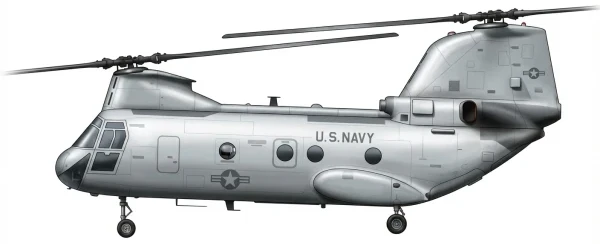
| Crew | 4 |
| Length | 13.9 m (45.7 ft) |
| Wingspan | 16 m (52.5 ft) |
| Height | 5.1 m (16.7 ft) |
| Empty weight | 7,047 kg (15,536 lbs) |
| Max. takeoff weight | 11,000 kg (24,251 lbs) |
| Powerplant | 2 × turboshafts General Electric T58-GE-16 1,400 kW each |
| Maximum speed | 266 km/h (165 mph) |
| Operational range | 1,020 km (634 mi) |
| Service ceiling | 4,267 m (13,999 ft) |
| Climb rate | 10.4 m/s (34.1 ft/s) |
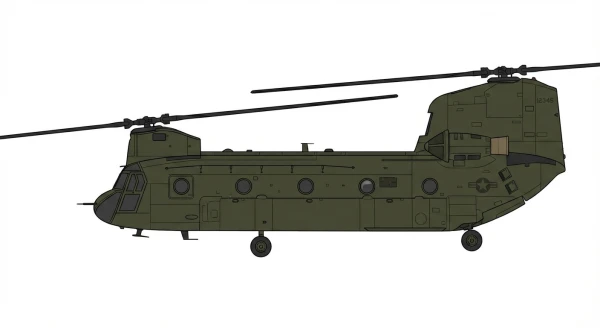
Description
The Boeing Vertol CH-46 Sea Knight is an American medium-lift tandem-rotor transport helicopter powered by twin General Electric T58 turboshaft engines. Designed by Vertol as the Model 107 and built by Boeing Vertol after Boeing's 1960 acquisition of the firm, it entered US Marine Corps and US Navy service in November 1964. Known colloquially as the "Phrog", it served in every USMC operational environment from the Vietnam War until its retirement in 2015.
Development
Work on the Model 107 began in 1956 at Vertol Corporation, the renamed Piasecki Helicopter, as a turbine-powered successor to piston types such as the H-21. The prototype, powered by two 877 shp Lycoming T53 engines, first flew on 22 April 1958. In June 1958 the US Army ordered ten YHC-1A aircraft, later cut to three to fund the larger V-114; these flew from August 1959 with GE T58 engines. In early 1961 the USMC selected the Model 107M as the HRB-1, redesignated CH-46A after its first flight in August 1962. The USAF ordered 12 UH-46B/XH-49A in 1962 but cancelled in favour of the Sikorsky S-61R. Production covered 160 CH-46A, 14 UH-46A, 266 CH-46D and 174 CH-46F, the last US-built model, delivered 1968–1971. Kawasaki Heavy Industries acquired manufacturing rights in 1965, building the KV-107 series. Columbia Helicopters bought the Model 107 type certificate on 15 December 2006.
Design
The CH-46 uses counter-rotating three-blade main rotors in tandem, with folding blades for shipboard stowage. Both T58 engines are mounted either side of the rear rotor pedestal and coupled so that either can drive both rotors. Fixed tricycle landing gear with twin wheels on each leg gives a nose-up stance for cargo loading; the main gear retracts into rear sponsons housing 350 US gal of fuel. The cargo bay has a rear ramp that can be removed or left open in flight, an internal forward winch, and an optional belly cargo hook rated at 10,000 lb. The airframe is partially amphibious and can rest on calm water for up to two hours. The CH-46E introduced fiberglass blades, airframe reinforcement and 1,870 shp T58-GE-16 engines; the mid-1990s Dynamic Component Upgrade strengthened the drive system and rotor controls.
Armament
Defensive armament consists of two door-mounted 0.50 in GAU-15/A or M2 Browning machine guns and an optional ramp-mounted 7.62 mm M240D. Vietnam-era aircraft received additional armour alongside the machine guns, and Iraq-era CH-46Es were fitted with missile warning sensors and flare dispensers.
Operational History
In Vietnam the CH-46 was a primary Marine troop transport, though engine FOD ingestion, transmission failures and rear pylon structural failures caused repeated groundings in 1966–1967; 80 CH-46As were modified at MCAS Futenma from December 1967. A CH-46 of HMM-164 flew the last helicopter from the US embassy roof during Operation Frequent Wind in April 1975, and over 100 were lost to enemy fire in the war. The type served in Operation Urgent Fury, the 2003 invasion of Iraq including the Jessica Lynch extraction on 1 April 2003, and CASEVAC during the occupation. The Navy retired it on 24 September 2004 for the MH-60S; the USMC ended flying on 5 October 2014 and held a retirement ceremony on 1 August 2015. Export operators included Canada (CH-113 Labrador/Voyageur, retired 2004), Sweden (Hkp 4, retired 2011), Japan, Saudi Arabia and Thailand. Seven State Department Air Wing CH-46s flew the 2021 Kabul airlift and were abandoned at Kabul airport.
Variants
- CH-46A: Initial USMC assault transport with 1,250 shp T58-GE-8 engines, 160 built.
- CH-46D: Improved model with revised blades and 1,400 shp T58-GE-10 engines carrying 25 troops or 7,000 lb, 266 built.
- CH-46E: Rebuild standard for roughly 275 A/D/F airframes with fiberglass blades and T58-GE-16 engines.
- CH-113 Labrador: Canadian SAR version with watertight hull, 5,000 kg hook and rescue hoist, upgraded under SAR-CUP from 1981.
- KV-107: Kawasaki-built family covering utility, minesweeping, SAR, VIP and firefighting subvariants for Japan, Sweden and Saudi Arabia.
Frequently Asked Questions
What type of aircraft is the CH-46 Sea Knight?
What is the maximum speed of the CH-46 Sea Knight?
What is the range of the CH-46 Sea Knight?
When did the CH-46 Sea Knight first fly?
How many CH-46 Sea Knight have been built?
How much does a CH-46 Sea Knight cost?
What is the service ceiling of the CH-46 Sea Knight?
- AUG 302026 Updated Description updated
- AUG 52026 Updated Powerplant updated in a site-wide editorial pass
- AUG 12026 Updated Manufacturer updated
- APR 72026 Updated Sources and cross-references refreshed
- JAN 122026 Updated Range updated in a site-wide editorial pass