H-21 Shawnee
American tandem-rotor transport helicopter, developed in the early 1950s, extensively used for troop transport, rescue and cold-weather support operations. Key figures: top speed 204 km/h, range 426 km, service ceiling 2,880 m, max takeoff weight 6,895 kg, built 707.
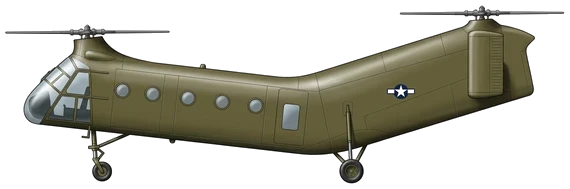
| Crew | 3–5 (pilot, co-pilot, crew chief, 1–2 door gunners) |
| Length | 16 m (52.5 ft) |
| Wingspan | 13.4 m (44.0 ft) |
| Height | 4.8 m (15.7 ft) |
| Wing area | 282.5 m² (3040.8 sqft) |
| Empty weight | 4,060 kg (8,951 lbs) |
| Max. takeoff weight | 6,895 kg (15,201 lbs) |
| Powerplant | 1 × radial piston engine Wright R-1820-103 Cyclone 1,063 kW each |
| Maximum speed | 204 km/h (127 mph) |
| Operational range | 426 km (265 mi) |
| Service ceiling | 2,880 m (9,449 ft) |
Description
The Piasecki H-21 Workhorse/Shawnee is an American tandem-rotor transport helicopter designed and built by Piasecki Helicopter, later Vertol Aircraft and Boeing Vertol. It was the fourth in Piasecki's line of tandem-rotor designs and was originally developed as an Arctic rescue helicopter. Following its first flight in 1952, it served with the United States Air Force (USAF) and the U.S. Army. It is known by the nickname "the flying banana" and for its early use in the Vietnam War. The type could be fitted with wheels, skis or floats.
Development
Piasecki supplied the United States Navy with a series of tandem-rotor helicopters beginning with the HRP-1 of 1944. In 1949, Piasecki proposed the YH-21 Workhorse to the USAF as an improved, all-metal derivative of the HRP-1. The YH-21 first flew on 11 April 1952. The USAF then ordered 32 H-21A search-and-rescue models and 163 H-21B assault transports. The U.S. Army received 334 H-21C Shawnees, and Weser Flugzeugbau built 32 under licence for the West German Army. In 1962, the H-21 was redesignated CH-21 in U.S. service. In 1959, Vertol proposed linking two to six H-21Bs with beams to lift heavy loads. The concept was judged unsafe because a mechanical failure in one helicopter could unbalance the structure.
Design
The H-21 uses two tandem, fully articulated, three-bladed counter-rotating rotors, each 44 ft (13.41 m) in diameter. The upswept aft fuselage prevents the rotors from striking the airframe in any flight attitude. The YH-21 was powered by a 1,150 hp Wright R-1820-103 Cyclone nine-cylinder radial engine. Later models used an uprated 1,425 hp version, and the H-21B also had rotor blades lengthened by 6 in (152 mm). Cold-weather features allowed operation down to −65 °F (−54 °C). The CH-21C carries 20 troops or 12 stretchers, has a gross weight of 15,200 lb (6,895 kg), and reaches a maximum speed of 127 mph (204 km/h).
Armament
French H-21Cs were tested with fixed forward-firing rockets, machine guns and bomb racks. The type proved unsuited to ground attack. Most French aircraft were instead fitted with door-mounted M2 Browning .50 cal machine guns or MG 151/20 20 mm autocannon. The U.S. Army tested nose-mounted flexible guns and a B-29 .50 cal remote turret beneath the nose. In Vietnam, CH-21Cs carried 7.62 mm M60 or 12.7 mm flexible door guns.
Operational History
The USAF and the Royal Canadian Air Force used H-21As and H-21Bs to support Distant Early Warning Line radar sites from the Aleutians to Iceland. On 24 August 1954, the H-21C Amblin' Annie became the first helicopter to cross the United States non-stop, using in-flight refuelling from a U-1A Otter. In the Algerian War, French H-21Cs operated as troop transports alongside H-34 gunships. The CH-21C deployed to South Vietnam in December 1961 with the Army's 8th and 57th Transportation Companies. In the heat, it could lift only nine passengers, and engine life fell from 600 hours to 200 or less. Its unprotected control cables and fuel lines were vulnerable to ground fire. A CH-21 shot down in July 1962 killed four aviators. The UH-1 Huey replaced it in June 1964, and most CH-21s were withdrawn in 1965. Other operators included France, Japan, Sweden, West Germany, Zaire and New York Airways.
Variants
- H-21A: USAF search-and-rescue model with a 1,250 hp R-1820-102 engine; 32 were built for the USAF and 6 for the RCAF.
- H-21B: Assault transport with the 1,425 hp engine, autopilot, limited armour and external fuel tanks; 163 were built for U.S. forces.
- H-21C Shawnee: U.S. Army version of the H-21B, of which 334 were built for U.S. forces and 98 for France.
- XH-21D: Two H-21Cs re-engined with twin General Electric T58 turboshafts; the variant was not placed into production.
- Model 44A: Commercial 19-passenger version, designated Hkp 1 by Sweden, which received 11.
Frequently Asked Questions
What type of aircraft is the H-21 Shawnee?
What is the maximum speed of the H-21 Shawnee?
What is the range of the H-21 Shawnee?
When did the H-21 Shawnee first fly?
How many H-21 Shawnee have been built?
Which countries operate the H-21 Shawnee?
What is the service ceiling of the H-21 Shawnee?
- OCT 12026 Created Page created: H-21 Shawnee