Bird-Eye
Israeli family of mini-UAVs, developed in the early 2000s and used since then for military and paramilitary intelligence, surveillance and reconnaissance missions. Key figures: range 150 km, service ceiling 4,572 m, max takeoff weight 30 kg.
| Wingspan | 4 m (13.1 ft) |
| Max. takeoff weight | 30 kg (66 lbs) |
| Powerplant | 1 × piston engine |
| Operational range | 150 km (93 mi) |
| Endurance | 15 hours |
| Service ceiling | 4,572 m (15,000 ft) |
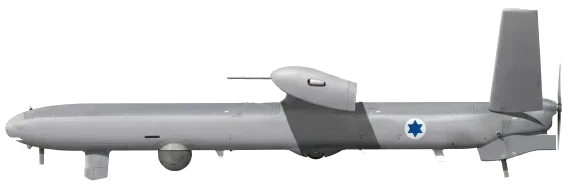
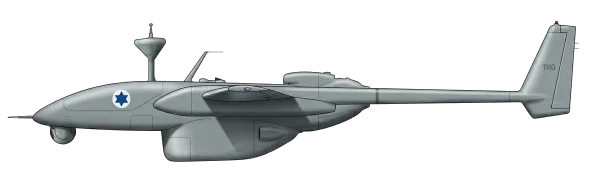
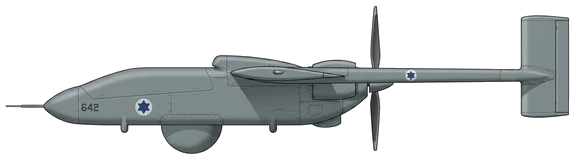

Description
The IAI Bird-Eye is a family of mini-unmanned aerial vehicles developed by the Malat division of Israel Aerospace Industries. The systems are marketed for military and paramilitary intelligence, surveillance and reconnaissance work, with later models also offered for civil tasks such as mapping, pipeline and power line monitoring, and disaster area survey. Russia became the first publicly announced foreign buyer of the type in 2009.
Development
Development began in 2003 in preparation for a tender issued by Israel's Administration for the Development of Weapons and Technological Infrastructure for mini-UAVs submitted for initial evaluation. The requirement followed the Second Intifada; in March 2002 the IDF contracted Aeronautics Defense Systems to fly drones over the Gaza Strip and the West Bank to monitor Palestinian Authority activity. A demonstration competition was held in January 2004 between systems from IAI, Elbit Systems and Rafael Advanced Defense Systems, among others. The IDF selected the Elbit Skylark, which won the formal tender several years later, and IAI redirected the Bird-Eye towards export markets. In June 2016 IAI began serial production of several hundred Bird-Eye 650D Small Tactical Unmanned Aerial Systems, credited with autonomous point takeoff and point recovery, a range of up to 150 km and endurance of up to 15 hours. In September 2020 IAI acquired 50% of BlueBird Aero Systems and merged its tactical UAV lines with those of BlueBird.
Operational History
In March 2009 Russia signed a contract for Bird-Eye 400 reconnaissance UAVs following the performance of its unmanned fleet in the Russo-Georgian War, during which Georgian forces operated the Israeli-built Elbit Hermes 450. The agreement, valued at about $50 million, was the first publicly announced Russian purchase of Israeli military equipment. Media reports in December 2009 indicated negotiations for a second purchase roughly twice the size of the first, and in October 2010 IAI announced a $400 million contract to supply UAV components to Russia's Oboronprom for an assembly line in Russia, without identifying the models involved. In February 2015 IAI and India's Alpha Design Technologies signed an agreement covering Indian production and marketing of the Bird-Eye 400 and Bird-Eye 650, with integration of additional applications and subsystems carried out by Alpha in India. In January 2019 IAI contracted with the Brazilian company Santos Lab, which was to operate BirdEye 650D aircraft for large-scale precision agriculture. In June 2021 the company announced a sale of 100 UAVs to an unnamed European customer.
Variants
- Bird-Eye 400: Mini-UAV supplied to Russia from 2009 and licensed for Indian production from 2015.
- Bird-Eye 650: Larger member of the family included in the 2015 Indian production and marketing agreement with Alpha Design Technologies.
- Bird-Eye 650D: Small Tactical Unmanned Aerial System placed in serial production in June 2016, with autonomous point takeoff and recovery, 150 km range and up to 15 hours endurance; supplied to Santos Lab of Brazil in 2019.
Frequently Asked Questions
What type of aircraft is the Bird-Eye?
What is the range of the Bird-Eye?
Which countries operate the Bird-Eye?
What is the service ceiling of the Bird-Eye?
- AUG 152026 Created Bird-Eye UAV page created (specs, description, 4 operators)