Orbiter
Israeli mini unmanned aerial vehicle, developed in the early 21st century, employed for close-range reconnaissance and, in a later variant, as a loitering munition. Key figures: top speed 130 km/h, range 100 km, service ceiling 5,486 m, max takeoff weight 28 kg, unit price $0.5M. In service with 1 air force as of 2026 — Azerbaijan (10).
| Wingspan | 4.2 m (13.8 ft) |
| Max. takeoff weight | 28 kg (62 lbs) |
| Powerplant | 1 × electric motor |
| Maximum speed | 130 km/h (81 mph) |
| Operational range | 100 km (62 mi) |
| Endurance | 7 hours |
| Service ceiling | 5,486 m (17,999 ft) |
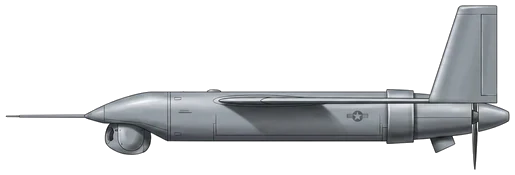
Description
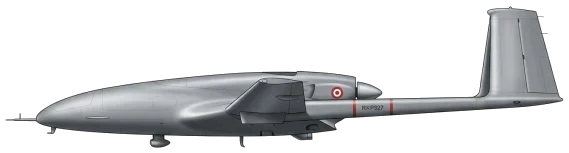
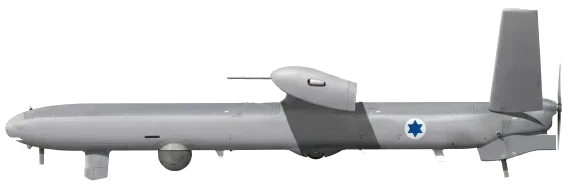
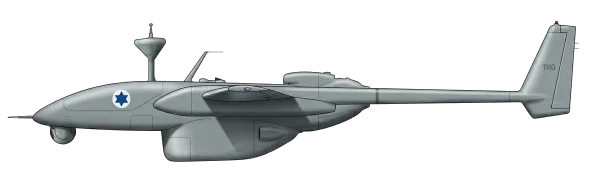
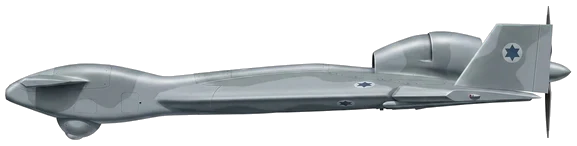
The Orbiter is an Israeli mini UAV produced by Aeronautics Defense Systems, designed for close reconnaissance missions, ISTAR intelligence, low-intensity conflicts and urban combat. Employed in the Middle East since its development, it comes in several surveillance versions as well as a loitering munition with the Orbiter 1K variant.
Development
The system was developed by Aeronautics Defense Systems as a compact, lightweight platform intended for military and security applications, in particular "over the hill" reconnaissance missions. In May 2015, Aeronautics announced the Orbiter 1K "Kingfisher", whose fuselage was adapted to carry a 2 kg explosive charge, turning it into a loitering munition. The manufacturer announced the operational capability of this armed version in August 2016. The later Orbiter 3 and Orbiter 4 versions broadened the range, with Azerbaijan having a local production plant for the Orbiter 3.
Design
The aircraft is of compact, lightweight construction, and recovery is by parachute. The Orbiter 1K carries an electro-optical/infrared sensor and has an endurance of 2 to 3 hours. It can be flown by an operator or given a waypoint, then sweep the area autonomously to detect a fixed or moving target. Its reduced acoustic signature means that, according to the manufacturer, it is detected only two seconds before the start of its terminal dive.
Armament
Only the Orbiter 1K is armed, its fuselage being adapted to carry a 2 kg explosive charge combined with a specific warhead. If no target is detected during the mission, the aircraft can return to base and land for reuse.
Operational History
The Orbiter 1K was employed by the Azerbaijani armed forces during the 2020 Nagorno-Karabakh conflict. In 2017, Aeronautics Limited was prosecuted for fraud and violation of Israeli export control legislation, employees of the company having carried out a "demonstration" of the loitering munition in the form of a live strike against Armenian positions. On 17 December 2010, an Orbiter operated by the Mexican federal government, most likely the Federal Police, suffered a failure during a surveillance mission, crossed the border and crashed in El Paso, Texas, without damage, its parachute having deployed; it was recovered by U.S. Customs and Border Protection. An Orbiter was observed in Ukrainian skies on 17 November 2022. Iranian media claimed that an Orbiter had been intercepted in Hormozgan province during the 2026 Iran-Israel war, an incident of which Israel said it had no knowledge. Users include Azerbaijan, Croatia (6 Orbiter 3Bs), Finland, Greece, Indonesia, Ireland, Israel, Mexico, Peru, Poland (11 systems), Serbia (10 systems), Singapore, South Africa, Spain, Thailand, Turkmenistan, the United States, the United Kingdom (3 ordered) and Vietnam.
Variants
- Orbiter 2 / 2B: basic reconnaissance version, the most widely exported.
- Orbiter 3 / 3B: enlarged version, produced under licence in Azerbaijan.
- Orbiter 4: heaviest variant, in service in Singapore and the United States.
- Orbiter 1K "Kingfisher": loitering munition carrying 2 kg of explosive, operational since August 2016.
Frequently Asked Questions
What type of aircraft is the Orbiter?
What is the maximum speed of the Orbiter?
What is the range of the Orbiter?
Which countries operate the Orbiter?
How much does a Orbiter cost?
What is the service ceiling of the Orbiter?
- AUG 302026 Updated Description updated
- AUG 202026 Updated Unit price filled (0.5 $M, estimate) for the UAV inventory weighting.
- AUG 152026 Created Orbiter UAV page created (specs, description, 20 operators)