BQM-74 Chukar
American remote-controlled subsonic aerial target drone, developed in the mid-1960s and utilized for gunnery and missile training exercises. Key figures: top speed 972 km/h, service ceiling 12,000 m, max takeoff weight 249 kg.
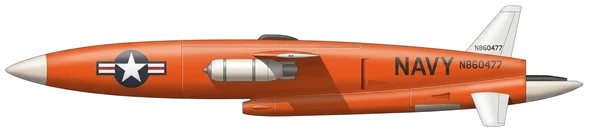
| Length | 3.9 m (12.9 ft) |
| Wingspan | 1.8 m (5.8 ft) |
| Height | 0.7 m (2.3 ft) |
| Empty weight | 123 kg (271 lbs) |
| Max. takeoff weight | 249 kg (549 lbs) |
| Powerplant | 1 × Williams J400-WR-404 1 kN each |
| Maximum speed | 972 km/h (604 mph) |
| Endurance | 1 hours |
| Service ceiling | 12,000 m (39,370 ft) |
Description
The Northrop BQM-74 Chukar target drone series began development in the early 1960s to meet a US Navy requirement. Northrop's initial delta-wing prototype, the NV-105, flew in 1964. It was replaced by the straight-wing NV-105A, which first flew in 1965 and entered production in 1968 as the MQM-74A. The US Navy purchased 1,800 MQM-74A Chukar I drones. This was followed by at least 1,400 MQM-74C Chukar IIs and more than 1,600 BQM-74C Chukar IIIs.
Design
The drone features a cigar-shaped fuselage (cylindrical on the BQM-74C), straight mid-mounted wings, and an underslung jet engine. Propulsion is provided by Williams turbojets, including the 121 lbf (540 N) WR24-6 on the MQM-74A and the 240 lbf (1.1 kN) J400-WR-404 on the BQM-74E. Launch is achieved from ground or ship launchers using dual rocket-assisted or jet-assisted takeoff (JATO) boosters, or via air-launch from aircraft including the DC-130, F-16, and TA-4J. Recovery uses a remote-controlled parachute—which also deploys if the control link is severed—and an optional flotation kit. The BQM-74C introduced a microprocessor-based autopilot for programmed flight operations.
Armament
The BQM-74 carries no offensive weapons. During target exercises, defensive missiles use telemetry warheads instead of explosives to preserve the drone for recovery, while gunnery systems utilize non-explosive dummy munitions. To simulate larger threats, the drone can be fitted with corner reflectors to enhance its radar signature. The BQM-74F variant is designed to tow targets and decoys.
Operational History
Export customers include NATO, the United Kingdom, Italy, West Germany, Greece, Iran, Japan, the Netherlands, Saudi Arabia, and Spain. During the 1991 Persian Gulf War, 37 BQM-74Cs were ground-launched as decoys on January 17 to activate Iraqi air defense radars, allowing allied aircraft to target them with AGM-88 HARM missiles. In an operational accident on November 16, 2013, a BQM-74E struck the USS Chancellorsville (CG-62) during exercises, damaging the superstructure and injuring two sailors.
Variants
- MQM-74A Chukar I: The initial production target drone powered by a Williams WR24-6 engine.
- MQM-74C Chukar II: A scaled-up version featuring an uprated WR24-7 engine and a top speed of 590 mph.
- BQM-74C Chukar III: A variant featuring a cylindrical fuselage, air-launch capability, and a microprocessor-based autopilot.
- BQM-74E Chukar III: An upgraded version incorporating the J400-WR-404 engine as standard for increased range and endurance.
- BQM-74F: A swept-wing variant featuring an uprated engine and the capability to tow targets and decoys.
Frequently Asked Questions
What type of aircraft is the BQM-74 Chukar?
What is the maximum speed of the BQM-74 Chukar?
When did the BQM-74 Chukar first fly?
Which countries operate the BQM-74 Chukar?
What is the service ceiling of the BQM-74 Chukar?
- JUL 62026 Created Page created: BQM-74 Chukar