Kawasaki C-2
Japanese mid-size, twin-turbofan military transport aircraft, developed in the early 21st century and entered service in 2016, used for long-range, high-speed tactical and strategic airlift operations. Key figures: top speed 920 km/h, range 7,600 km, service ceiling 13,100 m, max takeoff weight 141,400 kg, unit price $74M, built 14. In service with 1 air force as of 2026 — Japan (18).
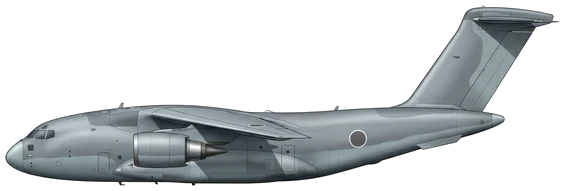
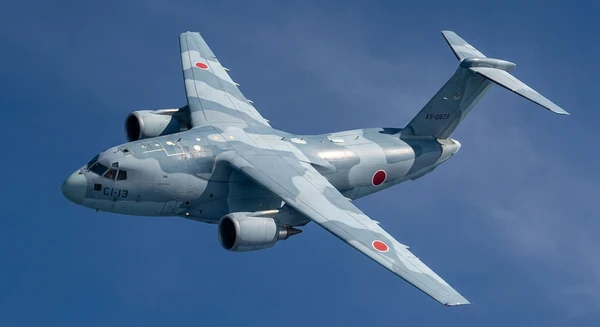
| Crew | 3 (2 pilots, loadmaster) |
| Length | 43.9 m (144.0 ft) |
| Wingspan | 44.4 m (145.7 ft) |
| Height | 14.2 m (46.6 ft) |
| Empty weight | 69,000 kg (152,119 lbs) |
| Max. takeoff weight | 141,400 kg (311,733 lbs) |
| Powerplant | 2 × General Electric CF6-80C2K1F 266 kN each |
| Maximum speed | 920 km/h (572 mph) |
| Operational range | 7,600 km (4,722 mi) |
| Service ceiling | 13,100 m (42,979 ft) |

Description
The Kawasaki C-2 is a twin-engine, long-range military transport aircraft developed and manufactured by the Kawasaki Aerospace Company to replace the Japan Air Self-Defense Force (JASDF) Kawasaki C-1. The Ministry of Defense initiated the program after concluding no foreign aircraft met its requirements. Kawasaki was selected as prime contractor in December 2001, developing the aircraft in parallel with the P-1 maritime patrol aircraft to share major structural components and systems. The first prototype flew on January 26, 2010, and development concluded in March 2017 after delays caused by component cracks, structural deformations, and a 2014 cargo door test failure. As of March 2022, the JASDF operated 14 C-2 aircraft.
Design
The C-2 is powered by two General Electric CF6-80C2K1F turbofan engines. The airframe features a composite forward fuselage and horizontal stabilizer made of KMS6115. Its cargo deck is equipped with an automated loading system and accommodates up to 37.6 tonnes of payload, including Patriot missile batteries, Type 16 maneuver combat vehicles, or H-60 helicopters. Avionics include a glass cockpit, fly-by-wire flight controls, a tactical flight management system, a head-up display, high-precision navigation, self-protection systems, in-flight aerial refueling capability, and forward-looking infrared systems.
Operational History
The JASDF formally introduced the C-2 into operational service in March 2016, assigning aircraft to the 403rd and 402nd Tactical Airlift Squadrons. Deployments include a 2017 mission to Djibouti and a 2021 deployment to assist with the Afghanistan airlift. Export campaigns targeted New Zealand, which selected the C-130J in 2019, and the United Arab Emirates. There are no recorded hull losses or fatalities, though incidents include a 2017 runway overrun at Yonago Airport and a 2024 emergency landing due to a sliding cockpit window.
Variants
- RC-2: An electronic intelligence (ELINT) platform that entered JASDF service in October 2020 to perform electronic warfare tasks.
- EC-2 Stand-Off Jammer: An electronic warfare aircraft configured with ESM, ECM, and SATCOM systems that completed its maiden flight on March 17, 2026.
- YC-X: A proposed civilian transport variant designed to carry outsize cargo payloads of up to 37 tons.
Frequently Asked Questions
What type of aircraft is the Kawasaki C-2?
What is the maximum speed of the Kawasaki C-2?
What is the range of the Kawasaki C-2?
When did the Kawasaki C-2 first fly?
How many Kawasaki C-2 have been built?
Which countries operate the Kawasaki C-2?
How much does a Kawasaki C-2 cost?
What is the service ceiling of the Kawasaki C-2?
- AUG 12026 Updated Manufacturer updated
- JUN 302026 Created Page created: Kawasaki C-2