Kawasaki P-1
Japanese maritime patrol aircraft, developed in the 21st century, solely operated by the Japan Maritime Self-Defense Force. Key figures: top speed 996 km/h, range 8,000 km, service ceiling 13,472 m, max takeoff weight 79,832 kg, unit price $142M, built 60. In service with 1 air force as of 2026 — Japan (38).
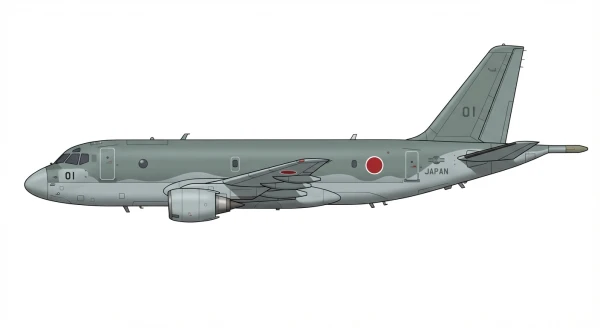
| Length | 38 m (124.7 ft) |
| Wingspan | 35.4 m (116.1 ft) |
| Height | 12.1 m (39.7 ft) |
| Max. takeoff weight | 79,832 kg (175,999 lbs) |
| Powerplant | 4 × turbojets Ishikawa-Harima XF7-10 6,123 kgf each |
| Maximum speed | 996 km/h (619 mph) |
| Operational range | 8,000 km (4,971 mi) |
| Service ceiling | 13,472 m (44,199 ft) |

Description
The Japan Maritime Self-Defense Force (JMSDF), requiring a replacement maritime patrol aircraft, determined that aircraft produced abroad did not meet their requirements, necessitating indigenous development. The domestic development of a P-X maritime patrol aircraft was included in the Japanese Defense Agency (JDA) April 2001 – March 2006 Five-Year Defense Plan. In 2001, Kawasaki Aerospace Company was designated the prime contractor for the P-X program, alongside the C-X program for a next generation cargo aircraft. The P-X shares components with the twin-engined Kawasaki C-2, which evolved from the C-X program. An indigenously produced turbofan engine, the IHI Corporation F7, was developed for the P-X. Discussions on potential cooperative efforts between Japan's P-X and the US Navy's Multi-mission Maritime Aircraft (MMA) programs occurred in April 2004. In June 2007, Kawasaki rolled out the XP-1 prototype, which conducted its maiden flight on 28 September 2007. Japan's Maritime Self-Defense Force took delivery of its first pair of P-1s on 26 March 2013. In September 2023, Kawasaki reported plans for a replacement project for the P-1.
Design
The Kawasaki P-1 is a purpose-built maritime patrol aircraft characterized by several design features. It employs a four-engine configuration utilizing podded IHI F7-10 turbofan engines mounted beneath its low-set wings. This configuration supports maneuverability, stability at low speeds and altitudes, and enhances operational survivability through single-engine capability. A fly-by-optics flight control system, utilizing optical fiber cables instead of traditional metal wiring, contributes to reduced electromagnetic interference with the aircraft's sensors. The P-1 is equipped with the Toshiba HPS-106 active electronically scanned array (AESA) radar, providing 240-degree coverage via three antennas, and Fujitsu HAQ-2 Infrared/Light detection systems for surface detection. Submarine detection capabilities include a CAE Inc.-built magnetic anomaly detector (MAD) embedded in the tail and deployable sonobuoys, supplemented by sophisticated acoustic systems.
Armament
The aircraft features a spacious internal bomb bay, comparable in size to that of the Hawker Siddeley Nimrod, capable of housing a majority of its munitions. This internal capacity is augmented by eight external hardpoints located on the wings. The P-1 is designed to deploy a wide array of ordnance, including torpedoes, mines, depth charges, air-to-surface missiles such as the US-built Harpoon, and bombs. Weapon management is facilitated by a Smith Aerospace-developed stores management system featuring a Universal Stores Control Unit (USCU) adaptable to a multitude of munitions, including future and precision-guided weapons. For self-defense, the P-1 incorporates multiple radar warning receivers providing comprehensive awareness of potential missile threats, integrated with a defensive countermeasures suite.
Operational History
The P-1 has entered operational service with the Japan Maritime Self-Defense Force (JMSDF), replacing the P-3C Orion fleet. The initial pair of operational P-1 aircraft were delivered to the JMSDF in March 2013, initiating test flights for evaluation and refinement. During efforts related to potential sales to the UK, a pair of P-1s attended the 2015 Royal International Air Tattoo, with one participating in a flying display and the other on static display. This marked the first European flight display by a Japanese military aircraft. Following the UK appearance, the P-1s proceeded to the Japan Self-Defense Force Base Djibouti at Ambouli International Airport for operational trials in tropical and desert climates. In November 2016, two P-1s deployed to New Zealand for the Royal New Zealand Navy's 75th anniversary participated in damage surveys following the 2016 Kaikōura earthquake, operating alongside P-3 Orions. Air Patrol Squadron 3 became the first operational squadron equipped solely with P-1s in August 2017. In December 2018, an incident occurred involving a P-1 belonging to Air Patrol Squadron 3 and a South Korean Navy Gwanggaeto the Great-class destroyer, which allegedly locked its target illumination radar onto the aircraft.
Variants
Main Variants:
-
XP-1: This was the prototype of the P-1 program, later reclassified as UP-1 and assigned to Air Development Squadron 51.
-
YPX: This was a proposed but cancelled twin-engine airliner variant of the P-1 maritime patrol aircraft.
-
Electronic warfare variant: This is a variant of the P-1 currently under research for electronic warfare purposes.
Frequently Asked Questions
What type of aircraft is the Kawasaki P-1?
What is the maximum speed of the Kawasaki P-1?
What is the range of the Kawasaki P-1?
When did the Kawasaki P-1 first fly?
How many Kawasaki P-1 have been built?
Which countries operate the Kawasaki P-1?
How much does a Kawasaki P-1 cost?
What is the service ceiling of the Kawasaki P-1?
- JUL 272026 Updated Name updated
- JUL 232026 Updated Sources and cross-references refreshed
- APR 72026 Updated Sources and cross-references refreshed
- FEB 72026 Updated Top speed added
- JAN 122026 Updated P-1: range added; P-1: price added