EA-18G Growler vs EA-6B Prowler
EA-18G Growler vs EA-6B Prowler at a glance — top speed 1,900 vs 1,048 km/h, range 2,346 vs 3,745 km, max takeoff weight 29,964 vs 27,896 kg, built 165 vs 170 units.
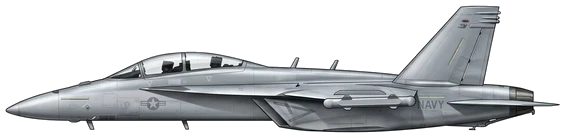
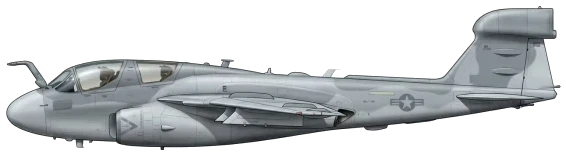
| EA-18G Growler | EA-6B Prowler | |
|---|---|---|
| Origin country | 🇺🇸 United States | 🇺🇸 United States |
| Category | Military Special Mission Aircraft | Military Special Mission Aircraft |
| Manufacturer | Boeing | Grumman |
| First flight | 15 August 2006 | 25 May 1968 |
| Year introduced | 2009 | 1971 |
| Number produced | 165 units | 170 units |
| Average unit price | $125 million | $52 million |
| Wing area | 46.5 m² | 49.2 m² |
| Wingspan | 13.6 m | 16.0 m |
| Height | 4.9 m | 5.1 m |
| Length | 18.3 m | 18.0 m |
| Maximum speed | 1900 km/h | 1048 km/h |
| Operational range | 2,346 km | 3,745 km |
| Service ceiling | 15,000 m | 11,460 m |
| Max. takeoff weight | 29,964 kg | 27,896 kg |
| Empty weight | 15,011 kg | 14,134 kg |
| Total thrust | 2 x 9,979 kgf | 2 x 4,717 kgf |
Detailed Comparison
The EA-18G Growler did not replace the EA-6B Prowler's jamming technology so much as its airframe. For most of the Growler's service life, both aircraft carried the same AN/ALQ-99 pods, a system rooted in the 1970s. The Growler's gains came from speed, self-defence and carrier-deck commonality, and it gave up crew size and range to get them.
Development and Design
The Prowler stretched the A-6 Intruder to seat a pilot and three ECMOs. This reflected a time when jamming was manual: two rear officers ran the transmitters while the right-front seat handled navigation and countermeasures. Successive upgrades (EXCAP, ICAP, ICAP II, ICAP III) kept the electronics current. The cancelled ADVCAP, cut in FY1995, left the Navy with ageing airframes and no successor until Boeing flew the ALQ-99-equipped F/A-18F demonstrator in 2001.
The Growler shares more than 90% of its parts with the Super Hornet. Northrop Grumman's ALQ-218 receivers sit on the wingtips, and automation lets two crew do what four did before. That trade drew scrutiny early on. DOT&E rated the aircraft "not operationally suitable" in February 2011 before software fixes reversed the finding in December. The ALQ-249 NGJ-Mid Band reached IOC only in December 2024. Because it covers neither the high nor the low band, mixed loads with ALQ-99 pods remain necessary.
Specifications and Performances
The defining difference is thrust. The Growler's two F414s produce 19,958 kgf combined, against the Prowler's 9,434 kgf from non-afterburning J52 turbojets. This lets the Growler fly with fighter strike packages rather than ahead of or behind them. Its nominal Mach 1.8 is not reached with pods fitted, but its 15,000 m ceiling and power margin still exceed the Prowler's 11,460 m and roughly 1,048 km/h.
The Prowler kept two advantages:
- Range: 3,745 km against 2,346 km, which allowed longer standoff stations.
- Crew: four seats spread emitter analysis across more people, which helped in dense, changing environments.
The Growler's conformal AIM-120 stations give it a self-escort capability the Prowler never had. Its ALQ-99 pods also interfere with its own APG-79 radar, a compromise the Prowler did not face.
Deployment and usage
The Prowler flew 720 sorties over Vietnam in 1972. In Desert Storm, 39 aircraft flew 1,648 sorties and fired more than 150 HARMs without loss. After the EF-111A retired in 1998, the Prowler was the only US tactical jammer. During Allied Force in 1999, that small fleet was stretched thin across every package. By the 2000s, airframe fatigue was limiting availability. Late-career work included counter-IED jamming in Afghanistan and Inherent Resolve; the Marines retired the type in 2019.
The Growler entered combat over Libya in 2011. Over the Red Sea, it used an AGM-88E to destroy a Houthi Mi-24 on the ground and shot down a drone. In 2026, it suppressed Venezuelan air defences during Absolute Resolve and Iranian ones during Epic Fury. RAAF No. 6 Squadron remains the type's only export operator.
Conclusion
The Growler is the better aircraft in contested airspace. It can keep pace with strike packages, defend itself with AMRAAM, and share Super Hornet logistics on the carrier deck. With TTNT, networked Growlers can also locate emitters passively.
The Prowler held a real advantage only in long-endurance standoff jamming in permissive airspace, where range and four-person workload sharing counted for more than speed. That mission has moved toward other platforms.
The Growler's weakness lies in its payload, not its airframe. Until NGJ covers all bands, part of its jamming capability still depends on the same ALQ-99 lineage it inherited from the Prowler.

