EA-18G Growler
American carrier-based electronic warfare aircraft, developed in the early 21st century, primarily deployed by the United States Navy and the Royal Australian Air Force. Key figures: top speed 1,900 km/h, range 2,346 km, service ceiling 15,000 m, max takeoff weight 29,964 kg, unit price $125M, built 165. In service with 2 air forces as of 2026 — United States (150), Australia (12).
| Crew | 2 |
| Length | 18.3 m (60.1 ft) |
| Wingspan | 13.6 m (44.7 ft) |
| Height | 4.9 m (16.0 ft) |
| Wing area | 46.5 m² (500.5 sqft) |
| Empty weight | 15,011 kg (33,094 lbs) |
| Max. takeoff weight | 29,964 kg (66,059 lbs) |
| Powerplant | 2 × General Electric F414-GE-400 9,979 kgf each |
| Ejection seat | Martin-Baker Mk 14 |
| Maximum speed | 1900 km/h (Mach 1.8) |
| Operational range | 2,346 km (1,458 mi) |
| Service ceiling | 15,000 m (49,213 ft) |


- Air-to-Air Short-Range AIM-9X Sidewinder
- Air-to-Air Medium-Range AIM-120 AMRAAM
- Anti-Radiation AGM-88 HARM
- Anti-Radiation AGM-88E AARGM
- Guided Bomb AGM-154 JSOW
Recent Events — EA-18G Growler
4 events →-
SEP 282026
 United States
Went over the side of USS Dwight D. Eisenhower off Virginia after an arresting wire failed on landing; both crew ejected and were rescued.
Crash
United States
Went over the side of USS Dwight D. Eisenhower off Virginia after an arresting wire failed on landing; both crew ejected and were rescued.
Crash
-
MAY 172026
United States
×2
Two EA-18G Growlers collided mid-air during Gunfighter Skies Air Show at Mountain Home AFB, Idaho; all four crew ejected safely.
Crash
Description
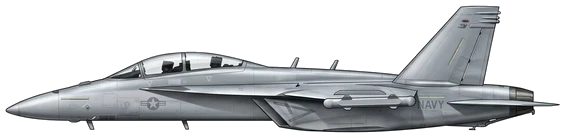
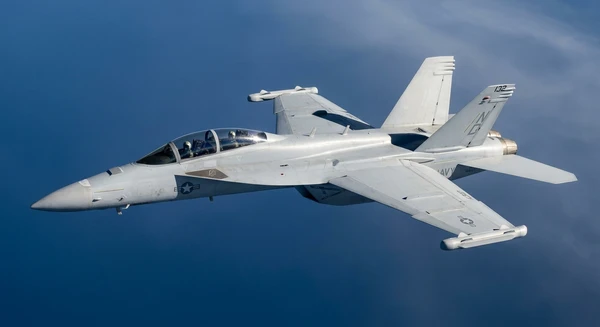
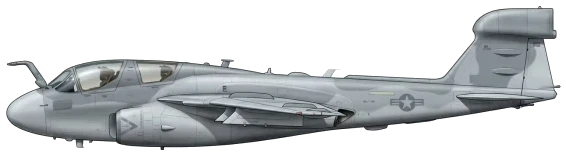
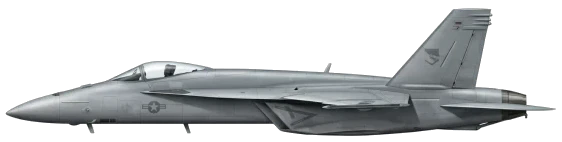
The Boeing EA-18G Growler is an American carrier-based electronic-warfare aircraft derived from the two-seat F/A-18F Super Hornet. Boeing is prime contractor, and Northrop Grumman supplies most of the electronic-warfare capability. The Growler replaced the EA-6B Prowler in US Navy service. Production began in 2007, and the type entered operational service in late 2009. After the EB-52H standoff jammer was cancelled, it became the only remaining crewed tactical jammer. The US Navy operates about 150 and the Royal Australian Air Force (RAAF) 12.
Development
On 15 November 2001, Boeing flew an F/A-18F fitted with the ALQ-99 system as an airborne electronic attack concept demonstrator. The Navy awarded the development contract in December 2003. Under it, Boeing built the forward fuselage and wings and performed final assembly, and Northrop Grumman supplied the centre and aft fuselage and the electronic combat system. The first test aircraft, EA-1, flew at St. Louis on 15 August 2006, and EA-2 followed on 10 November 2006. Both were converted F/A-18Fs designated NEA-18G. Low-rate production was approved in 2007 and full-rate production on 23 November 2009. A May 2010 multiyear contract added 58 aircraft, raising orders to 114. In February 2011 the Director of Operational Test and Evaluation judged the aircraft "still not operationally suitable", but software fixes brought a finding of "operationally effective and suitable" in December 2011. In December 2014 the Navy added 15 aircraft and cut the production rate from three to two per month.
Design
The Growler shares more than 90% of its components with the Super Hornet, including the airframe and the AN/APG-79 AESA radar. Boeing modified the leading-edge and wing-fold fairings and added wing fences and aileron tripper strips. Two General Electric F414-GE-400 turbofans each produce 22,000 lbf with afterburner, giving a maximum speed of Mach 1.8. AN/ALQ-218 receivers replace the wingtip missile rails, and electronics occupy the former cannon bay. The INCANS system allows voice communication while jamming. The ALQ-99 pods have poor reliability, interfere with the radar, and reduce top speed. The Raytheon AN/ALQ-249 Next Generation Jammer – Mid Band reached initial operational capability in December 2024. Because it does not cover the ALQ-99's high and low bands, aircraft fly mixed pod loads. Navy aircraft are being fitted with the TTNT datalink, which allows passive targeting of emitters by three networked aircraft.
Armament
The Growler has no gun and nine hardpoints with a capacity of 17,750 lb (8,050 kg). The inboard pylons carry fuel tanks, the mid-board pylons ALQ-99 high-band pods, and the outboard pylons AGM-88 HARM missiles. The two conformal fuselage stations take AIM-120 AMRAAMs, and the centreline station carries an ALQ-99 low-band pod. Published configurations also include the AGM-154 JSOW, SHARP, and AN/ASQ-228 ATFLIR.
Operational History
VAQ-129 accepted the first fleet aircraft on 3 June 2008, and VAQ-132 became operational in October 2009. The Growler's first combat use came over Libya in Operation Odyssey Dawn in 2011. During Operation Prosperity Guardian, a Growler destroyed a Houthi Mi-24 on the ground with an AGM-88E and shot down a Houthi drone. On 3 January 2026, Growlers disabled Venezuelan air defences during Operation Absolute Resolve. From February 2026, VAQ-133 and VAQ-142 flew air-defence suppression missions against Iran in Operation Epic Fury.
Australia received 12 new-build aircraft between July 2015 and July 2017 for No. 6 Squadron at RAAF Base Amberley. One was written off after an engine failure at Red Flag in January 2018, and a replacement was delivered in February 2023. US Navy losses include a fatal crash near Mount Rainier in October 2024, a mid-air collision at an Idaho air show in May 2026, and an aircraft that went over the side of USS Dwight D. Eisenhower after an arresting-gear failure in September 2026.
Variants
- EA-18G Growler: US Navy production standard carrying AN/ALQ-99 pods and, from 2024, AN/ALQ-249 pods.
- RAAF EA-18G: Australian aircraft equipped with AIM-9X missiles and the AN/ASQ-228 ATFLIR targeting pod.
- Growler Lite: Boeing export proposal without jamming pods, intended for electronic awareness rather than electronic attack.
Frequently Asked Questions
What type of aircraft is the EA-18G Growler?
What is the maximum speed of the EA-18G Growler?
What is the range of the EA-18G Growler?
When did the EA-18G Growler first fly?
How many EA-18G Growler have been built?
Which countries operate the EA-18G Growler?
How much does a EA-18G Growler cost?
What is the service ceiling of the EA-18G Growler?
- OCT 52026 Updated Ejection seat recorded
- OCT 52026 Updated Description rewritten: 2026 Venezuela and Iran operations, Next Generation Jammer, recent losses
- AUG 52026 Updated Thrust updated
- JUL 12026 Created Page created: EA-18G Growler