F-100 Super Sabre
American fighter-bomber, prominent during the Cold War, extensively deployed in Vietnam and the first supersonic in level flight. Key figures: top speed 1,390 km/h, range 3,211 km, service ceiling 15,240 m, max takeoff weight 15,800 kg, unit price $2M, built 2,294.
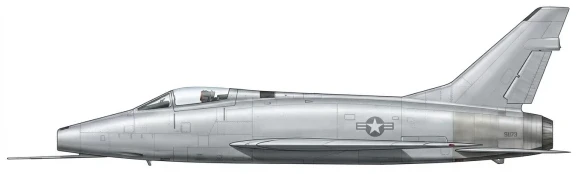
| Crew | 1 |
| Length | 15.2 m (49.9 ft) |
| Wingspan | 11.8 m (38.7 ft) |
| Height | 5.0 m (16.2 ft) |
| Wing area | 37 m² (398.3 sqft) |
| Empty weight | 9,500 kg (20,944 lbs) |
| Max. takeoff weight | 15,800 kg (34,833 lbs) |
| Powerplant | 1 × turbojet Pratt & Whitney J57-P-21 7,257 kgf each |
| Ejection seat | North American WA-1 |
| Maximum speed | 1390 km/h (Mach 1.39) |
| Operational range | 3,211 km (1,995 mi) |
| Service ceiling | 15,240 m (50,000 ft) |
| Climb rate | 114.0 m/s (374.0 ft/s) |
- Air-to-Surface AGM-12 Bullpup
- Air-to-Air Short-Range Raytheon AIM-9 Sidewinder
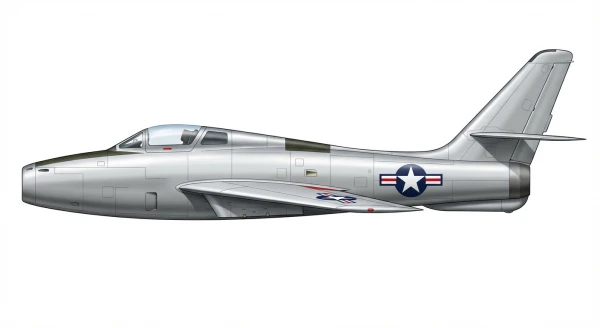
Description
The North American F-100 Super Sabre is an American supersonic jet fighter designed and produced by North American Aviation. The first of the Century Series, it was the first USAF fighter capable of supersonic speed in level flight. It entered service on 27 September 1954 with the 479th Fighter Wing at George AFB, California, and was later known as the "Hun". It served as the USAF's primary close air support aircraft over South Vietnam and was the first Wild Weasel platform.
Development
The design originated in a 1949 North American study named Sabre 45, after its 45° wing sweep, an evolution of the F-86. An unsolicited proposal was delivered to the USAF in January 1951 and accepted as the F-100 on 30 November 1951. Two prototypes were ordered on 3 January 1952, followed by 23 F-100As and a further 250 that August. Chief test pilot George Welch flew the YF-100A on 25 May 1953, seven months ahead of schedule; the first production F-100A flew on 29 October 1953. The fighter-bomber F-100C was contracted in February 1954, the F-100D followed in October 1954 and first flew on 24 January 1956, and the two-seat F-100F was contracted in December 1955, flying on 7 March 1957. Six major accidents by 10 November 1954 grounded the fleet until February 1955. Derivatives including the F-100BI interceptor and the F-107 were not produced.
Design
The F-100 was among the first aircraft with an all-moving tailplane, using gearing and a variable stiffness spring on the control stick rather than an anti-servo tab. Titanium was used throughout the airframe. Yaw instability produced inertia coupling, which killed George Welch on 12 October 1954; fixes included yaw and pitch dampers, reshaped vertical tail surfaces and increased rudder chord. Tip stall at high angles of attack caused the violent pitch-up known as the "Sabre dance". The F-100D used a Pratt & Whitney J57-P-21/21A turbojet of 16,000 lbf with afterburner; original petal-style afterburners were replaced from the 1970s with units from retired F-102s. Avionics included the MB-3 autopilot, AN/AJB-1B low-altitude bombing system, AN/APG-30 fire-control radar and AN/APG-25 tail warning radar.
Armament
The F-100D carried four 20 mm M39A1 revolver cannon with 200 rounds per gun, reduced to two on the F-100F. Six hardpoints carried 7,040 lb, with AIM-9 Sidewinder, AGM-12 Bullpup, LAU-3/A rocket dispensers, conventional bombs and Mark 7, Mk 28, Mk 38 or Mk 43 nuclear weapons. Wild Weasel F-100Fs were fitted with APR-25 receivers and later the AGM-45 Shrike.
Operational History
F-100s deployed to Thailand on 16 April 1961, the first US jets in combat in Southeast Asia. On 4 April 1965 Captain Donald W. Kilgus downed a MiG-17 with cannon fire, credited as a probable. The type flew 360,283 combat sorties, ending 31 July 1971; 242 were lost in Vietnam. Exports went to France, Denmark, Turkey and the Republic of China. Turkish F-100s flew close air support during the 1974 invasion of Cyprus. ANG service ended in 1979; Danish and Turkish aircraft served until 1982.
Variants
- F-100A: Single-seat day fighter, 203 built.
- RF-100A: Six unarmed reconnaissance conversions with five cameras, used for Soviet Bloc overflights.
- F-100C: Fighter-bomber with wing fuel tanks and probe-and-drogue refuelling, 476 built.
- F-100D: Fighter-bomber with larger wing and fin, 1,274 built.
- F-100F: Two-seat trainer and Wild Weasel conversion, 339 built.
Frequently Asked Questions
What type of aircraft is the F-100 Super Sabre?
What is the maximum speed of the F-100 Super Sabre?
What is the range of the F-100 Super Sabre?
When did the F-100 Super Sabre first fly?
How many F-100 Super Sabre have been built?
How much does a F-100 Super Sabre cost?
What is the service ceiling of the F-100 Super Sabre?
- AUG 302026 Updated Description updated
- AUG 52026 Updated Thrust updated
- JUN 262026 Updated Bombs updated
- APR 72026 Updated Sources and cross-references refreshed
- JAN 122026 Updated Range updated in a site-wide editorial pass