F-100 Super Sabre vs F-86 Sabre
F-100 Super Sabre vs F-86 Sabre at a glance — top speed 1,390 vs 1,127 km/h, range 3,211 vs 2,454 km, max takeoff weight 15,800 vs 9,621 kg, built 2,294 vs 9,860 units.
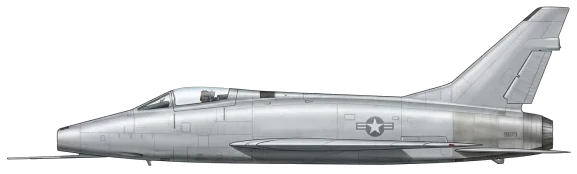
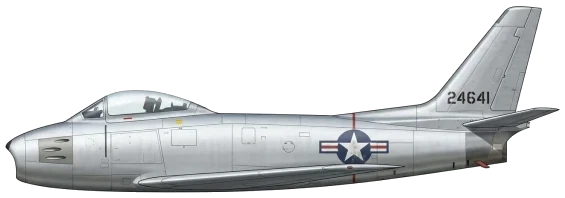
| F-100 Super Sabre | F-86 Sabre | |
|---|---|---|
| Origin country | 🇺🇸 United States | 🇺🇸 United States |
| Category | Combat Aircraft | Combat Aircraft |
| Manufacturer | North American | North American |
| First flight | 25 May 1953 | 1 October 1947 |
| Year introduced | 1954 | 1949 |
| Number produced | 2294 units | 9860 units |
| Average unit price | $2 million | $1.2 million |
| Wing area | 37.0 m² | 28.1 m² |
| Wingspan | 11.8 m | 11.3 m |
| Height | 5.0 m | 4.4 m |
| Length | 15.2 m | 11.4 m |
| Maximum speed | 1390 km/h | 1127 km/h |
| Operational range | 3,211 km | 2,454 km |
| Service ceiling | 15,240 m | 15,850 m |
| Max. takeoff weight | 15,800 kg | 9,621 kg |
| Empty weight | 9,500 kg | 5,443 kg |
| Total thrust | 1 x 7,257 kgf | 1 x 3,402 kgf |
Detailed Comparison
The North American F-86 Sabre and F-100 Super Sabre illustrate the rapid evolution of jet propulsion and aerodynamics between the post-WWII era and the supersonic age. While the F-86 defined the first generation of swept-wing subsonic combat, the F-100 was designed explicitly as its supersonic successor, transitioning the USAF from gun-based dogfighters to faster, heavier platforms capable of delivering nuclear ordnance and guided missiles.
Development and Design
The F-86 utilized captured German aerodynamic data, incorporating a 35° swept-back wing and automatic slats to delay compressibility effects, effectively bridging the gap between piston-engine fighters and jet interceptors. It prioritized maneuverability and pilot handling. In contrast, the F-100, initially dubbed "Sabre 45," pursued raw speed with a sharper sweep and extensive use of titanium to withstand aerodynamic heating. The Super Sabre introduced the all-moving stabilator to maintain control at supersonic speeds, a critical innovation over the F-86’s traditional tail. However, the F-100's aggressive aerodynamic design resulted in severe handling deficiencies, including inertia coupling and yaw instability, necessitating automated stability augmentation systems that were unnecessary on the more forgiving Sabre.
Specifications and Performances
Performance metrics highlight the shift from agility to velocity. The F-100 achieved a maximum speed of 1,390 km/h, eclipsing the F-86’s 1,127 km/h and validating its status as the first operational USAF fighter to break the sound barrier in level flight. This speed increase required a massive jump in mass; the Super Sabre’s empty weight of 9,500 kg nearly doubled the Sabre’s 5,443 kg. To compensate, the F-100’s J57 engine generated 4,587 kgf of thrust compared to the F-86’s lower output (approx. 3,402 kgf with the Avon 26). Consequently, the F-100 offered a superior climb rate of 114 m/s against the F-86’s 61 m/s, providing a distinct advantage in interception and energy retention, albeit with a higher takeoff weight.
Deployment and Usage
The F-86 cemented its legacy in the Korean War as a pure air superiority fighter, utilizing machine guns to counter the MiG-15 in high-altitude dogfights. Conversely, the F-100’s service life largely pivoted away from air-to-air combat toward the close air support role during the Vietnam War. While later F-86 variants could carry significant payloads, the F-100D was a true fighter-bomber capable of delivering 3,190 kg of ordnance on six hardpoints, including AGM-12 Bullpups and tactical nuclear weapons like the Mk 28. The F-100 replaced the multiple .50 caliber machine guns of the Sabre with four 20mm cannons and integrated the AIM-9 Sidewinder as standard, a capability only retrofitted to export Sabres like those used by Taiwan during Operation Black Magic.
Conclusion
Ultimately, the F-86 Sabre remains the apex of subsonic gun-fighting, celebrated for its balanced handling and combat record. The F-100 Super Sabre, while offering superior kinematics and payload, proved to be a transitional platform. It sacrificed the Sabre's forgiveness for speed, suffering from high accident rates while bridging the technological gap to Mach 2 multirole aircraft like the F-4 Phantom II.