F4D Skyray
American carrier-based delta-wing interceptor, developed in the early 1950s, used briefly by the US Navy and Marine Corps for high-altitude fleet air defence. Key figures: top speed 1,161 km/h, range 1,926 km, service ceiling 16,764 m, max takeoff weight 12,300 kg, built 422.
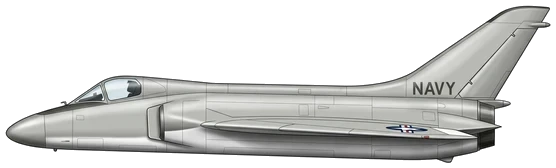
| Crew | 1 |
| Length | 13.8 m (45.2 ft) |
| Wingspan | 10.2 m (33.5 ft) |
| Height | 4.0 m (13.0 ft) |
| Wing area | 51.8 m² (557.0 sqft) |
| Empty weight | 7,268 kg (16,023 lbs) |
| Max. takeoff weight | 12,300 kg (27,117 lbs) |
| Powerplant | 1 × turbojet Pratt & Whitney J57-P-8 7,257 kgf each |
| Maximum speed | 1161 km/h (721 mph) |
| Operational range | 1,926 km (1,197 mi) |
| Service ceiling | 16,764 m (55,000 ft) |
| Climb rate | 93.0 m/s (305.1 ft/s) |
- Air-to-Air Short-Range AIM-9 Sidewinder
- Unguided Bomb 2,000 lb bomb
- Rocket Pod 7 x 2.75 in (70 mm) unguided rockets
- Rocket Pod 19 x 2.75 in (70 mm) unguided rockets
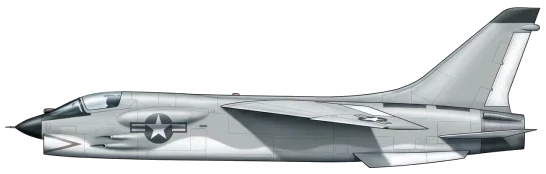
Description
The Douglas F4D Skyray (redesignated F-6A in 1962) is an American single-seat, carrier-based delta-wing interceptor designed and built by the Douglas Aircraft Company. It entered service with the US Navy and US Marine Corps in 1956 and was withdrawn from front-line units in February 1964 without seeing combat. It was the first carrier-launched aircraft to hold the absolute world speed record, at 752.943 mph (1,211.487 km/h), and it set a time-to-altitude record of 49,221 ft (15,003 m) in 2 minutes 36 seconds from a standing start. It was the last fighter Douglas produced before its merger with McDonnell Aircraft.
Development
The Skyray originated in the Navy-funded D-571-1 study, a fast-climbing delta-wing interceptor that drew on German wartime delta-wing research and initially specified twin afterburning Westinghouse J34 engines. A June 1947 contract took the concept to the mockup stage. Navy concern over high-altitude Soviet bombers shaped the 1948 requirement, which called for interception at 50,000 ft (15,240 m) within five minutes of the alarm. The design was refined around a thinner wing and a single Westinghouse J40. That engine was cancelled, so the prototype flew with an Allison J35 and production aircraft used the larger Pratt & Whitney J57. The resulting delays allowed the F-100 Super Sabre and the MiG-19 to reach service first.
The XF4D-1 prototype first flew on 23 January 1951. The first production F4D-1 flew on 5 June 1954 and was reported to have exceeded Mach 1 in level flight, a claim later disputed: the Navy's acceptance report stated that the aircraft lacked level-flight supersonic capability, and the record flight, made at an unusually high 37 °C, equated to only Mach 0.95. Testing led to revised intake geometry, intake baffle plates and a reprofiled aft fuselage. Carrier trials took place aboard USS Ticonderoga in September 1955, and the type was declared ready for fleet introduction in April 1956. Production ended in 1958 after 422 aircraft, two prototypes and 420 F4D-1s. The design earned the Collier Trophy for 1953.
Design
The Skyray has a wide delta wing with long, sharply swept, rounded tips, and was named for its resemblance to the manta ray. Air intakes sit in the thick wing roots, and fuel is carried in the wings and deep fuselage. Leading-edge slats provide additional lift at low speed. Elevons occupy most of the trailing edge, with inboard pitch trimmers that are locked up for takeoff and landing. A single hydraulic system includes manual reversion. The J57-P-8 series turbojet produces 10,200 lbf dry and 16,000 lbf with afterburner, giving 722 mph (1,161 km/h) at sea level, a 55,000 ft (16,800 m) ceiling and an 18,300 ft/min climb rate. Fire-control radars included the AN/APQ-50A (later replaced by the AN/APQ-72) and the Westinghouse Aero 13F. Crews nicknamed it the "Ford", after the "Four" and "D" of its designation.
Armament
Fixed armament consisted of four 20 mm Colt Mk 12 cannon in the wings, with 65 rounds per gun. Alternative loads included six pods of seven or four pods of nineteen 2.75 in (70 mm) unguided rockets, four AIM-9 Sidewinders, or two 2,000 lb (907 kg) bombs.
Operational History
VC-3 became the first operational F4D-1 squadron in April 1956. Redesignated VFAW-3 and based at NAS North Island, it was the only US Navy fighter squadron assigned to NORAD. Navy and Marine Corps squadrons flew the type, as did reserve units VF-881, VF-882 and VMF-215. As a dedicated high-altitude interceptor, the Skyray was unsuited to the multi-mission demands of the period, and its career was short. VMF(AW)-115 retired the last operational examples in February 1964. NACA, later NASA, flew four aircraft for research until 1969.
Variants
- XF4D-1: Prototype, two built, redesignated YF-6A in 1962.
- F4D-1: Single-seat production fighter, 420 built, redesignated F-6A in 1962.
- F4D-2: F4D-1 re-engined with the J57-F-14; the order for 100 was cancelled.
- F4D-2N: Unbuilt F4D-2 project with a lengthened nose housing twin radar scanners.
- F5D Skylancer: Mach 2 development of the F4D-2N; four prototypes flew before cancellation.
Frequently Asked Questions
What type of aircraft is the F4D Skyray?
What is the maximum speed of the F4D Skyray?
What is the range of the F4D Skyray?
When did the F4D Skyray first fly?
How many F4D Skyray have been built?
Which countries operate the F4D Skyray?
What is the service ceiling of the F4D Skyray?
- OCT 12026 Created Page created: F4D Skyray