F11F Tiger
American single-seat supersonic carrier-based fighter, developed in the early 1950s, flown by the US Navy for fleet service, pilot training and Blue Angels aerobatic demonstrations. Key figures: top speed 1,211 km/h, range 2,056 km, service ceiling 14,935 m, max takeoff weight 10,641 kg, built 199.
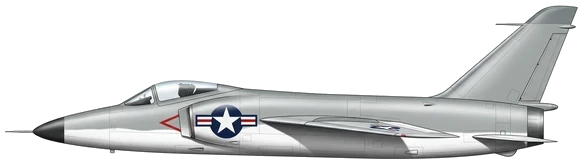
| Crew | 1 |
| Length | 14.0 m (45.9 ft) |
| Wingspan | 9.6 m (31.6 ft) |
| Height | 4.0 m (13.2 ft) |
| Wing area | 23.2 m² (250.0 sqft) |
| Empty weight | 6,264 kg (13,810 lbs) |
| Max. takeoff weight | 10,641 kg (23,459 lbs) |
| Powerplant | 1 × turbojet Wright J65-W-18 4,763 kgf each |
| Maximum speed | 1211 km/h (752 mph) |
| Operational range | 2,056 km (1,278 mi) |
| Service ceiling | 14,935 m (48,999 ft) |
| Climb rate | 82.8 m/s (271.7 ft/s) |
- Air-to-Air Short-Range AIM-9 Sidewinder
- Rocket Pod Aero 6A Rocket Package
- Rocket Pod Aero 7A Rocket Package
Description
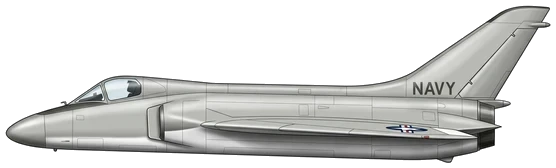
The Grumman F11F Tiger, redesignated F-11 in 1962, is an American supersonic, single-seat carrier-based fighter designed and produced by Grumman for the United States Navy. It entered service in 1956 and was Grumman's first supersonic fighter. It held the world altitude record of 76,939 ft (23,451 m) for a time, was the first jet aircraft to shoot itself down, and was flown by the Blue Angels from 1957 to 1969.
Development
The Tiger began in 1952 as G-98, a privately funded Grumman study to improve the swept-wing F9F-6/7. The design team applied the area rule and sought to minimise the aircraft's size. By the end of the design work in 1953, the aircraft bore only a vague resemblance to the F9F. In early 1953 the Bureau of Aeronautics ordered two prototypes as XF9F-8. These were later redesignated XF9F-9 when the XF9F-8 designation was reassigned to a derivative of the F9F.
The first prototype flew on 30 July 1954 with a non-afterburning J65 and nearly reached Mach 1. The second prototype had an afterburning engine and became the second supersonic Navy aircraft, after the Douglas F4D Skyray. The designation F11F-1 followed in April 1955. Carrier trials began aboard USS Forrestal on 4 April 1956.
On 21 September 1956, a test pilot fired two cannon bursts during a shallow dive. The rounds' decaying trajectory crossed the aircraft's flight path and disabled it. The pilot crash-landed and survived with a broken leg and broken vertebrae.
Grumman built 199 F11F-1s, and the last was delivered on 23 January 1959.
Design
The wing has full-span leading-edge slats and trailing-edge flaps, and spoilers replace ailerons for roll control. The wings fold downward manually for carrier stowage, reducing span to 27 ft 4 in (8.33 m). The tailplane is all-moving. Later production aircraft had a longer nose.
Power comes from a Wright J65-W-18, a licence-built Armstrong Siddeley Sapphire, rated at 7,450 lbf (33.1 kN) dry and 10,500 lbf (47 kN) with afterburner. Maximum speed is Mach 1.1 at 35,000 ft, and service ceiling is 49,000 ft. Avionics include:
- AN/APG-30A fire-control radar
- AN/APX-6B IFF transponder
- AN/ARC-27A UHF transceiver
- AN/ARN-14E VOR receiver
Armament
Fixed armament is four 20 mm Colt Mk 12 cannon with 125 rounds per gun. Four hardpoints carry AIM-9 Sidewinder missiles, Aero 6A or Aero 7A rocket packages, or 150 US gal (570 L) drop tanks.
Operational History
Seven Navy squadrons flew the Tiger:
- Atlantic Fleet: VF-21 and VF-33
- Pacific Fleet: VA-156 (later VF-111), VF-24 (later VF-211), VF-51, VF-121 and VF-191
It operated from Intrepid, Lexington, Hancock, Bon Homme Richard, Shangri-La, Forrestal, Saratoga, Ranger and Independence.
Frontline service lasted four years. The F-8 Crusader was faster, the J65 proved unreliable, and range and endurance were inadequate. The Tiger could not sustain supersonic flight in operational configuration. It left carrier service by 1961.
Naval Air Training Command used the F-11 at NAS Chase Field and NAS Kingsville until the late 1960s. Students flew it after completing TF-9J training, to gain brief supersonic experience.
The Blue Angels flew the Tiger until it was replaced by the F-4 Phantom II in 1969. In 1973 Grumman modified two ex-Blue Angels F-11As as testbeds. BuNo 141853 received a Rohr thrust reverser, and BuNo 141824 served as chase aircraft. Testing ran from March 1974 at Calverton and then at NATC Patuxent River until 1975. These were the last Tigers to fly.
Variants
- F9F-9: Original designation of the prototypes.
- F11F-1 (F-11A): Production single-seat fighter, with 199 built and 231 more cancelled.
- F11F-1P: Photo-reconnaissance version, with all 85 on order cancelled.
- F11F-1F Super Tiger (G-98J): J79-GE-3A-powered version, two built, which Switzerland evaluated.
- F11F-1T: Proposed tandem-seat trainer that was never built.
Frequently Asked Questions
What type of aircraft is the F11F Tiger?
What is the maximum speed of the F11F Tiger?
What is the range of the F11F Tiger?
When did the F11F Tiger first fly?
How many F11F Tiger have been built?
Which countries operate the F11F Tiger?
What is the service ceiling of the F11F Tiger?
- OCT 12026 Created Page created: F11F Tiger