H-37 Mojave
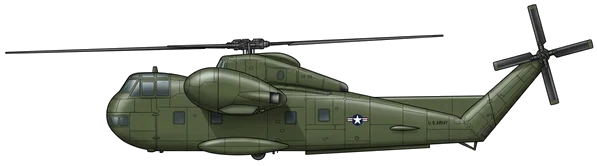
American heavy-lift military transport helicopter, developed in the early 1950s, used in the 1950s and 1960s for troop and cargo transport and recovery of downed aircraft. Key figures: top speed 209 km/h, service ceiling 2,652 m, max takeoff weight 14,061 kg, built 154.
| Crew | 3 |
| Length | 19.6 m (64.2 ft) |
| Wingspan | 22.0 m (72.0 ft) |
| Height | 6.7 m (22.0 ft) |
| Wing area | 378.3 m² (4072.0 sqft) |
| Empty weight | 9,449 kg (20,831 lbs) |
| Max. takeoff weight | 14,061 kg (30,999 lbs) |
| Powerplant | 2 × radial piston engines Pratt & Whitney R-2800-54 Double Wasp 1,566 kW each |
| Maximum speed | 209 km/h (130 mph) |
| Service ceiling | 2,652 m (8,701 ft) |
| Climb rate | 4.6 m/s (15.1 ft/s) |
Description
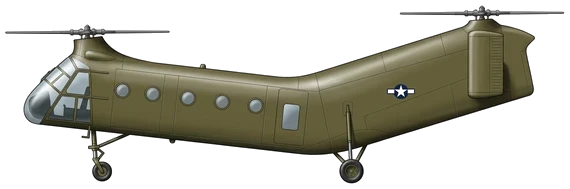
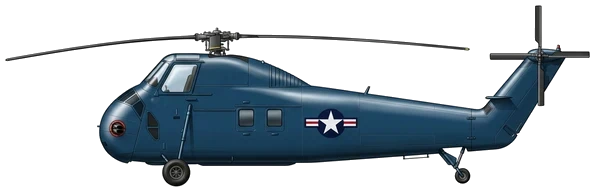
The Sikorsky H-37 Mojave (company designation S-56) is an American twin-engine heavy-lift transport helicopter of the 1950s. It entered service in 1956 with the U.S. Marine Corps as the HR2S-1 "Deuce" and with the U.S. Army as the H-37A Mojave. The Marine Corps aircraft were redesignated CH-37C in 1962. When delivered, it was the largest helicopter in the Western world and Sikorsky's first twin-engine helicopter. It remains the largest piston-powered helicopter built, and it was known for its noise and its reliability.
Development
The S-56 answered a 1950 U.S. Navy requirement for an assault helicopter able to carry up to 20 Marines and their combat equipment. An order was placed in 1951 under the designation HR2S, and the first of four XHR2S-1 prototypes flew in 1953. The Army evaluated the prototype in 1954 and ordered 94 as the H-37A. HR2S-1 deliveries to Marine Helicopter Squadron One (HMX-1) began in July 1956, and the first Army example followed that summer. All Marine Corps and Army aircraft had been delivered by mid-1960, and production totalled 154.
In 1956 the HR2S-1 set three records:
- A speed of 162.7 mph (141.4 kt) without payload.
- An altitude of 12,100 ft (3,688 m) carrying 11,023 lb (5,000 kg).
- A lift of 13,227 lb (6,000 kg) to 6,561 ft (2,000 m).
The S-56 was the basis for the Sikorsky S-60 skycrane prototype. In Britain, Westland used S-56 rotors, gearbox and control systems in the Westminster. That test rig was powered by two 2,900 hp Napier Eland turboshafts but did not enter production.
Design
Two Pratt & Whitney R-2800-54 Double Wasp 18-cylinder radial engines, each rated at 2,100 hp (1,600 kW), sit in outboard pods that also house the retractable landing gear. This leaves the fuselage clear for cargo, which is loaded through clamshell doors and a ramp in the nose. The cabin holds 26 troops, 24 stretchers or three M422 Mighty Mite light vehicles.
The helicopter has a crew of three, a 72 ft (21.95 m) main rotor and a 31,000 lb (14,061 kg) maximum takeoff weight. Maximum speed is 113 kn (209 km/h), and range with maximum payload is 126 nmi (233 km). For storage, the main rotor blades fold back along the fuselage and the tail rotor mast folds forward. The piston engines were larger, heavier and less powerful than later turboshafts, which shortened the type's service life.
Operational History
The Marine Corps operated the HR2S-1 with HMR(M)-461 (1957–1966), HMR(M)-462 (1957–1965) and HMR(M)-463 (1958–1959). In September 1965, six CH-37Cs deployed to Vietnam to recover downed U.S. aircraft, operating from Marble Mountain Air Facility until May 1967. They recovered more than US$7.5 million worth of equipment, some of it from behind enemy lines. The type also performed mid-air recovery of rocket nose cones at White Sands Missile Range.
All examples were withdrawn by the late 1960s. The CH-54 Tarhe replaced them in Army service and the CH-53 Sea Stallion in the Marine Corps. Many ex-military aircraft entered civilian service in the 1970s. Six survive in U.S. museums, including CH-37C BuNo 145864 at the National Museum of Naval Aviation in Pensacola.
Variants
- XHR2S-1: Marine Corps assault transport prototype with two 1,900 hp R-2800-54 engines, four built.
- HR2S-1 (CH-37C): Marine Corps production model with modified nacelles, twin mainwheels and a dorsal fin; 55 were built and an order for 36 more was cancelled.
- HR2S-1W: U.S. Navy airborne early warning version carrying a naval radar, two built.
- H-37A Mojave (CH-37A): Army transport with a dorsal fin and modified rotor head fairing, 94 built.
- H-37B Mojave (CH-37B): All but four H-37As were converted with automatic stabilization, crashproof fuel cells, a sliding cargo door and larger oil tanks.
Frequently Asked Questions
What type of aircraft is the H-37 Mojave?
What is the maximum speed of the H-37 Mojave?
When did the H-37 Mojave first fly?
How many H-37 Mojave have been built?
Which countries operate the H-37 Mojave?
What is the service ceiling of the H-37 Mojave?
- OCT 12026 Created Page created: H-37 Mojave