CH-54 Tarhe
American twin-engine heavy-lift helicopter, developed in the early 1960s, primarily used for logistical support and heavy transport during the Vietnam War. Key figures: top speed 240 km/h, range 370 km, service ceiling 11,000 m, max takeoff weight 21,319 kg, built 105.
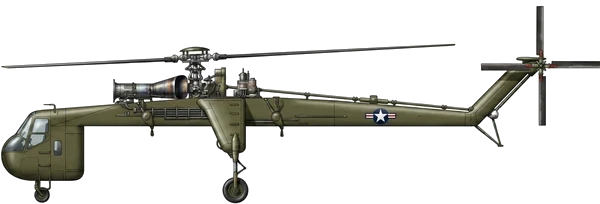
| Crew | 3 |
| Length | 27.0 m (88.5 ft) |
| Wingspan | 22.0 m (72.0 ft) |
| Height | 7.8 m (25.4 ft) |
| Wing area | 378.3 m² (4071.4 sqft) |
| Empty weight | 8,981 kg (19,800 lbs) |
| Max. takeoff weight | 21,319 kg (47,000 lbs) |
| Powerplant | 2 × Pratt & Whitney T73-P-700 turboshaft 3,600 kW each |
| Maximum speed | 240 km/h (149 mph) |
| Operational range | 370 km (230 mi) |
| Service ceiling | 11,000 m (36,089 ft) |
| Climb rate | 6.8 m/s (22.3 ft/s) |
- Unguided Bomb 10,000 lb bomb (Combat Trap program)
Description
The Sikorsky CH-54 Tarhe is a twin-engine heavy-lift helicopter developed for the United States Army as a successor to the piston-engined CH-37 Mojave. Derived from the Sikorsky S-60 and the civilian S-64 Skycrane, the design process involved modifying the Pratt & Whitney JT12 turbojet into the T73 turboshaft powerplant. The first of three prototypes conducted its maiden flight on May 9, 1962. Following evaluations at Fort Benning and in West Germany, the US Army ordered an initial six CH-54A units in June 1963, with the first delivery occurring on June 30, 1963. The Army ultimately procured 105 aircraft.
Design
The CH-54 features a specialized fuselage designed for external cargo carriage, allowing loads to be held tight against the center spine to reduce drag and the pendulum effect. The helicopter incorporates an automatic flight control system with fly-by-wire functionality, providing an aft-facing crew member 10% control authority over pitch, roll, and yaw, along with an altitude-hold function. To facilitate loading and operations on sloped surfaces, the landing gear employs a kneeling mechanism. The aircraft can be equipped with a multipurpose "people pod" for transporting up to 87 combat-equipped troops or for use as a mobile hospital or command post. Performance specifications for the CH-54B include a maximum takeoff weight of 47,000 lb and a payload capacity of 25,000 lb.
Armament
In addition to external slung loads, the CH-54 was utilized under the Combat Trap program to drop 10,000 lb bombs for clearing landing zones.
Operational History
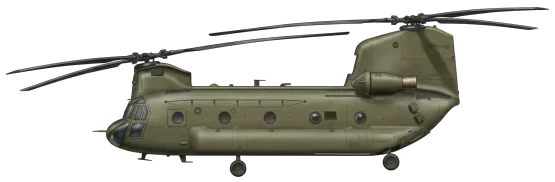
Operational service was centered on the Vietnam War, where the CH-54 provided logistical support, repositioned M101 howitzers, and transported heavy equipment such as bulldozers and patrol boats. The type recovered more than 380 downed aircraft during the conflict. Forces near the Demilitarized Zone (DMZ) relied on the CH-54 for supply due to the lack of viable ground routes. In the 1980s, the Regular Army began replacing the fleet with the tandem-rotor Boeing CH-47 Chinook due to maintenance costs and budget constraints. The Army National Guard continued operations until January 10, 1993. Following military retirement, many airframes were acquired by civilian operators for tasks such as aerial firefighting and heavy construction. Erickson Air-Crane obtained the manufacturing rights and type certificate for the aircraft in 1992.
Variants
- YCH-54A: Preproduction aircraft with six units manufactured.
- CH-54A: Initial production model powered by two 4,500 shp Pratt & Whitney T73-P-1 turboshafts.
- CH-54B: Heavy-lift variant featuring 4,800 shp T73-P-700 engines and twin-wheeled main undercarriage.
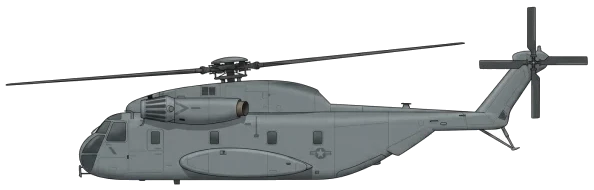
- S-64B: Proposed three-engine derivative that served as the design basis for the CH-53E Super Stallion.
Frequently Asked Questions
What type of aircraft is the CH-54 Tarhe?
What is the maximum speed of the CH-54 Tarhe?
What is the range of the CH-54 Tarhe?
When did the CH-54 Tarhe first fly?
How many CH-54 Tarhe have been built?
Which countries operate the CH-54 Tarhe?
What is the service ceiling of the CH-54 Tarhe?
- MAY 102026 Created Page created: CH-54 Tarhe